

A battery’s location and available energy determine which local constraint it can relieve. NREL distinguishes power, energy, duration and state of charge, and relates siting to the services delivered [1]. Apply those distinctions at the household AC boundary.
Write the balance at the transformer boundary
Choose import positive at the transformer: net demand plus battery charging minus discharging, including network loss at that boundary. Power in kW changes the interval balance; integrating it in hours gives kWh [2]. Available stored energy and owner reserves limit duration.
Map every battery to the current transformer and phase connection. Include household generation and demand at the same measurement boundary. Otherwise a battery’s commanded discharge may be mistaken for equal export, even though some or all of it serves load inside the dwelling.
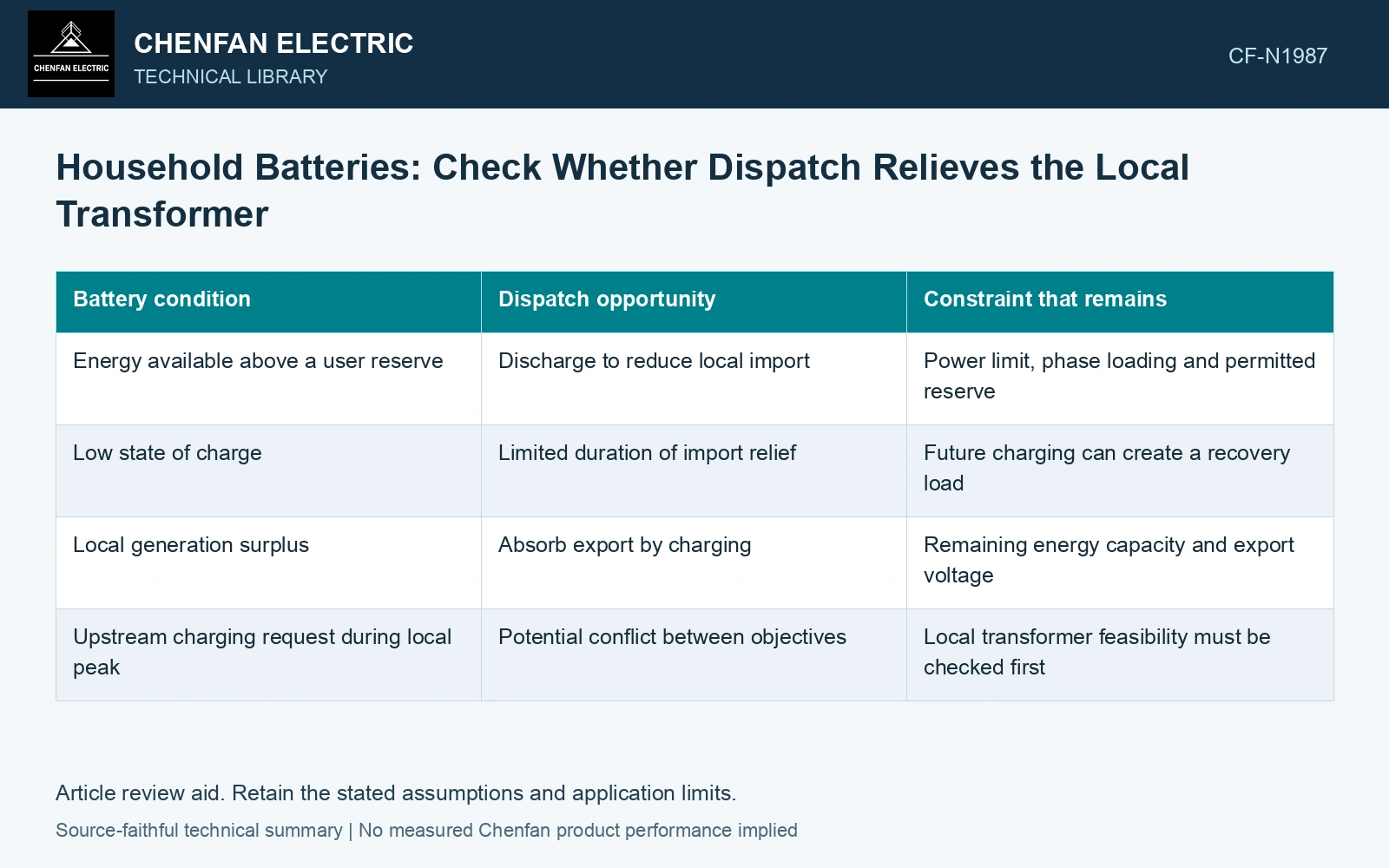
| Battery condition | Dispatch opportunity | Constraint that remains |
|---|---|---|
| Energy available above a user reserve | Discharge to reduce local import | Power limit, phase loading and permitted reserve |
| Low state of charge | Limited duration of import relief | Future charging can create a recovery load |
| Local generation surplus | Absorb export by charging | Remaining energy capacity and export voltage |
| Upstream charging request during local peak | Potential conflict between objectives | Local transformer feasibility must be checked first |
Reserve energy without counting it as controllable
Record the owner’s minimum retained energy, device availability and expected departure or service requirements. Flexibility above the reserve is different from the battery’s total stored energy. If a participation agreement changes the reserve, update the resource model before dispatch rather than treating the change as a temporary override.
For a constant-efficiency illustrative balance, the stored-energy change over Δt hours is ηc pᶜΔt − pᵈΔt/ηd, in kWh when charge and discharge powers at the battery system’s AC interface are in kW. The efficiencies ηc and ηd are dimensionless assumptions. This simple ledger does not model every battery limitation; it exposes why the same power request can consume different available energy.
Evaluate the period in which the battery must recover
Include the recovery charging duty and verified availability. NREL’s value-stacking discussion requires services to share limited battery capability [1]; do not count the same reserve simultaneously for conflicting commitments.
Assume the battery starts with 20 kWh stored energy, must retain 5 kWh, and has constant 95% discharge efficiency at the stated AC boundary. Available AC energy is (20 − 5) × 0.95 = 14.25 kWh. At an assumed 10 kW discharge request, maximum duration from this ledger is 1.425 h; a 2 h commitment would require limiting discharge to 7.125 kW before other device constraints. Bind that feasible schedule to the correct transformer and phase, then include the measured recharge profile; nominal battery energy cannot be counted twice as both customer reserve and transformer relief.
Compare commands with the achieved local response and the energy still available in each resource. Report the upstream benefit separately. A local transformer limit can prevent an aggregate request even when the wider portfolio has unused flexibility; the electrical location of that flexibility matters.
References
- T. Bowen, I. Chernyakhovskiy and P. Denholm, NREL, Grid-Scale Battery Storage: Frequently Asked Questions, NREL/TP-6A20-74426, September 2019.
- U.S. Department of Energy, DOE-HDBK-1011/4-92, Electrical Science, Volume 4, 1992.