

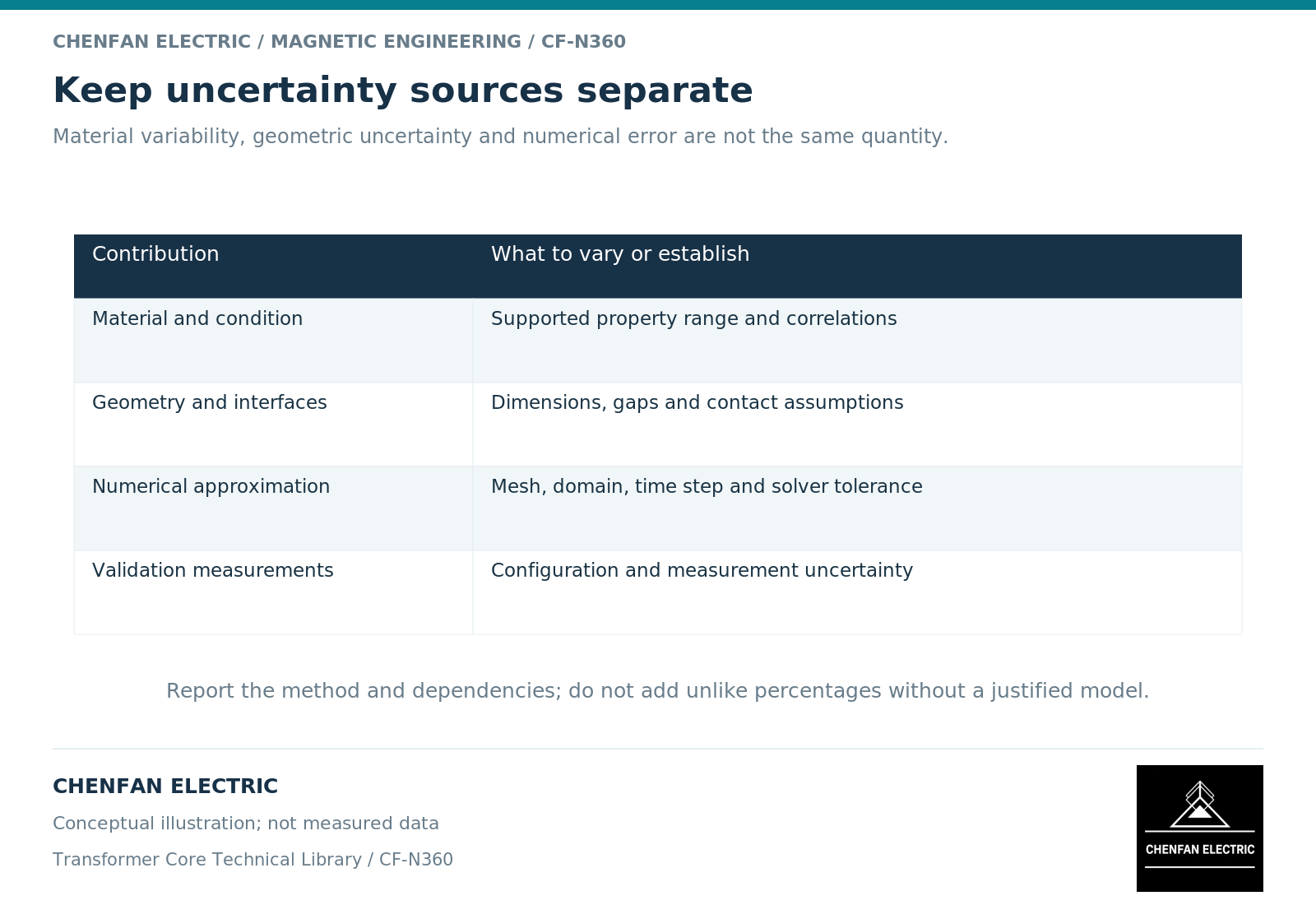
Uncertainty in a core simulation comes from more than numerical convergence. Material variability, geometry, excitation, parameter identification and the model’s own simplifications can all affect the result. Separate these contributions before presenting a precise loss, current or temperature prediction.
Distinguish uncertainty from numerical error
Mesh and time-step studies address discretization. Solver tolerances address the solution of the discretized equations. Neither establishes that the material data, boundary conditions or model form are correct.
A magnetic model can converge tightly while using an incorrect material axis or an unsupported high-field curve. Finite-element documentation describes the material and boundary choices that define the problem, not merely the solver settings. [1]
Model-form uncertainty concerns the physics or geometry omitted by the representation. A lumped return branch and a resolved tank model may agree on one terminal quantity while disagreeing on local structural loss.
Build an input uncertainty register
List the quantities that affect the target output and record their evidence. Distinguish measured uncertainty, manufacturing variation, estimated parameters and deliberately conservative assumptions.
Measurement-uncertainty guidance distinguishes statistical evaluation from evaluation using other information and provides a framework for combining and reporting components. [2] Applying that framework to model inputs still requires a valid mathematical relationship and attention to correlations.
Do not assign probability distributions simply because software requires them. A bounded engineering assumption is not automatically a normally distributed random variable. When evidence supports only a range, state the range and its origin.
Propagate only what the assumptions support
For a simple illustrative product or ratio with small independent input uncertainties, a first-order propagation can be useful. For strongly nonlinear saturation behavior, a local linear approximation may be inadequate; evaluate the response over the relevant input range.
Correlated inputs deserve particular attention. Net area and core mass derived from the same packet schedule are not necessarily independent. Treating them as independent can create combinations that no manufactured core could have.
Separate a sensitivity range from a confidence interval. A set of extreme deterministic cases does not establish the probability that the actual result lies between them. Likewise, a numerical sampling distribution reflects the assumed input distributions, not evidence that those assumptions are true.
Report the result at a justified precision
| Contribution | Typical evidence |
|---|---|
| Material input | Test uncertainty, batch data and model-fit range |
| Geometry | Controlled dimensions and relevant tolerances |
| Excitation | Waveform scaling, timing and operating envelope |
| Numerical solution | Mesh, domain, time-step and tolerance studies |
| Model form | Comparison with more detailed models or independent tests |
The final statement should identify the dominant contributions and the intended interpretation of the reported interval. Avoid displaying several decimal places when the input evidence supports only a broad range.
Where uncertainty changes the design decision, prioritize better evidence for the dominant input rather than refining every part of the model equally. Where the conclusion remains unchanged across defensible cases, state that robustness with its scope.
For procurement and manufacturing, the useful outcome is a clear separation between controlled requirements and uncertain predictions. A simulation estimate should not become an unqualified acceptance limit unless the responsible parties have agreed the method, uncertainty treatment and decision rule.
References
[1] David Meeker. Finite Element Method Magnetics User Manual.
[2] Barry N. Taylor and Chris E. Kuyatt / NIST. NIST Technical Note 1297: Guidelines for Evaluating and Expressing the Uncertainty of NIST Measurement Results (1994).