

A sensitivity study should identify which uncertain or adjustable core inputs change the engineering result most. It is a screening step before optimization, not a contest to find the largest percentage change in any output. Define the decision variable, realistic input ranges and physical constraints first.
Choose one decision-driving output at a time
Possible outputs include peak branch density, excitation current, total loss, local temperature or material quantity. An input can be important for one output and nearly irrelevant for another.
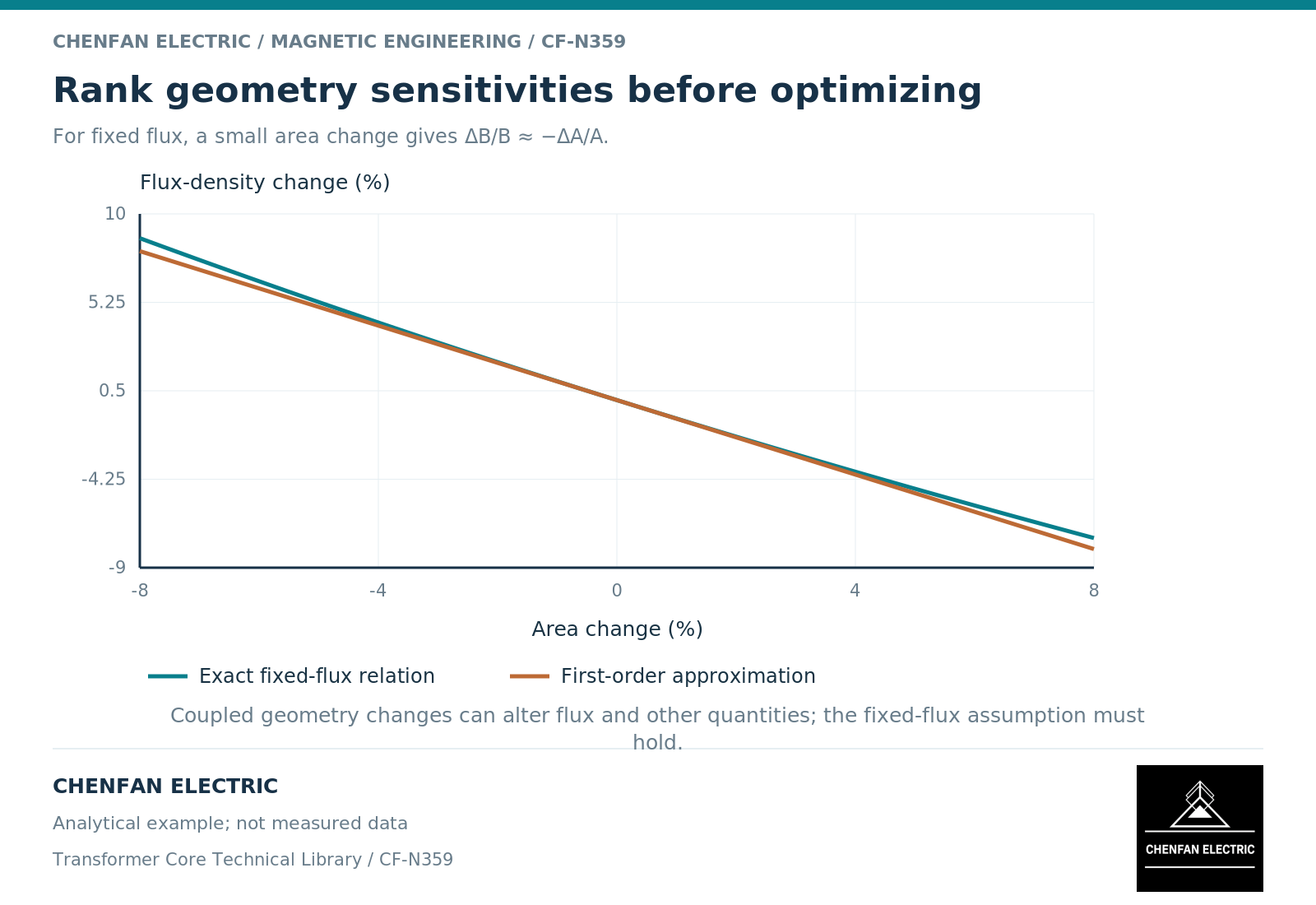
For an illustrative fixed-flux section, B = Phi/A. A one-percent reduction in area produces a density increase of approximately one percent for a small change, but the resulting excitation-current change can be much larger near a nonlinear region. This follows from separating geometry from the constitutive response. [1]
Do not rank inputs using mixed output definitions. A study that compares a percentage temperature change for one parameter with an absolute watt change for another has no consistent basis.
Use physically admissible variations
A packet width, window dimension and core envelope may be linked by the design. Varying them independently can create impossible geometries. Similarly, changing net area while holding an inconsistent mass or stacking definition can distort the comparison.
Define allowable ranges from drawings, manufacturing capability or documented uncertainty. Keep design choices separate from random variation. An intentional increase in limb area is not the same kind of input as measurement uncertainty in the existing area.
A field or magnetic-network model must preserve topology and source conditions across cases. [2] Otherwise a supposed geometry sensitivity may partly reflect a changed excitation boundary.
Distinguish local sensitivity from wide-range behavior
A local derivative describes behavior near one point. It may not represent a wider range containing saturation, a topology change or a geometric constraint. Use finite changes or a structured sampling plan when the response is nonlinear.
An illustrative normalized sensitivity can be written S = (Delta y/y)/(Delta x/x) for a defined finite perturbation, with nonzero baseline x and y. Near a zero baseline, report a dimensional sensitivity or use an explicitly chosen reference scale instead of dividing by zero. State the perturbation size and direction. A plus-five-percent change and a minus-five-percent change may produce different sensitivities near a nonlinear boundary.
After screening individual inputs, examine interactions among the most influential ones. A change in area and a change in volts per turn can reinforce or offset each other, so a one-at-a-time ranking may not identify the controlling combination.
Turn the ranking into an evidence priority
| Sensitivity outcome | Practical next action |
|---|---|
| High influence, well-known input | Preserve the controlled design value |
| High influence, uncertain input | Improve measurement or obtain better data |
| Low influence, expensive detail | Consider retaining a simpler representation |
| Strong interaction | Evaluate combined cases within physical constraints |
| Unstable numerical response | Resolve convergence before ranking the physics |
Record the baseline model revision, input ranges and output definition with the ranking. A sensitivity chart without those details cannot be reused reliably by the manufacturing or procurement team.
Optimization should follow only after the model’s important assumptions are understood. Otherwise an optimizer can exploit an unsupported material extrapolation or unrealistic geometric freedom.
The useful handover identifies which dimensions and data deserve the tightest control for the chosen performance objective. It does not justify tightening every tolerance indiscriminately, and it does not convert a numerical sensitivity into a guaranteed production variation without a separate uncertainty and manufacturing assessment.
References
[1] Lloyd Dixon / Texas Instruments. Magnetics Design 1 – Introduction and Basic Magnetics.
[2] David Meeker. Finite Element Method Magnetics User Manual.