

Differential heating of core packets, spacers and restraints changes the usable oil channel. Carry thermal expansion through the contact and structural response to assess the limiting hot-state passage. [1] [2]
Define the reference temperature, material directions and locating restraints before predicting a channel dimension.
Compare free expansions without calling them gap changes
For a uniform unconstrained span, the small thermal extension is ΔL≈αLΔT. Consider fictional equal reference spans of 100 mm, an 80 K increase and assumed expansion coefficients of 12×10−6 K−1 and 30×10−6 K−1. Their extensions are 0.096 mm and 0.240 mm, a mismatch of 0.144 mm.
That mismatch is not automatically the change in duct width. The spans may act along a different axis, share restraints or develop contact pressure instead. Use coefficients for the actual material direction; an anisotropic spacer should not receive a single convenient scalar without justification.
Draw the restrained dimensional chain
Identify which member sets the spacing, which packet surfaces can move and where contact exists. Include the frame or clamp whose expansion can control their relative position. Use the individual temperature fields when the spacer and steel do not warm equally.
Separate purely thermal strain from compression, moisture-related dimensional change and time-dependent deformation where those are relevant. Combining them into one apparent expansion coefficient can make the model depend on the test history.
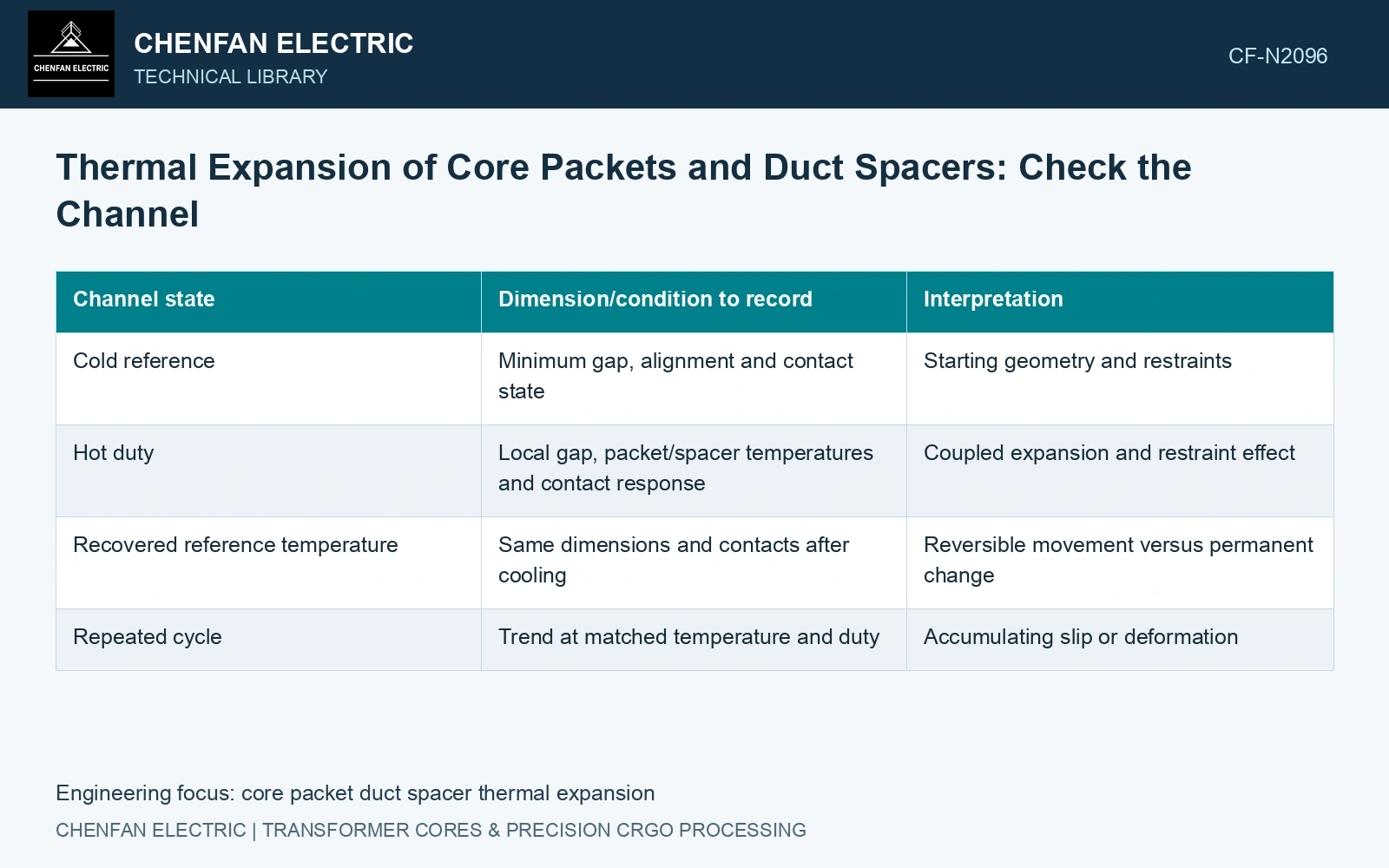
| Channel state | Dimension/condition to record | Interpretation |
|---|---|---|
| Cold reference | Minimum gap, alignment and contact state | Starting geometry and restraints |
| Hot duty | Local gap, packet/spacer temperatures and contact response | Coupled expansion and restraint effect |
| Recovered reference temperature | Same dimensions and contacts after cooling | Reversible movement versus permanent change |
| Repeated cycle | Trend at matched temperature and duty | Accumulating slip or deformation |
Check the cooling consequence
A small minimum-gap change can matter at a throat even when the mean duct width changes little. Update the local flow geometry and heat transfer if the mechanical prediction indicates a meaningful restriction.
Contact opening can also change conduction through the spacer; increased pressure may change it in another direction. Neither response should be assigned a thermal benefit without checking the relevant path and mechanical limits.
Use approved dimensional or instrumented validation on a representative restrained assembly. Verify recovered geometry as well as the hot condition. If the model assumes reversible elastic movement but the channel fails to return, revisit that assumption before extending the result to repeated service cycles.
The steel catalogue gives 0.23 mm nominal gauge [3]. Assume 400 laminations: 92 mm steel before coating and compression. With the assumed 12 × 10⁻⁶ K⁻¹ stack-direction coefficient and 80 K rise, free packet growth is 0.08832 mm. An assumed spacer defining a 5.00 mm gap grows 0.012 mm using 30 × 10⁻⁶ K⁻¹. In the stated assumed restraint arrangement, packet growth consumes the gap: 5.00 + 0.012 − 0.08832 = 4.92368 mm. This is 0.02632 mm below an assumed 4.95 mm minimum hot-passage criterion. Revise the locating chain before hydraulic qualification; these coefficients and the passage gate are assumptions, not catalogue limits.
Sheet count, coating build, packet compression and spacer location determine the cold chain; differential temperatures and restraints determine how that chain moves. Neither nominal gauge nor free expansion alone defines an oil channel.
Identify the limiting hot channel with its thermal and mechanical evidence. Compare the oil path after differential heating and restraint response with the measured room-temperature geometry.
References
- Z. Chen, Z. He and S. Wang, Transformer Iron Core Temperature Field Calculation Based on Finite Element Analysis, Energies 18, 6537, 2025. DOI: 10.3390/en18246537.
- U.S. Department of Energy, DOE-HDBK-1012/2-92, Thermodynamics, Heat Transfer, and Fluid Flow, Volume 2, 1992.
- Nippon Steel Corporation, Grain-Oriented Electrical Steel Sheets, catalogue D004je, April 2020, specification and typical-property tables.