

Reduced-size core models can identify flow mechanisms and compare layouts when the relevant similarity is preserved. Check natural-convection scaling and internal heat paths before translating those results to full-unit temperatures. [1]
Start with the similarity groups controlling the intended mechanism, then state which the test preserves and which it does not.
Check the buoyancy scale
For an appropriate natural-convection model, the Rayleigh number is Ra=gβΔTL³/(ναfluid), where β is volumetric thermal expansion, ν kinematic viscosity, αfluid thermal diffusivity and L the defined characteristic length.
In an illustrative half-size model, the same fluid properties and temperature difference give one eighth of the full-size Rayleigh number. Keeping Ra unchanged would mathematically require eight times the temperature difference under those assumptions. That is not a recommendation to heat a mock-up to such a temperature; material limits and property changes can make the proposed similarity impossible.
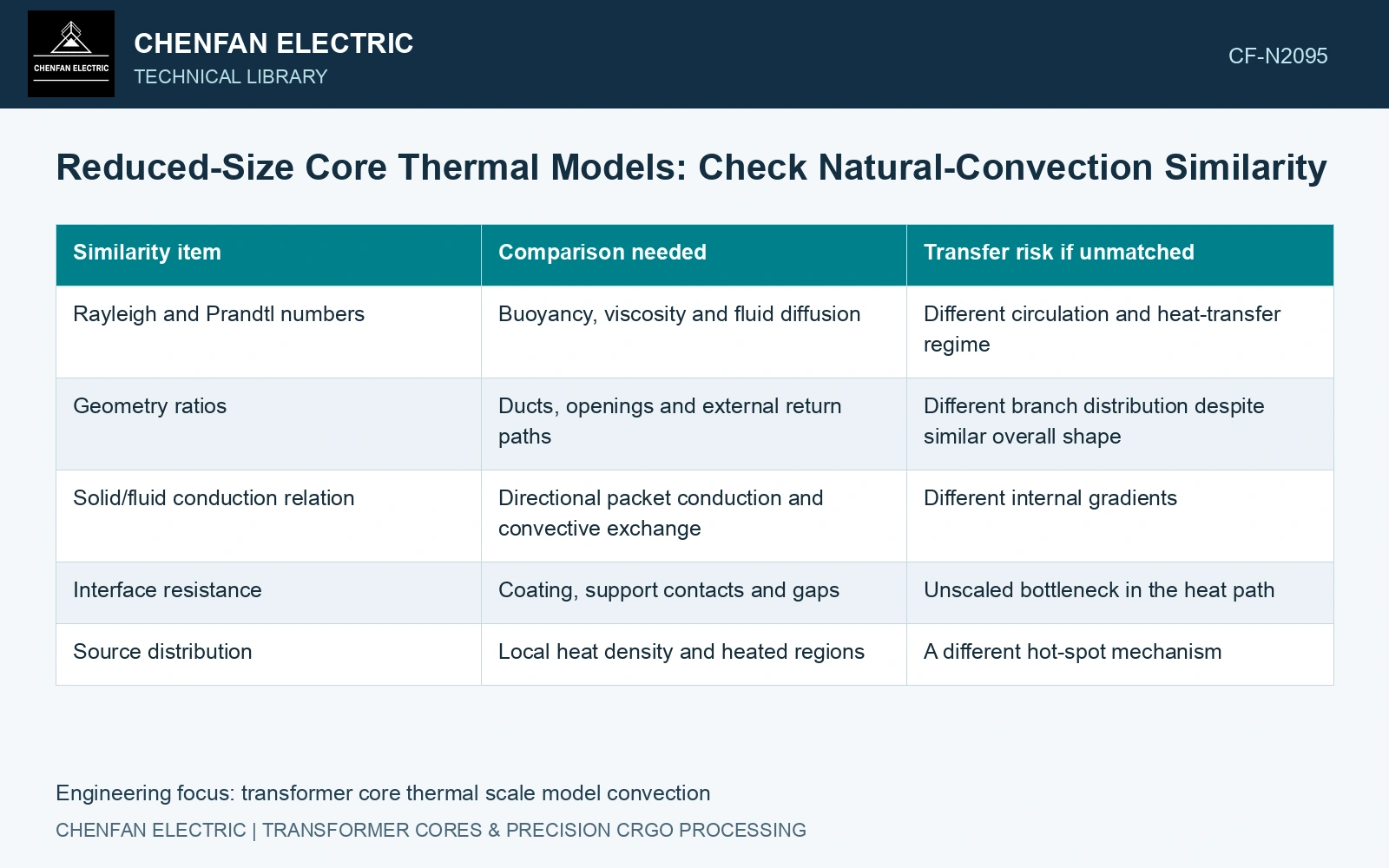
| Similarity item | Comparison needed | Transfer risk if unmatched |
|---|---|---|
| Rayleigh and Prandtl numbers | Buoyancy, viscosity and fluid diffusion | Different circulation and heat-transfer regime |
| Geometry ratios | Ducts, openings and external return paths | Different branch distribution despite similar overall shape |
| Solid/fluid conduction relation | Directional packet conduction and convective exchange | Different internal gradients |
| Interface resistance | Coating, support contacts and gaps | Unscaled bottleneck in the heat path |
| Source distribution | Local heat density and heated regions | A different hot-spot mechanism |
Scale the source deliberately
If every length is halved while volumetric heat generation stays fixed, total heat falls to one eighth and surface area to one quarter. The average source per external area is therefore halved. That scaling does not preserve temperature because the convection and internal conduction responses also change.
Using heaters to reproduce a magnetic source requires matching its spatial distribution sufficiently for the question. A surface heater cannot automatically represent volumetric packet heating. Likewise, coating thickness and contact roughness usually do not shrink in proportion to the mock-up.
Use the model within its demonstrated scope
A core-temperature model can represent the source distribution, directional heat paths and local boundaries of a specified construction. Those inputs must be checked afresh when scale changes; a model-to-test match on one geometry does not establish natural-convection similarity for another assembly. [2]
Document unavoidable mismatches and compare them with a full-size calculation or suitable larger test. An unmatched mock-up may still reveal a blocked exit or compare two spacer arrangements, but its absolute rise needs a separate transfer model.
For a source-scaling check, take the 23ZH90 catalogue limit of 0.90 W/kg at 1.7 T and 50 Hz. [3] Assume a 1,000 kg full-size represented steel inventory and a geometrically half-size model of identical density. Steel mass scales to 125 kg and the strip-input budgets become 900 W and 112.5 W. If exposed area is assumed to fall from 10 m² to 2.5 m², their source-to-area ratios are 90 W/m² and 45 W/m². The model therefore reproduces neither heat flux nor Rayleigh number by retaining the same specific loss. Use it for a stated flow-mechanism comparison until the source and buoyancy mismatches are explicitly corrected.
Retain actual lamination gauge, coating and contact construction in the reduced model. These manufacturing lengths do not automatically scale with the external core dimensions, so packet conduction may remain dissimilar even when the outer shape matches.
State whether the model supports a flow mechanism, layout comparison or bounded full-size prediction. Document the preserved convection, conduction and oil-loop conditions behind that result.
References
- U.S. Department of Energy, DOE-HDBK-1012/2-92, Thermodynamics, Heat Transfer, and Fluid Flow, Volume 2, 1992.
- Z. Chen, Z. He and S. Wang, Transformer Iron Core Temperature Field Calculation Based on Finite Element Analysis, Energies 18, 6537, 2025. DOI: 10.3390/en18246537.
- Nippon Steel Corporation, Grain-Oriented Electrical Steel Sheets, catalogue D004je, April 2020, specification and typical-property tables.