

Before comparing scrap percentages, ask what went into the denominator and what was counted as good output.
Without those definitions, the comparison may reward a different product mix rather than better manufacturing.
Separate geometric offcuts from preventable rejection
A core family with many widths and complex cut patterns can have a different material-utilization opportunity from a family of repetitive parts. Parent-coil width, order grouping and the approved joint geometry all influence the amount of unavoidable offcut.
That is not the same as scrap caused by damaged material, incorrect programs, tool problems or lost packet identity. Combining unavoidable geometric loss with preventable rejection makes it harder to see where improvement is possible.
The output boundary matters too. Does “good” mean a cut lamination, a completed packet or a core released after its required checks? Counting a lamination as good before later rejection can produce a flattering cutting yield and a disappointing finished-core yield.
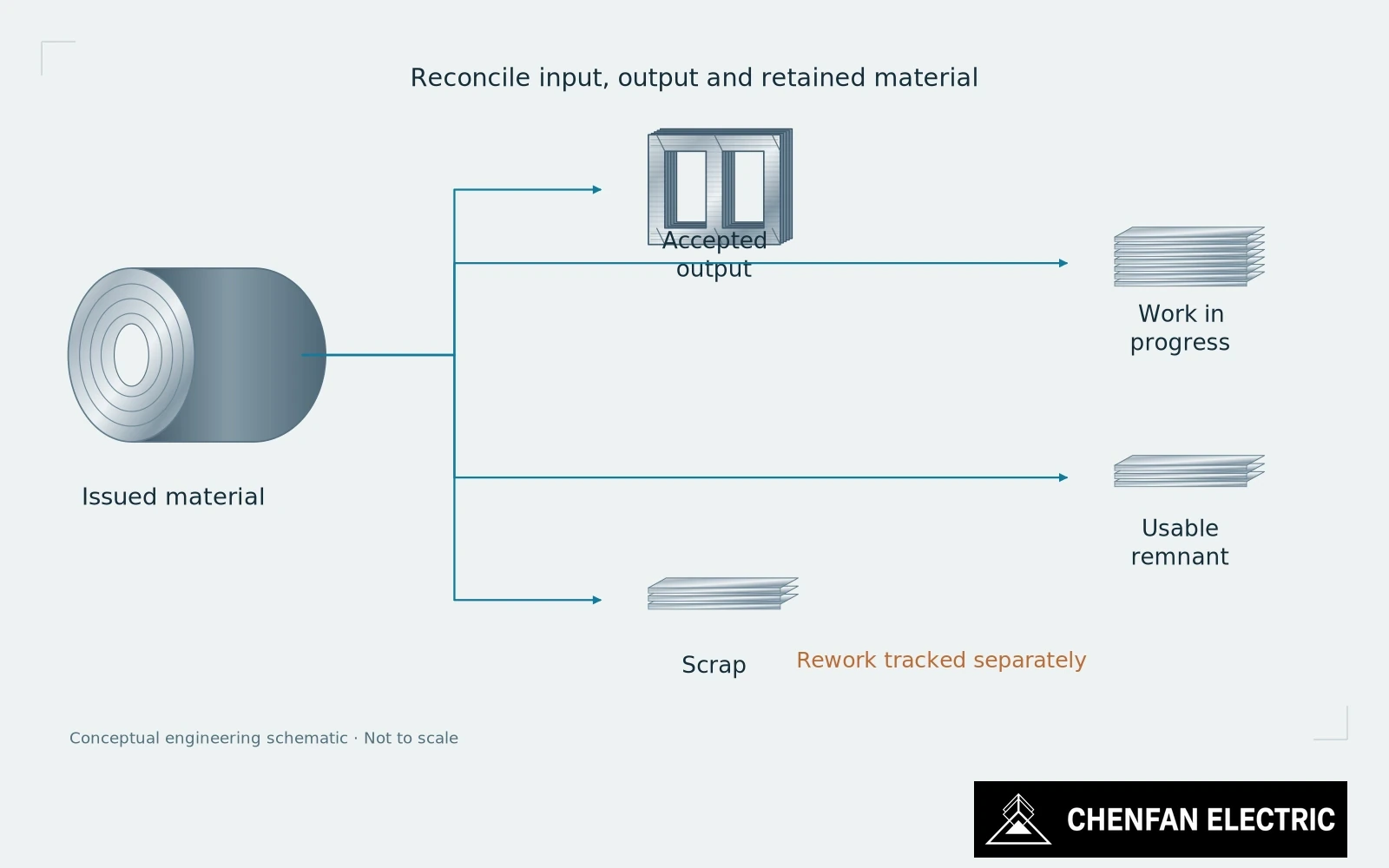
Reconcile input, accepted output and usable remnants
Track material through the route. Reconcile purchased or issued input with accepted output, identified work in progress, usable remnants and scrap. A remnant should not be counted as a permanent saving if it has no realistic, controlled use.
Rework belongs in a separate view. Material can avoid the scrap bin while consuming additional labor and inspection. That may be the right technical disposition, but it is not evidence that the process produced the item correctly first time.
A meaningful supplier comparison therefore uses similar product scope and consistent accounting boundaries. Where the designs differ, explain the difference instead of forcing the percentages into a league table.
Improve yield without hiding downstream defects
Then investigate the controllable causes. A better slit-width plan may reduce offcuts. Improved tool control may reduce rejected edges. Better identification may prevent otherwise usable packets from becoming untraceable. Each improvement has a different mechanism and should be verified accordingly.
Do not pressure the factory to protect the scrap figure by accepting questionable material into a core. The purpose of material efficiency is to produce more accepted function from the input, not to postpone the point at which a defect is recognized.
A scrap rate becomes useful when it explains loss of material within a defined route. By itself, a small percentage says too little about magnetic quality, first-pass performance or the amount of work required to release the core.
Practical takeaway
An attractive scrap percentage can conceal product-mix, remnant and acceptance-boundary differences.
Chenfan Electric manufactures custom transformer cores according to customer drawings. Where applicable to the specified material and core design, agreed process controls include burr height below 0.02 mm and stacking factor above 97%. Measurement methods and acceptance conditions are defined for each order.