

The nesting software may find a better fit by rotating a part.
GOES does not become magnetically equivalent because the outline still fits the sheet.
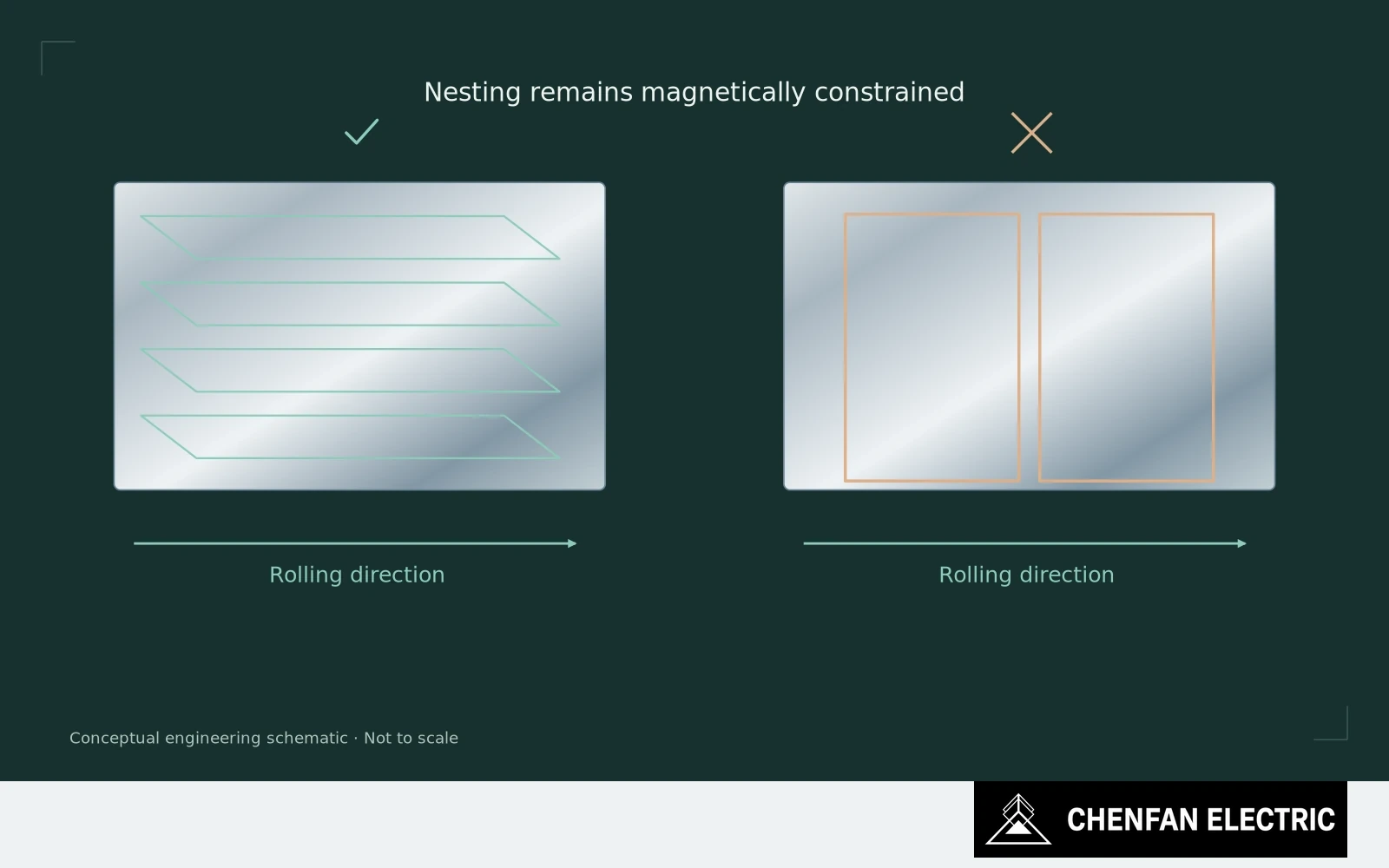
Keep magnetic orientation and joint geometry fixed
The preferred rolling direction is a design input, not an inconvenience to remove from the cutting plan.
Grain-oriented steel is selected for its directional magnetic behavior. A layout optimization must preserve the approved orientation of each lamination relative to the intended flux path. A geometrically efficient arrangement can therefore be technically unacceptable.
Joint geometry adds another constraint. Changes to cut angles, overlap relationships or the set of required widths can improve raw-material utilization while altering the core that was originally qualified. The saving then belongs to a proposed redesign, not an equivalent manufacturing optimization.
Separate better nesting from a design change
There are still useful yield improvements within the approved design. Selecting suitable parent widths, grouping compatible orders and reducing avoidable setup remnants can improve utilization without changing the magnetic function. Those opportunities should be exhausted before altering controlled geometry.
Distinguish three cases during review: the same design produced with a better cutting plan; an approved design adjustment with verified consequences; and an unapproved change made to improve yield. Combining them into one material-efficiency number hides the decision that engineering must make.
A proposed adjustment should show where the saving comes from and which magnetic or assembly assumptions change. If the only benefit is less scrap, the engineering review still needs to determine whether loss, excitation behavior or interface geometry is affected.
The comparison should use total required input material for accepted output. A layout that minimizes visible offcuts but causes more rejected laminations or difficult packet management may not improve effective yield.
Evaluate accepted output, not just visible offcuts
For purchasing, it is reasonable to invite manufacturability proposals. It is equally reasonable to require that rolling direction and controlled joint features remain fixed unless a revision is explicitly approved.
The useful relationship is collaborative: the core supplier identifies a real manufacturing opportunity, and the transformer designer decides whether the function can tolerate the proposed change.
Material utilization is a constrained optimization problem. The magnetic direction and qualified geometry are part of the constraints. Delete them from the problem and the software may solve a cheaper job, but it may no longer be the job the customer ordered.
Practical takeaway
A better geometric nesting result can violate the magnetic rolling-direction requirement.
Chenfan Electric manufactures custom transformer cores according to customer drawings. Where applicable to the specified material and core design, agreed process controls include burr height below 0.02 mm and stacking factor above 97%. Measurement methods and acceptance conditions are defined for each order.