

The value of a core test station is measured partly in how quickly a problem can be isolated while the evidence still exists.
Owning a wattmeter is the least demanding part of that capability.
Use a test suited to the assembled core
A supplier that can perform an appropriate core test can examine an assembly before packaging and shipment. It can also compare a controlled process change without waiting for a complete transformer to reach final testing.
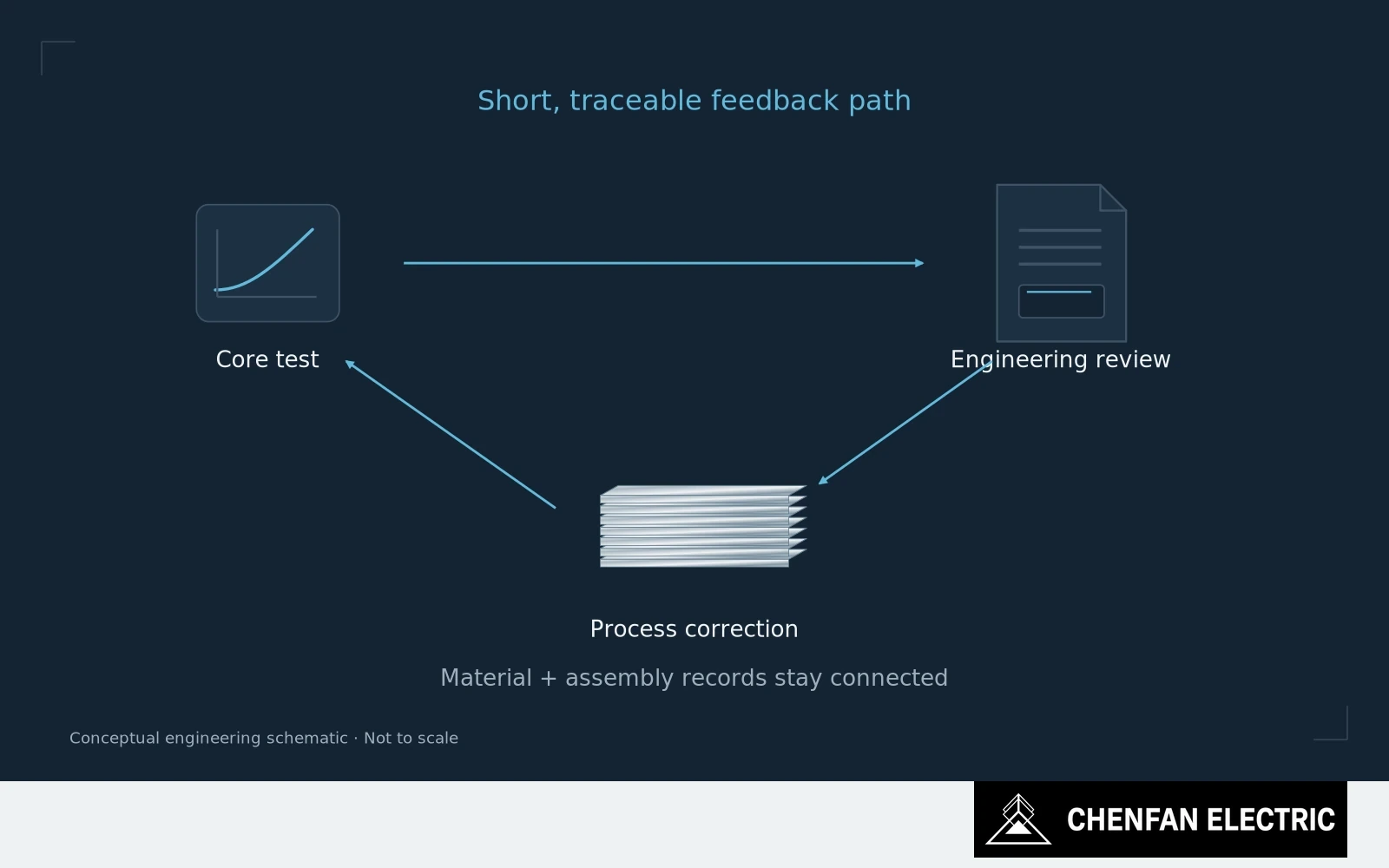
That shortens the feedback path. A suspect result can be connected to the material, program, stacking record and mechanical state while the same production team and components remain available.
The benefit depends on the test being suitable. A material specimen tester and an assembled-core test arrangement answer different questions. The supplier needs to understand excitation, connection, waveform, instrument capability and the boundary of the measured power.
Keep final-transformer verification separate
The result also needs an owner. Who checks an unexpected current pattern? Who determines whether a repeat measurement is legitimate? Who records an intervention between tests? A station that generates a pass sheet without a defined response process provides less protection than its equipment list suggests.
In-house testing does not eliminate the need for final transformer verification. The transformer manufacturer still has integration variables and its own applicable test requirements. The useful relationship is an agreed interpretation of the supplier’s evidence, not a claim that one test replaces the other.
An external laboratory can also provide valid measurements. The commercial question is whether the arrangement gives the required access, turnaround, object identity and technical response. Physical ownership of the instrument should not become an arbitrary qualification gate where an effective alternative exists.
Follow one abnormal result through corrective action
For a supplier audit, choose one abnormal result and follow the response. Was the measurement checked? Was the proposed cause tested? Was the disposition recorded against the correct assembly? Did the finding change a relevant process control?
That exercise reveals whether testing is integrated into engineering or merely attached to shipping documentation.
The strongest reason to value supplier-side testing is early, traceable problem resolution. It moves information closer to the operation that can act on it, before a core issue becomes entangled with winding assembly, transport history and the final transformer schedule.
Practical takeaway
Testing is valuable because it shortens an evidence-preserving feedback path, not because the equipment is owned.
Chenfan Electric manufactures custom transformer cores according to customer drawings. Where applicable to the specified material and core design, agreed process controls include burr height below 0.02 mm and stacking factor above 97%. Measurement methods and acceptance conditions are defined for each order.