

Additional core lamination steps change packet edges and contact heat paths as well as geometric fit. Reconstruct those paths to qualify the thermal effect of the revised section. [1] [2]
This review begins after the stepped section has been selected. Its task is to trace the changed heat paths, rather than to repeat the geometric optimization.
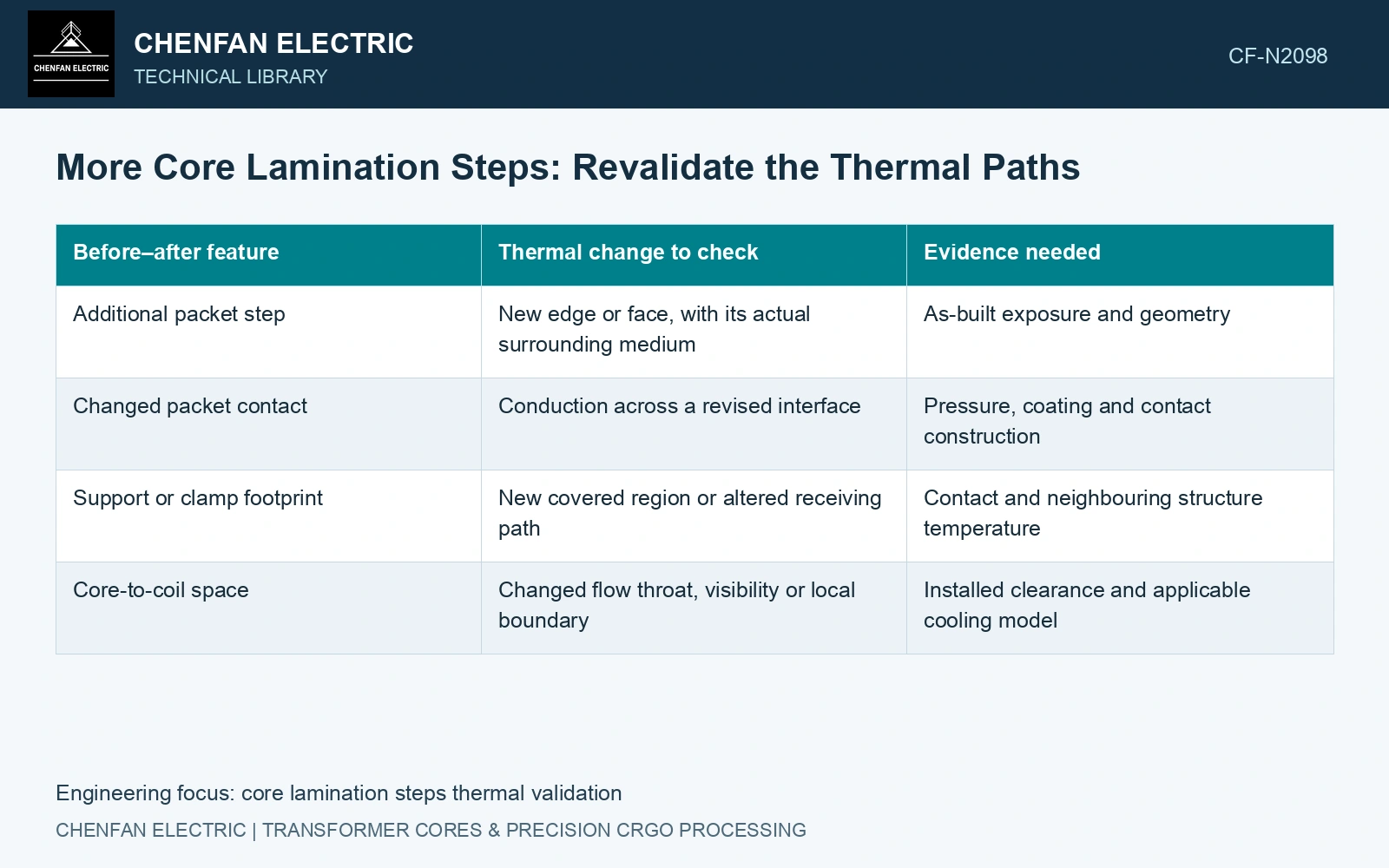
Register every changed interface
| Before–after feature | Thermal change to check | Evidence needed |
|---|---|---|
| Additional packet step | New edge or face, with its actual surrounding medium | As-built exposure and geometry |
| Changed packet contact | Conduction across a revised interface | Pressure, coating and contact construction |
| Support or clamp footprint | New covered region or altered receiving path | Contact and neighbouring structure temperature |
| Core-to-coil space | Changed flow throat, visibility or local boundary | Installed clearance and applicable cooling model |
An extra interface between packets is not automatically an oil duct. Determine whether it is closed, wetted, gas-filled or connected to flow. Applying a cooling coefficient to every new step can give the model additional heat removal that the construction does not provide.
Rebuild the thermal material description
Retain the physical lamination axes and the applicable directional packet properties. If the previous model homogenized the entire section, check whether the new interface layout remains within that representation’s scope.
Keep contact resistance separate from solid conductivity where it controls the path. Changes in packet count or local compression can make a previously fitted effective value unsuitable. A dimensional improvement does not justify transferring it unchanged.
Update the spatial heat source where the magnetic construction changes. Equal total watts can still be distributed differently around the new edges or joints. Conversely, if the source distribution is intentionally held fixed for a thermal-only comparison, label that assumption.
Compare matched physical regions
Map sensor positions from the old geometry to the new one by their thermal role, not only by an unchanged global coordinate. A point previously on an exposed face may now lie beside a step or support and answer a different question.
Compare local steel and surrounding-fluid temperatures under matched excitation, load and cooling boundaries. Include sheltered step regions, the limiting packet interior where evidence is available and the changed core-to-coil throat.
Check model resolution around new narrow regions; a coarse mesh can smooth out the very interface being reviewed. Validate the predicted peak’s position as well as its value.
Use the 0.90 W/kg catalogue limit for 23ZH90 at 1.7 T, 50 Hz as a strip-input budget. [3] Assume a 500 kg region, unchanged 450 W thermal source and effective conductances of 30 W/K before the step change and 25 W/K afterwards. Mean rises are 15 K and 18 K. Against an assumed 17 K mean-rise review gate, the former passes and the latter fails; reopen the contact or exposure design. These assumed conductances are not verified production data. Validate assembled loss and the spatial peak separately before extending the comparison to a manufactured core.
Packet thickness, contact footprint, joint registration and compression establish which additional step surfaces actually exchange heat. Do not qualify the geometry using a model that treats closed contacts as open cooling ducts.
Associate added, removed and uncertain heat paths with calculation or measurement. Release the higher-step construction on that thermal evidence alongside its geometric and magnetic results.
References
- Z. Chen, Z. He and S. Wang, Transformer Iron Core Temperature Field Calculation Based on Finite Element Analysis, Energies 18, 6537, 2025. DOI: 10.3390/en18246537.
- U.S. Department of Energy, DOE-HDBK-1012/2-92, Thermodynamics, Heat Transfer, and Fluid Flow, Volume 2, 1992.
- Nippon Steel Corporation, Grain-Oriented Electrical Steel Sheets, catalogue D004je, April 2020, specification and typical-property tables.