

A polarity-reversal test starts before the voltage changes sign. Its initial condition includes the previous DC hold, temperature, interfacial charge and any interval spent disconnected or earthed. Reporting only the positive and negative test voltages omits part of the stress. Apply the HVDC transformer specification framework of IEC/IEEE 60076-57-129 to the stated liquid-immersed equipment [1]. [2]
In a layered oil-pressboard system, charge developed during the first hold can persist into reversal. The applied field changes quickly while slower material responses retain memory. The local peak field therefore need not follow the new terminal voltage by a simple proportional scaling.
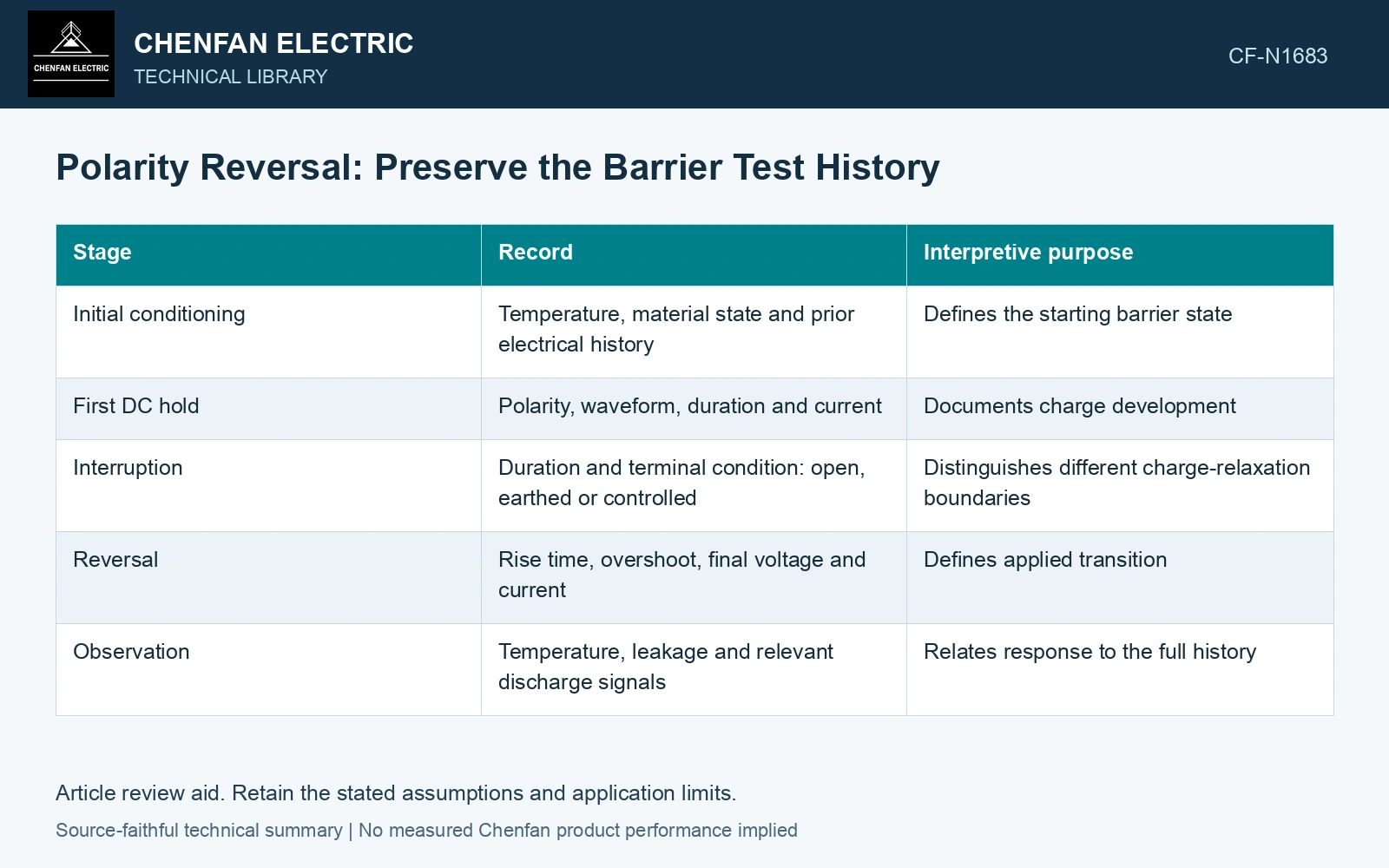
Write the history as a continuous timeline
| Stage | Record | Interpretive purpose |
|---|---|---|
| Initial conditioning | Temperature, material state and prior electrical history | Defines the starting barrier state |
| First DC hold | Polarity, waveform, duration and current | Documents charge development |
| Interruption | Duration and terminal condition: open, earthed or controlled | Distinguishes different charge-relaxation boundaries |
| Reversal | Rise time, overshoot, final voltage and current | Defines applied transition |
| Observation | Temperature, leakage and relevant discharge signals | Relates response to the full history |
Change one history variable at a time
To examine interruption-time sensitivity, keep the barrier geometry, materials, temperature and first hold consistent while varying only the defined pause. State whether the pause is open-circuit or earthed. These are different electrical boundary conditions and should not be combined as a single “rest time.”
A simplified relaxation time τ = ε/σ, with permittivity ε in F/m and conductivity σ in S/m, illustrates why materials can retain field history. Real composites can have several response times, field-dependent conductivity and injected charge. One τ does not prescribe a sufficient waiting time or certify that the barrier has reset.
Compare pauses under one defined relaxation model
Assume a single linear relaxation mode with relative permittivity 4.0, vacuum permittivity 8.854 × 10⁻¹² F/m and conductivity 1 × 10⁻¹⁴ S/m. Then τ = ε/σ = 3541.6 s. Under an assumed earthed-pause model with normalized retained state exp(−t/τ), pauses of 600 s and 3600 s leave 0.844 and 0.362 respectively. The longer pause retains about 43% of the shorter-pause state. Preserve the actual terminal boundary and measured response when selecting reversal preconditioning; this single-mode calculation cannot prescribe a test waiting time.
Compare histories before comparing results
If two tests differ in peak current or discharge behavior, first compare the preceding holds and temperature traces. A different residual state may explain a difference without a changed barrier geometry. Conversely, matched histories help make a geometric comparison meaningful.
Retain the voltage waveform and terminal boundary through the pause, including automatic transitions. If they change, the next stage starts from a different polarization history. Compare that history with the applicable qualification plan; this analysis supplies no universal pre-stress recipe.
References
- IEC/IEEE, IEC/IEEE 60076-57-129:2017, Power transformers – Part 57-129: Transformers for HVDC applications.
- CIGRE JWG A2/B4.28, Technical Brochure 406, HVDC Converter Transformers – Design review, test procedures, ageing evaluation and reliability in service, 2010.