

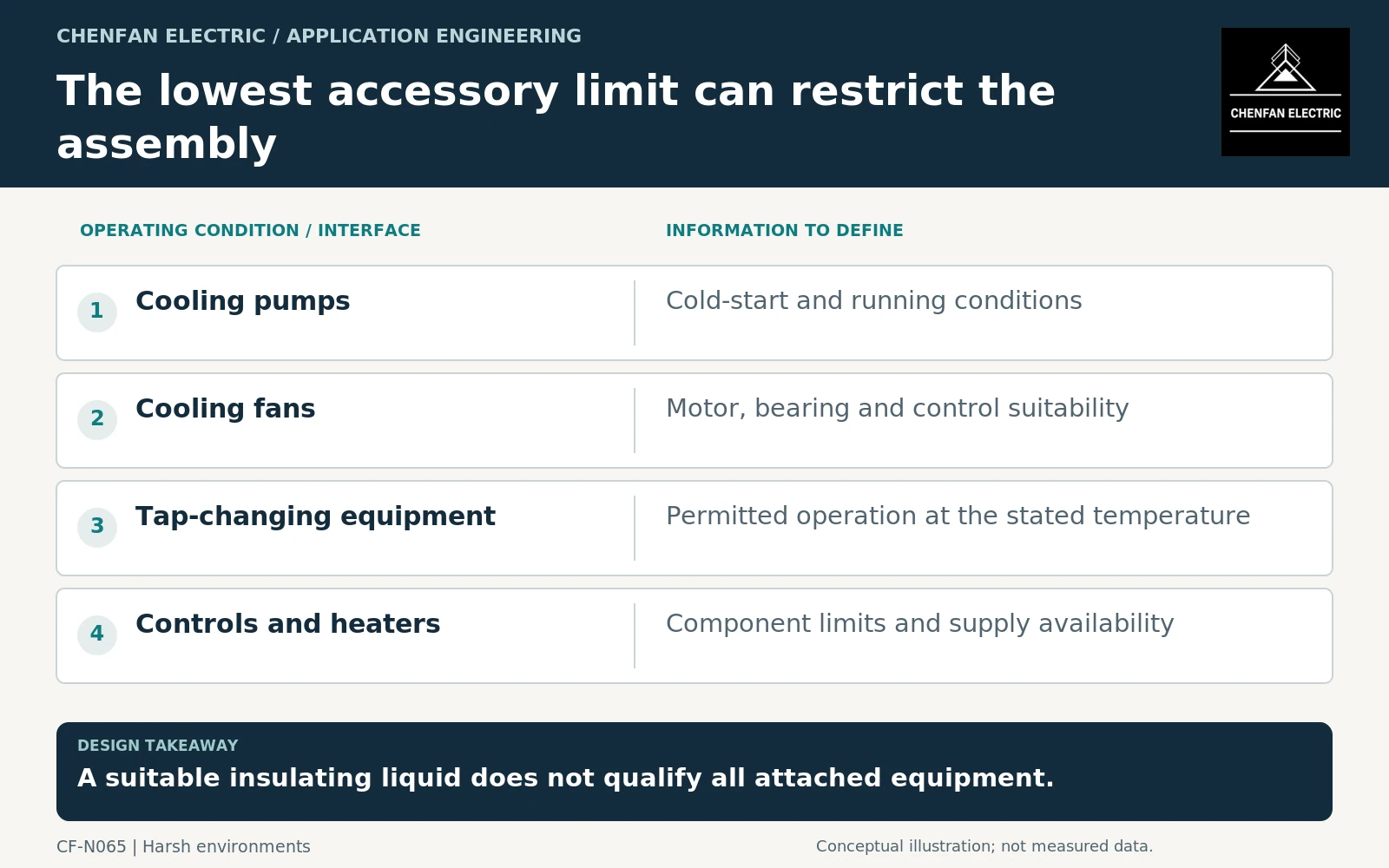
Cold-climate transformer suitability requires a component-by-component auxiliary review. Fans, pumps, tap-changing equipment, controls and seals can have operating limits different from those of the main insulation system. A favorable low-temperature fluid property or transformer ambient statement does not establish that every attached device can start and function after the specified cold soak.
Define cold start, cold running and storage separately
State the minimum operating temperature, expected shutdown duration and the lowest condition before energization. Distinguish continuous energized service from equipment that has cooled during a prolonged outage. Also keep transport and storage conditions separate from electrical operation.
General transformer requirements provide the framework for agreeing service conditions. The enquiry must identify unusual low-temperature cases and the available auxiliary supplies. [1]
A component that operates acceptably after the transformer warms may have a different starting restriction. The supplier should state that distinction explicitly rather than reporting one temperature range without explaining the tested or guaranteed function.
Build an auxiliary limit schedule
| Device or interface | Required confirmation |
|---|---|
| Cooling pump | Starting and running limits with the specified medium |
| Cooling fan | Motor, mechanical and control operation at the stated condition |
| Tap-changing equipment | Permitted function and operating restrictions |
| Sensors and relays | Measurement and functional limits |
| Cabinet heaters | Supply source and required availability |
| Seals and connections | Compatibility with the specified temperature cycle |
IEC 60076-22-5 and IEC 60076-22-6 address specified pumps and fans for liquid-immersed power transformers and reactors, not all cold-climate cooling equipment. They support treating auxiliaries as specified equipment, not as an automatic extension of the main transformer rating. [2] [3]
For tap-changing or protective equipment, obtain the actual manufacturer’s applicable temperature and functional evidence. Do not invent a universal warm-up time or operating sequence. Those restrictions depend on the purchased device and assembly.
Check dependencies between the devices
A pump may depend on control power, a heater may depend on an auxiliary transformer and a monitoring device may need to report that the heater supply has failed. Map those dependencies through a prolonged outage and restoration.
Avoid circular assumptions. If the transformer must be prepared before energization, the preparation supply cannot simply be assumed to come from the transformer after it is already operating unless the approved design addresses that sequence.
Transformer protective-accessory requirements address their own equipment scope. They do not establish the complete site’s recovery logic. [4] The integrator should coordinate what is detected, what operation is restricted and who owns the response.
Accept the assembly against a defined cold-state matrix
The supplier’s response should list each relevant component, supported function, temperature boundary and evidence source. Any assembly test should identify the configuration, duration and functions demonstrated. A certificate for one fan model should not be presented as a test of the complete cooling system.
The operating documentation should preserve restrictions on unavailable heating, low-temperature mechanism operation or initial loading. It should also distinguish a sensor’s valid measurement range from the temperature at which the equipment may safely perform its function.
The useful purchasing outcome is a cold-state matrix showing which functions are available before startup, during initial operation and after normal thermal conditions are established. It replaces the vague assurance that the transformer is “winterized” with a traceable set of auxiliary capabilities and dependencies.
Core procurement checkpoint: List the auxiliaries actually included in the order
A core-only quotation should not silently include fans, pumps or tap-changing equipment. State whether clamps, brackets or other interfaces are supplied and leave auxiliary selection and cold-start qualification with the responsible equipment manufacturer unless separately agreed. Keep any requested material or core tests distinct from the functional checks for the completed transformer’s liquid-circulation and control system.
For the core enquiry: Included component schedule; core/clamp drawings; cold-storage requirements; material records; explicit auxiliary supply and test exclusions.