

Seismic transformer projects need separate but coordinated evidence for the equipment assembly, its anchorage and the supporting foundation or structure. A qualification statement for one transformer configuration does not automatically cover a different support arrangement or accessory layout. The specification should connect the site’s seismic demand to the exact installed configuration and define who designs each interface.
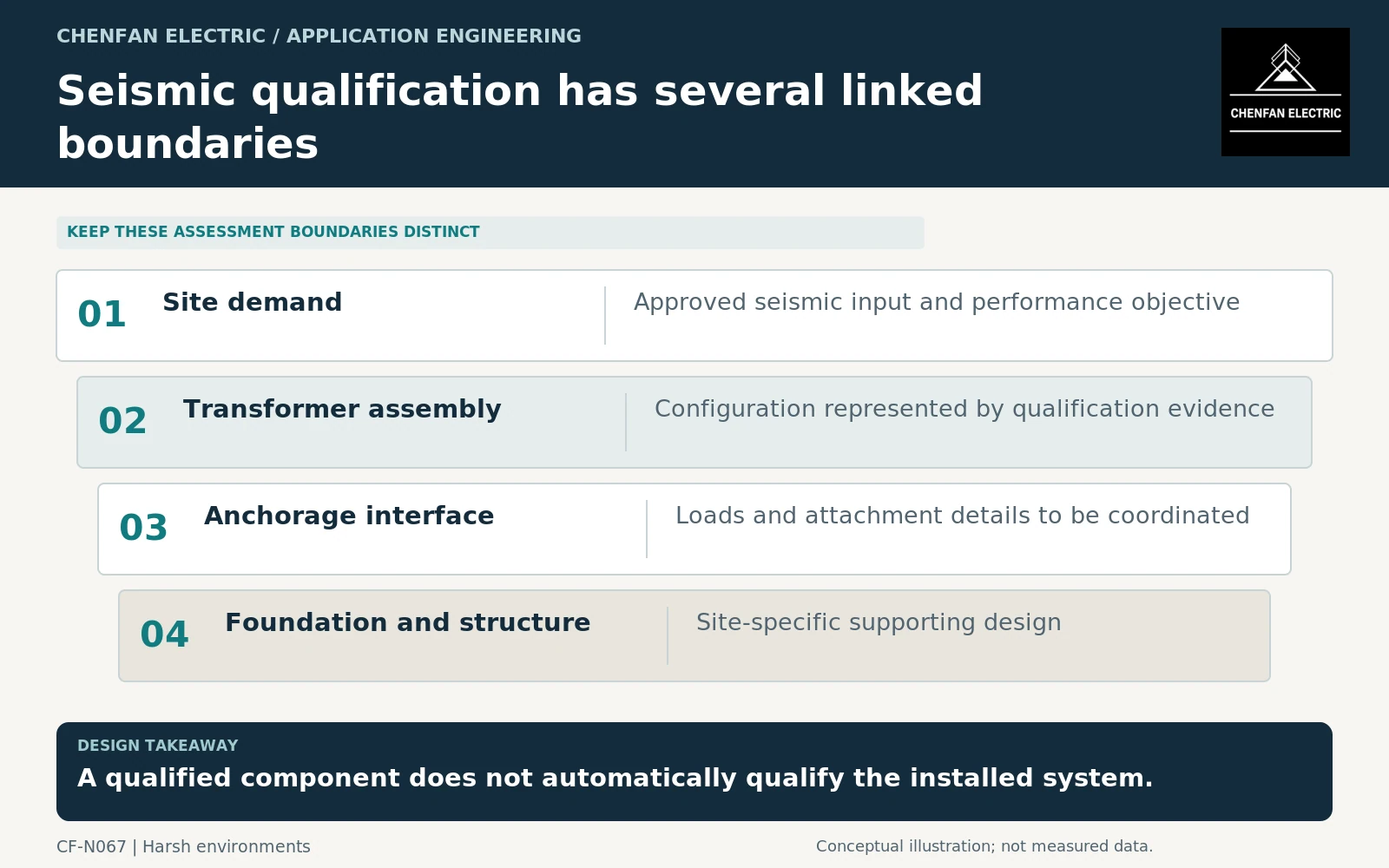
Start with the site’s approved demand and objective
Obtain the seismic input and required performance objective from the responsible structural and electrical designers. State the installation elevation and support conditions where relevant. Equipment mass alone is not a seismic qualification criterion.
IEEE 693 addresses seismic design and qualification of substation equipment within its scope. The publication history includes the 2018 base document and a 2024 amendment; the contract should identify the applicable edition and amendment set rather than citing an unspecified “latest IEEE 693.” [1]
A catalogue seismic category is useful only when its supporting evidence and applicability to the purchased assembly are clear. Do not infer a universal site acceptance from a short product label.
Match evidence to the actual assembly
The qualification record should identify the transformer configuration, major accessories, support arrangement and method used. Changes to bushings, cooling equipment, conservator arrangement or other attached masses can affect whether the evidence remains representative.
The assessment should distinguish structural integrity from continued electrical or functional performance where those are separate acceptance objectives. A document demonstrating one outcome should not be silently used to claim another.
Ask the supplier to provide interface loads and attachment information needed by the foundation designer. In return, the supporting-structure design should confirm the conditions assumed by the equipment assessment. An equipment model with an idealized rigid base may not automatically represent every real structure.
General transformer requirements provide the broader equipment framework, but unusual mechanical service conditions must be specified and agreed. [2]
Close anchorage and connection interfaces
| Interface | Required coordination |
|---|---|
| Equipment supports | Geometry and conditions represented by the qualification |
| Anchorage | Agreed loads, attachments and design responsibility |
| Foundation or structure | Site-specific supporting assessment |
| Electrical connections | Relative movement and equipment-interface loads |
| Cooling and controls | Attached components and service connections |
This matrix is not an anchor-sizing method or a construction detail. Those require the actual loads, materials, geometry and applicable structural design.
Flexible or rigid external connections can impose additional forces or movement constraints. Their design should be coordinated with the equipment rather than treated as an unrelated installation item added after qualification is complete.
Preserve the qualified configuration through delivery
The final review should compare the delivered assembly, support details and accessory positions with the configuration represented by the evidence. Record deviations and obtain the responsible engineering disposition before relying on the original qualification claim.
The installation handover should retain equipment records, foundation and anchorage documents, interface drawings and acceptance responsibilities. A later replacement bushing or altered cooling arrangement may require review if it changes the qualified configuration.
The useful seismic claim is specific: this assembly, installed on the stated support and connections, has evidence against the agreed demand and objective. “Seismic resistant” without those boundaries is not a complete purchasing requirement, and a foundation calculation alone cannot qualify the transformer mounted on it.
Core procurement checkpoint: Name the configuration behind any seismic requirement
A seismic requirement must identify the actual equipment, supports and anchorage to be assessed. A drawing-based core supplier needs the approved core and clamp interfaces and a clear statement of which components are included. Do not present steel traceability or dimensional conformity as seismic qualification of the complete transformer, and do not extend evidence from one assembly configuration to another without approval.
For the core enquiry: Core/clamp drawings; supplied mass and dimensional requirements; support interface; qualification configuration and responsible approval party.