

Condensation risk in tropical transformer installations should be reviewed during shutdown and idle periods as well as normal operation. Warm equipment can cool in humid surroundings, and auxiliary heaters or ventilation may be unavailable when the main supply is disconnected. An enclosure ingress classification does not, by itself, establish that internal surfaces remain free of condensation.
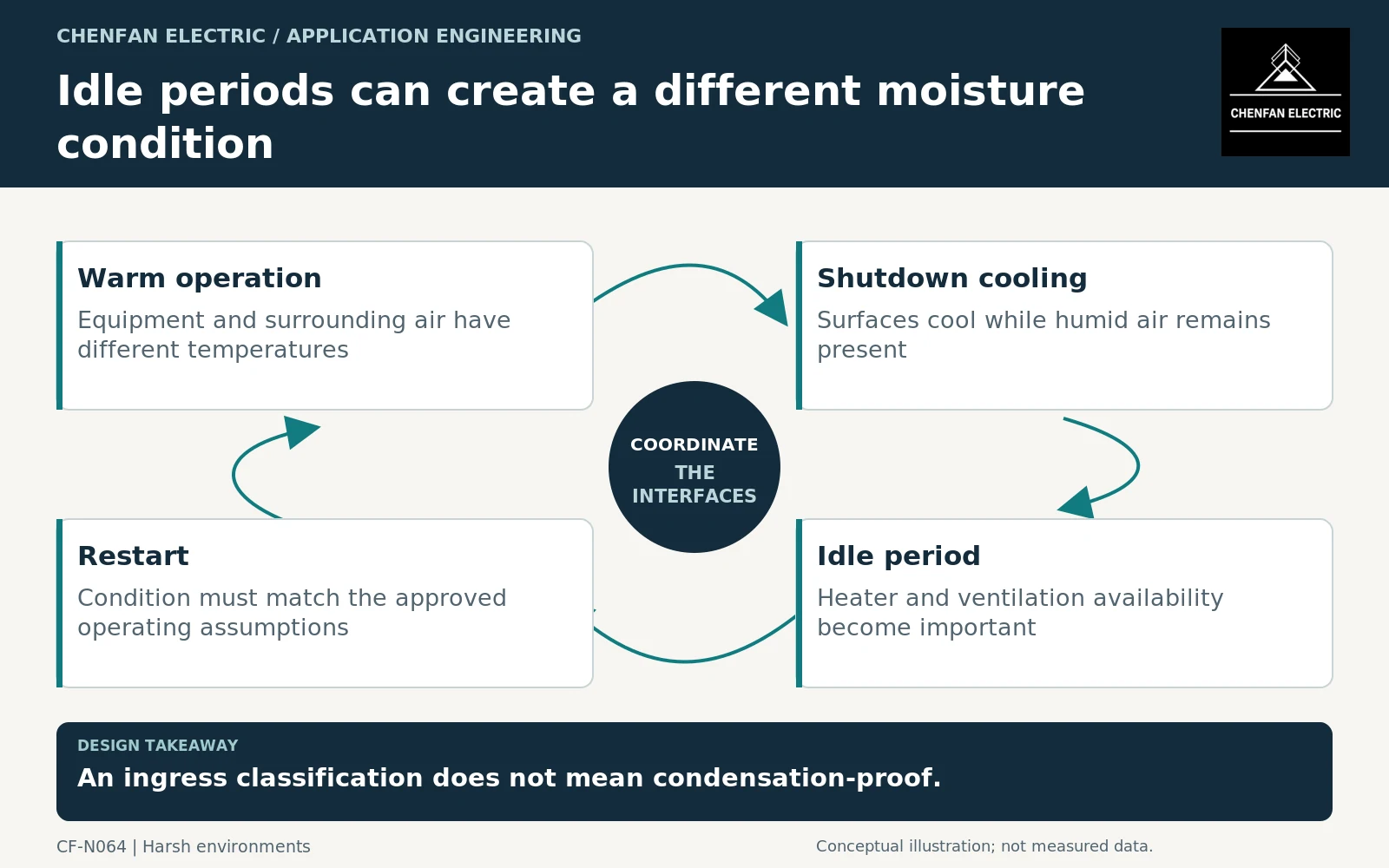
Follow temperature and moisture through the shutdown
Condensation becomes possible when a surface is below the dew-point temperature of the surrounding air. The relevant surface and local air conditions may differ from a room-average sensor reading. A daily temperature range can therefore matter even when ambient conditions appear consistently warm.
Record whether the transformer is outdoors, in a ventilated room or in a container, and identify the compartments or accessories that depend on moisture control. The main insulation system, control cabinet and external connections need not have the same exposure.
General transformer requirements and dry-type environmental provisions provide equipment-specific frameworks. They do not remove the need to describe the actual installation and idle-state conditions. [1] [2]
Do not label a hypothetical dew-point example as a site measurement. Where a project uses humidity and temperature records, preserve their location, sampling method and missing-data assumptions.
Identify what remains powered when the transformer is off
A heater that depends on the disconnected main supply cannot be assumed available throughout a shutdown. State the source of cabinet heaters, monitoring and ventilation, including any independent auxiliary supply.
The control philosophy should identify the consequence of losing those services. A device may be electrically disconnected yet still require environmental protection. Conversely, continuously heating every enclosure is not a universal solution; the approved arrangement must match equipment instructions and the surrounding environment.
IEC 60529 classifies enclosure ingress protection. It does not certify a compartment against all condensation mechanisms, nor does a higher IP number automatically solve trapped moisture or thermal cycling. [3]
A useful idle-state schedule identifies duration, expected local conditions, available auxiliaries and the condition required before returning to service. That schedule is more informative than a single maximum-humidity value detached from temperature and operating state.
Specify evidence and restoration boundaries
Ask the supplier to identify the moisture-control features and the conditions under which they are intended to work. Separate component evidence from complete-assembly evidence. A heater datasheet does not demonstrate that every vulnerable surface in an enclosure remains above dew point.
The installation package should retain ventilation paths, sealing details and monitoring locations relevant to the approved design. Later changes to enclosure openings or auxiliary supply can alter the moisture behavior without changing the transformer’s electrical rating.
For prolonged storage or shutdown, use the manufacturer’s approved preservation and return-to-service requirements. This article does not provide a field drying, insulation-testing or energization procedure, which would require equipment-specific instructions and qualified personnel.
The procurement acceptance question is bounded: does the proposed assembly, with the stated auxiliary availability, address the defined humid operating and idle conditions? Record any restrictions and the evidence supporting them.
A tropical rating should therefore describe more than hot-weather operation. It should explain what happens as the equipment cools, what environmental controls remain available and which assumptions must be restored before the next operating period. That is how an idle-period moisture issue becomes a manageable design interface rather than an unexpected commissioning problem.
Core procurement checkpoint: Preserve the core through receiving and idle storage
For a tropical project, request agreed instructions for unpacking, storage and transfer into assembly, including how the receiving party will manage condensation. A core delivery record should identify its preservation state and supplied components. Those records do not certify the completed transformer’s resistance to humidity; enclosure, heating and operating controls remain part of the equipment and installation design.
For the core enquiry: Delivery and storage conditions; packing/preservation method; receiving inspection; component list; approved assembly and handling instructions.