

Ferroresonance transitions can be abrupt across source voltage and cable capacitance, with the response depending on the path into that region. Scan the relevant parameters and initial histories to map the transition-sensitive operating cases. [1]
Ferracci’s study discussion uses bifurcation and continuation methods to reveal these boundaries. A practical time-domain response map should distinguish what it observes from the full mathematical solution structure it has not computed.
Define the map and its fixed assumptions
Choose capacitance and a stated source-voltage quantity as coordinates. Keep topology, loss model, source impedance and load fixed for one layer. Store the initial magnetic and electric states used by every run. [2]
For a cable-fed circuit, capacitance may be a matrix rather than one scalar. If the map scales one parameter, say which physical branches it changes. Increasing only phase-to-ground capacitance is not necessarily equivalent to adding cable length in every connection.
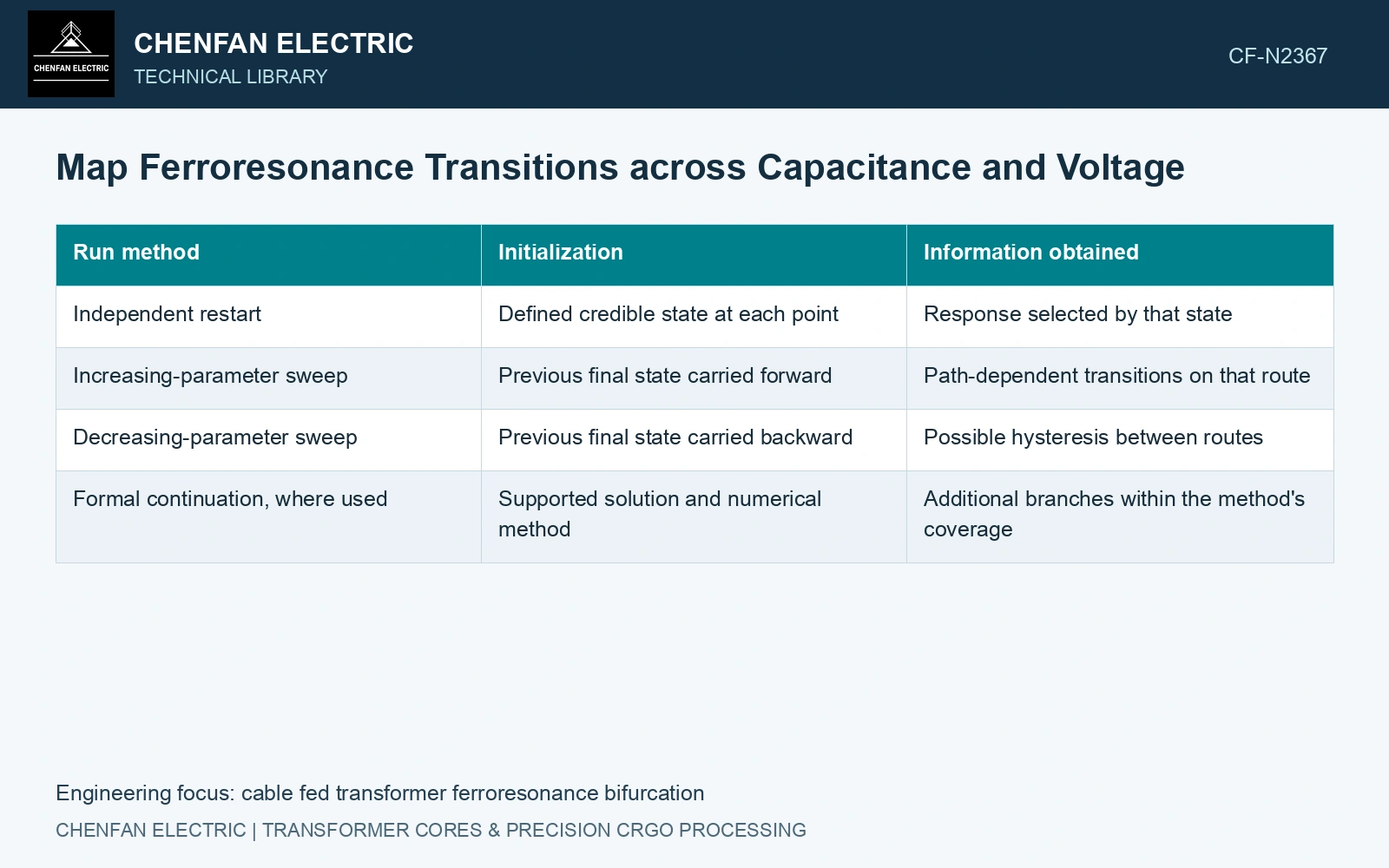
Use restart and state-carrying runs
| Run method | Initialization | Information obtained |
|---|---|---|
| Independent restart | Defined credible state at each point | Response selected by that state |
| Increasing-parameter sweep | Previous final state carried forward | Path-dependent transitions on that route |
| Decreasing-parameter sweep | Previous final state carried backward | Possible hysteresis between routes |
| Formal continuation, where used | Supported solution and numerical method | Additional branches within the method’s coverage |
Carrying the final state includes magnetic history and capacitor voltages, not merely copying the previous peak voltage. Resetting those states while calling the run continuation would misdescribe the method. [1]
A transient sweep normally follows accessible stable responses. It does not automatically locate unstable branches or disconnected solution families. Label it a response map unless the broader bifurcation analysis has actually been performed.
Refine transitions and keep unresolved cells
Record mode, voltage/current metrics and the observation interval at each point. Use a separate unresolved label where the transient has not settled or classification is uncertain. [1]
Refine parameter spacing near jumps and verify numerical convergence. A coarse grid can place a transition at the wrong boundary or miss a narrow region. Repeat relevant points with different credible initial states rather than extrapolating one start across the entire plane.
Compare increasing and decreasing sweeps at the same coordinates. Different results are meaningful path information, not errors to average into one curve.
Publish the model, scan coverage and response-selection method with the map. Investigate state and parameter uncertainty where the intended operating envelope crosses a transition-sensitive region.
References
- P. Ferracci, Schneider Electric, Ferroresonance, Cahier Technique No. 190, March 1998.
- D. A. N. Jacobson, Examples of Ferroresonance in a High Voltage Power System, IEEE PES General Meeting, 2003. DOI: 10.1109/PES.2003.1270499.