

A subharmonic ferroresonant response repeats over multiple source periods. Observe enough cycles to establish its persistence and separate the sustained mode from the preceding transient. [1] [2]
Ferracci’s mode classification describes this multi-cycle periodic behavior. The analysis window should be chosen to observe that behavior rather than merely to produce a familiar FFT display.
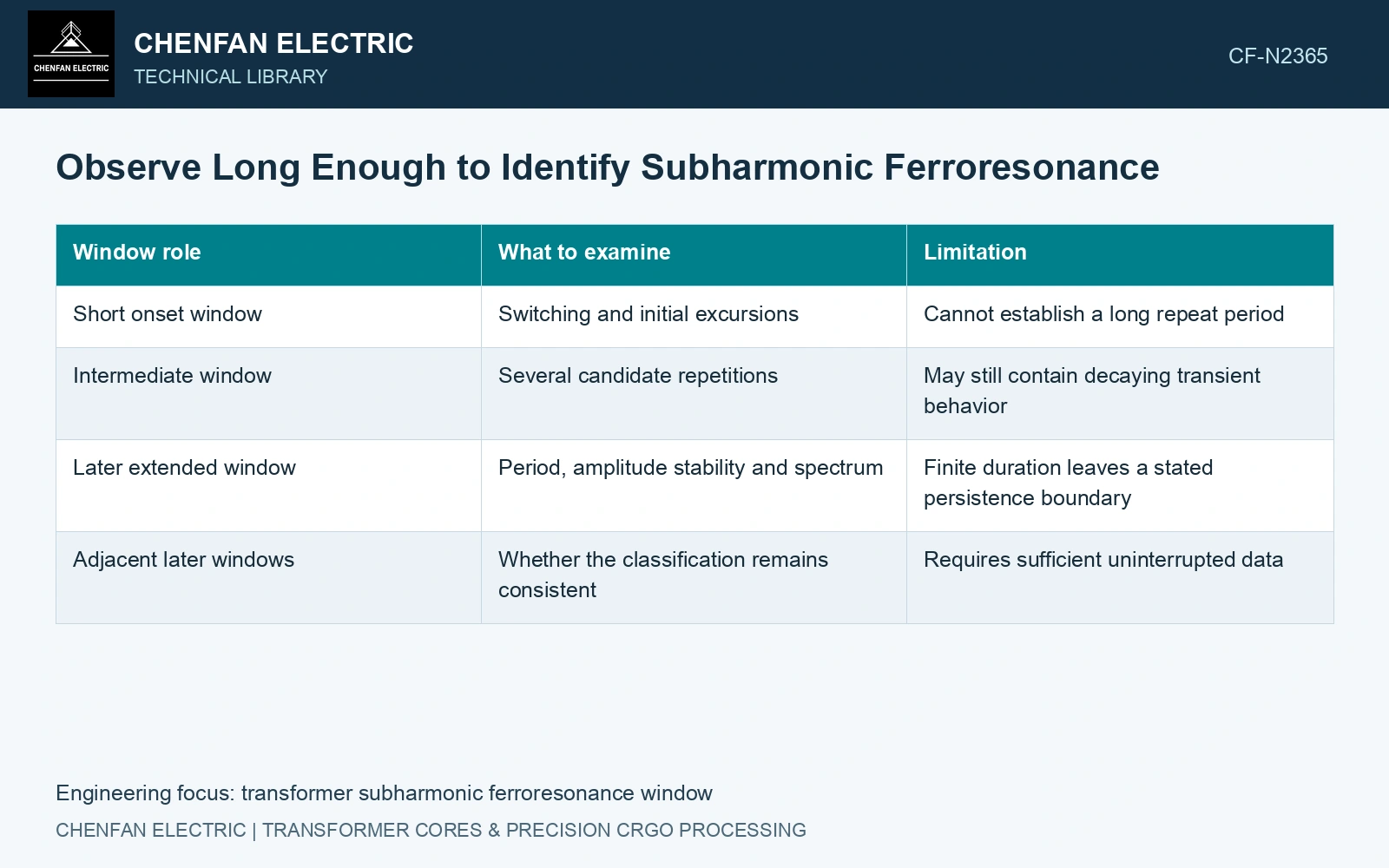
Relate the window to the candidate repeat period
For an illustrative 50 Hz source, one cycle lasts 20 ms. A response at one third of that frequency has a 60 ms repeat period. A 20 ms record contains only part of that pattern; a 120 ms record contains just two repetitions. [1]
A 1.2 s record contains twenty such repeat periods and has nominal FFT-bin spacing of about 0.833 Hz. These numbers illustrate observation scale, not a universal recording requirement. Longer candidate periods or slower state evolution require a corresponding window.
| Window role | What to examine | Limitation |
|---|---|---|
| Short onset window | Switching and initial excursions | Cannot establish a long repeat period |
| Intermediate window | Several candidate repetitions | May still contain decaying transient behavior |
| Later extended window | Period, amplitude stability and spectrum | Finite duration leaves a stated persistence boundary |
| Adjacent later windows | Whether the classification remains consistent | Requires sufficient uninterrupted data |
Compare time-domain recurrence with the spectrum
Inspect whether the waveform repeats after the candidate number of source cycles. Sample at a consistent source phase to compare successive cycles; a period-three response can produce three recurring phase-synchronous values rather than one. [1]
Use spectral analysis with its window length and leakage treatment stated. A broad or displaced spectral feature can result from a transient, modulation or changing period. A peak below the source frequency is supporting evidence, not a complete mode classification.
Keep the source waveform itself in the record. Frequency drift or an inconsistent phase reference can smear phase-synchronous samples and make a periodic response appear irregular.
Exclude acquisition explanations
Check sampling rate, anti-alias behavior, clipping and missing samples. Resampling cannot recover absent cycles, and a filtered trend may hide the actual repeating waveform. [1]
Compare classifications over several windows after the initial event. If the apparent subharmonic decays, report the transient behavior rather than a sustained state. If the repeat pattern changes, retain the transition instead of selecting only the interval that fits one label.
Connect the repeatable recorded mode with the nonlinear circuit and its energy-transfer path. Together, the time-window analysis and circuit evidence establish the response and the mechanism capable of supplying it.
References
- P. Ferracci, Schneider Electric, Ferroresonance, Cahier Technique No. 190, March 1998.
- D. A. N. Jacobson, Examples of Ferroresonance in a High Voltage Power System, IEEE PES General Meeting, 2003. DOI: 10.1109/PES.2003.1270499.