

A battery energy storage system (BESS) auxiliary transformer should be specified from a complete station load list, not as an unexplained percentage of the main power conversion system (PCS) rating. Heating, ventilation, air conditioning, pumps, controls and other services have their own operating sequences. Some may remain necessary after the PCS stops transferring power. Startup, backup supply and restoration conditions can therefore govern the auxiliary supply even when normal demand is modest.
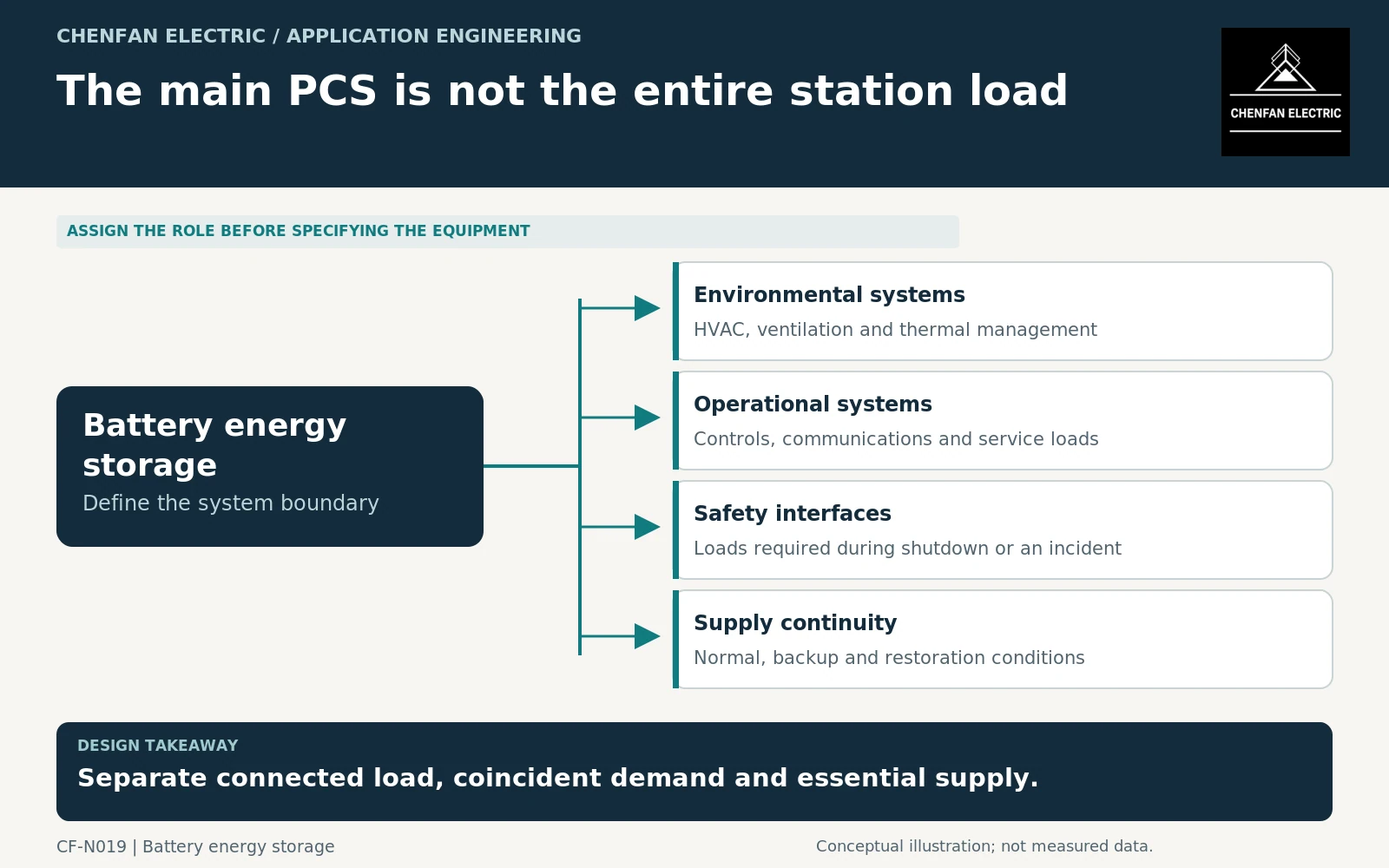
Divide the load list by function and operating state
For each load, record electrical rating, supply voltage, phase arrangement, starting method, duty cycle and the condition in which it operates. Distinguish continuously operating controls from temperature-driven equipment and intermittent maintenance loads.
The maximum connected load is not necessarily the maximum coincident demand. However, any diversity assumption must follow an actual control or operating restriction. Two heating, ventilation and air conditioning (HVAC) systems labeled duty and standby can become simultaneous loads during testing, recovery or an abnormal condition unless the design prevents it.
Transformer application guidance addresses ratings and operating conditions; the load list supplies the project-specific inputs. [1] Do not assume that a transformer catalogue can determine which station services are essential.
Capture starting and recovery demand
Motor starting can impose a short-duration voltage condition different from continuous heating duty. Identify which fans, pumps or compressors can start together and whether a restart sequence is enforced after a supply interruption.
Motor-acceleration study tools explicitly address starting and sequence-of-events analysis. Their relevance is the need to model the source, motors and sequence together, not a claim that software has already validated the auxiliary transformer. [2] [3]
A load schedule should distinguish motor output power from electrical input current. Variable-speed drives and electronic power supplies introduce their own input characteristics, so motor nameplate kilowatts alone may not describe the supply interface.
Define what remains supplied after a trip
| Station state | Auxiliary-supply question |
|---|---|
| Normal charging or discharge | Which thermal-management loads coincide? |
| PCS stopped | Which controls and environmental loads remain active? |
| Main supply unavailable | Which loads have an independent backup source? |
| Restoration | Which loads restart, and in what permitted sequence? |
| Maintenance | Which temporary or service loads are allowed? |
Keep the source of essential functions explicit. A device cannot depend solely on the same supply whose loss creates the condition it must respond to, unless the approved system design addresses that dependency through stored energy, another source or an appropriate fail-safe response.
This is a supply-boundary review, not a prescription for fire-system architecture. Safety functions and their required continuity must be determined by the responsible project disciplines and applicable requirements.
Turn the list into an acceptance matrix
The transformer enquiry should include the coincident continuous load, credible starting cases, harmonic data where relevant, environmental conditions and the backup-source arrangement. Ask for confirmation of the stated duty rather than a generic auxiliary-transformer label.
Separate transformer monitoring from the continuity of the supplied loads. A temperature alarm or communication interface can report equipment condition, but it does not replace the independent supply arrangements needed by the station. The cited communication guidance concerns accessories of liquid-immersed power transformers and reactors; it is not a universal monitoring specification for every auxiliary transformer. [4]
The handover should preserve the approved load list and mark reserved future loads. Adding a new container cooling system or changing a restart sequence can alter the auxiliary duty without changing the main BESS power rating.
A complete auxiliary specification explains what operates, when it operates, how it starts and what happens when the normal source disappears. Those four questions are more useful than a fixed sizing percentage.
Core procurement checkpoint: Keep auxiliary-core orders separate from the main BESS unit
A station-service transformer and the main PCS transformer may have different voltages, duty schedules and winding arrangements. Give each its own core drawing and quantity reference, even when both belong to one BESS project. Labeling packets only with the project name risks mixing parts that appear similar but belong to different approved designs and inspection requirements.
For the core enquiry: Auxiliary versus main design IDs; separate core drawings; quantities; material specifications; packet and delivery labels.