

The thinner sheet reaches the stacking station more often.
It also gives the handling system less forgiveness.
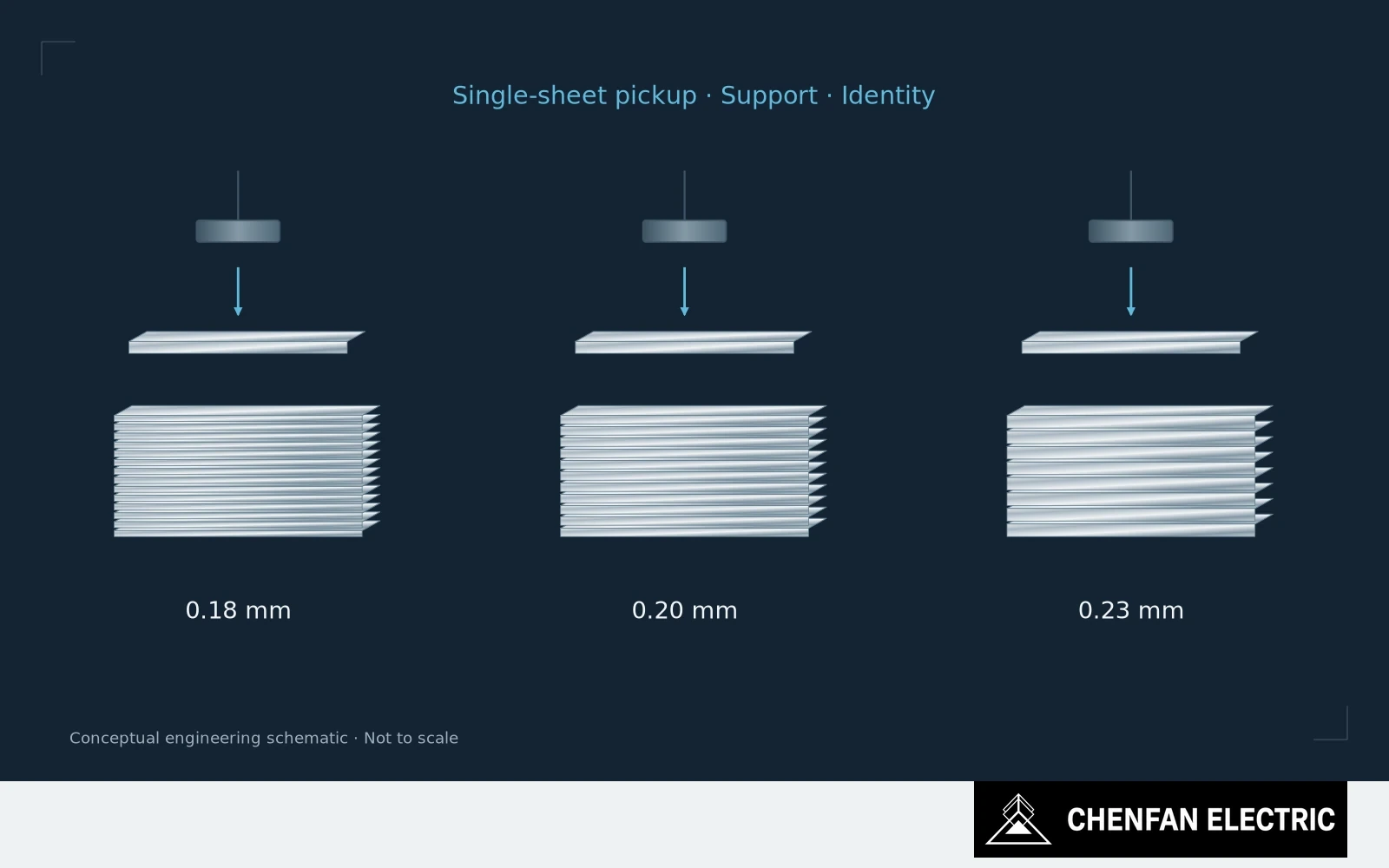
Account for the increased sheet count
That deserves a place in the 0.18 mm, 0.20 mm and 0.23 mm discussion, rather than appearing as a production complaint after the material has been selected.
For a fixed amount of iron through a packet, reducing sheet thickness increases the required sheet count. The exact production count also depends on the specified geometry and how the stack is defined. More sheets mean more opportunities for an incorrect pick, displaced edge or interrupted step sequence unless the process accommodates the change.
This does not make thin-gauge GOES unsuitable. It changes what needs to be demonstrated.
Verify picking, support and sequence control
A stacking device qualified on one gauge is not automatically qualified on another. Separation, double-sheet detection, grip support, feed settings and release behavior need to work with the selected surface and thickness. A machine can place every accepted pick accurately while failing to detect that a pick contains two sheets.
Manual handling has its own exposure. An unsupported thin lamination can be bent during transfer even when its cut length is correct. The relevant question is how the sheet is supported through the actual operation, not whether the operator has handled electrical steel before.
The magnetic benefit needs equal discipline. Thinner material can reduce classical eddy-current loss under comparable conditions, but total specific loss also depends on the material’s other characteristics. Thickness alone does not establish the ranking of commercial products at the design operating point.
Compare two complete routes: the chosen grade and gauge, packet definition, sheet-handling method, inspection coverage and measured core behavior. Record first-pass assembly performance as well as the final loss result. Hidden sorting and restacking are part of the qualification evidence.
Trial the difficult widths and packet transitions
A useful pilot should include the awkward widths and packet transitions in the intended design family. Demonstrating an easy rectangular stack says little about the least stable sheet in the real core.
Thin-gauge material earns its place when its magnetic advantage survives a production route that can handle it repeatedly. Rejecting it because it is demanding is premature; approving it because it is thinner is equally premature.
The qualification sample should challenge the handling process, not just the wattmeter.
Practical takeaway
Thin material changes sheet-handling and counting risk, not only magnetic loss.
Chenfan Electric manufactures custom transformer cores according to customer drawings. Where applicable to the specified material and core design, agreed process controls include burr height below 0.02 mm and stacking factor above 97%. Measurement methods and acceptance conditions are defined for each order.