

A core can have an acceptable average loss while a small region deserves attention.
Averages preserve the total. They discard the location.
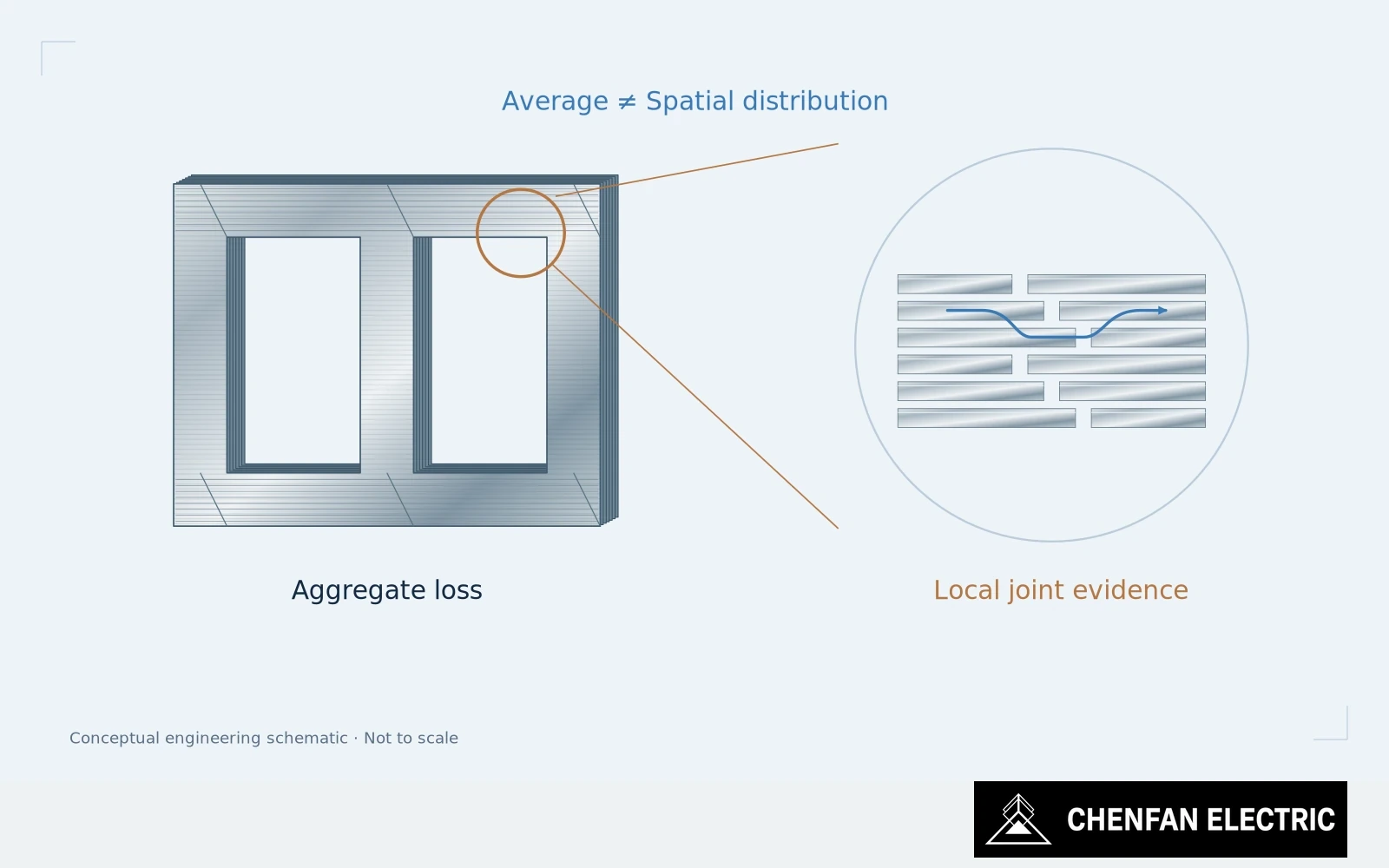
Separate material averages from local flux conditions
Material W/kg describes a specimen under defined magnetic conditions. A finished core contains regions with different local flux paths and mechanical states. Straight rolling-direction paths and a T-joint are not magnetically identical pieces of steel merely because they came from the same coil.
At joints, flux can redistribute between sheets and change direction. Around a local restriction, induction can concentrate. Near a damaged interface, an unintended current path may create a thermal signature. The importance of each mechanism depends on the actual construction; none should be assigned a fixed share of loss without evidence.
The total wattmeter reading integrates what the test boundary contains. A small high-loss region may contribute too little to change the average dramatically while still indicating a condition worth investigating. Conversely, a modestly higher average does not prove the existence of one dangerous hotspot.
Use local measurements within their own limits
This is where local measurements complement, rather than replace, total loss measurement. Search-coil measurements can investigate local flux. Suitable thermal techniques can help locate abnormal heating. Both require a defined method and interpretation appropriate to the specimen.
Do not read steady surface temperature as a direct map of local W/kg. Cooling, contact, thermal conduction, emissivity and the time after energization affect the image. JFE’s local-loss work uses a controlled thermal method; a workshop thermal photograph is not automatically the same measurement.
For production quality, use the information to target inspection. A repeatable indication near one joint should lead to checks of that region’s sequence, alignment and interfaces. Randomly tightening the whole core may change several conditions while leaving the original explanation uncertain.
Connect global acceptance with targeted inspection
The purchasing implication is not that every core needs research-laboratory instrumentation. It is that the acceptance plan should include escalation when local evidence and an acceptable average disagree. The appropriate escalation can be agreed during qualification.
Keep both views in the file: the global performance quantity required by the contract and the localized evidence used to investigate construction quality. Neither should be made to answer the other’s question.
An average is valuable for energy accounting. It is incomplete evidence for deciding where a magnetic assembly is behaving differently from its intended design.
Practical takeaway
An acceptable aggregate can coexist with a localized anomaly.
Chenfan Electric manufactures custom transformer cores according to customer drawings. Where applicable to the specified material and core design, agreed process controls include burr height below 0.02 mm and stacking factor above 97%. Measurement methods and acceptance conditions are defined for each order.