

Supplier A reports fewer watts than Supplier B.
Before ranking them, put the test conditions on the same line.
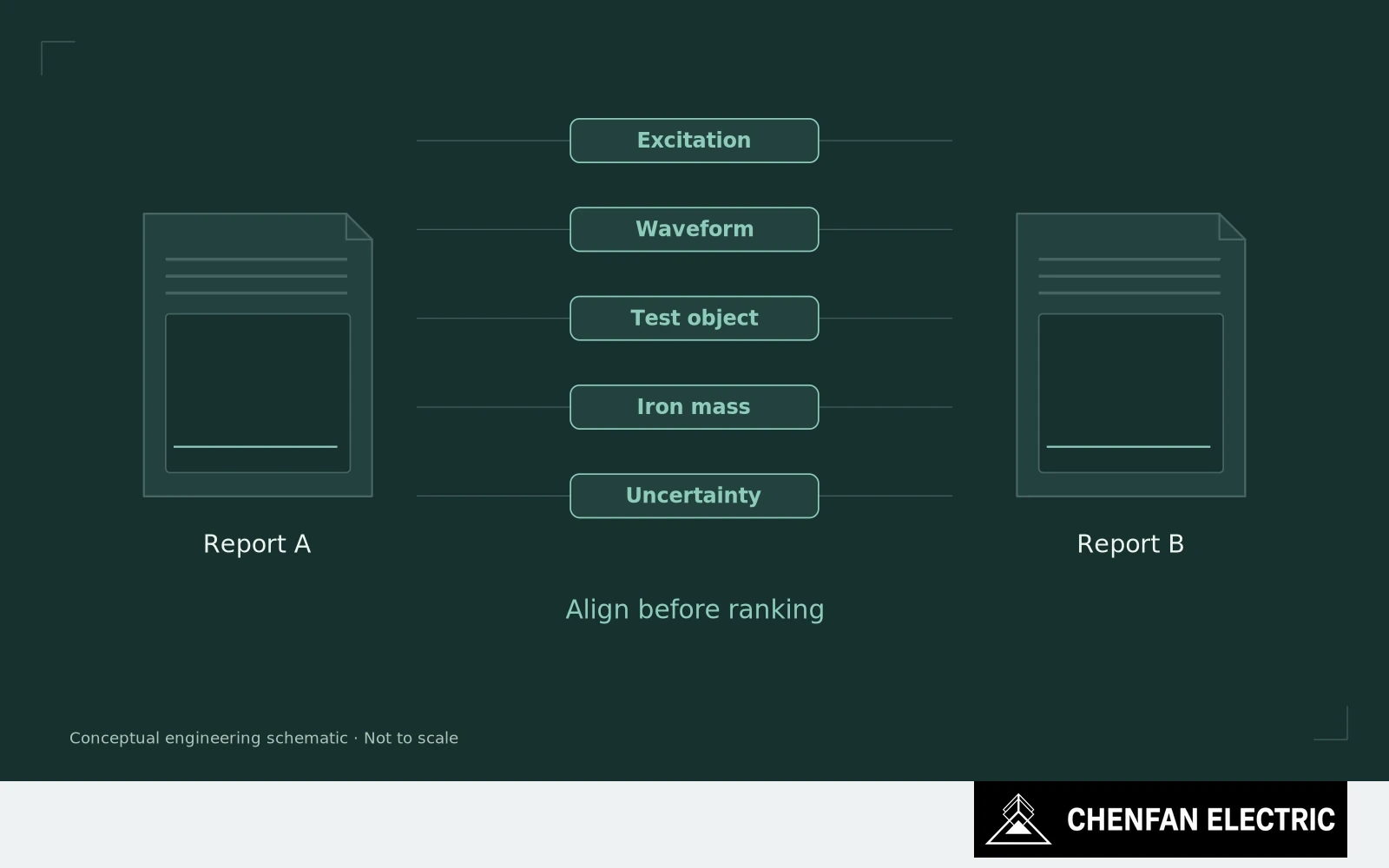
Align excitation, waveform and test object
Start with frequency and flux density. The loss of the same steel changes with both. A result at a lower induction is not evidence of better manufacturing at your operating point. For a core test, the claimed induction also depends on the winding, voltage method and effective area used to establish it.
Waveform belongs on that line as well. Two supplies can have the same displayed RMS voltage and different waveforms. For no-load testing, the applicable procedure may use an average-sensing voltage measurement and a waveform correction. Do not substitute a generic RMS match for the specified method.
Next identify the object being measured. Is the number from a material specimen, a closed core with temporary windings, or a completed transformer? Does it include the fixture, winding resistance loss, instrument burden or auxiliary devices? A lower total may simply contain fewer contributors.
Check mass and temperature conventions
Mass normalization can create another false comparison. W/kg is meaningful only when the mass boundary is clear. Including clamps or supports in one denominator can make its specific result look better without reducing measured power. For mixed materials or different regions, state how the reference estimate was assembled.
Temperature should be recorded, and any correction should follow the agreed procedure. A correction intended for winding load loss must not be applied indiscriminately to no-load core loss. Different physical contributions do not share one universal temperature law.
Finally, assess uncertainty. Small differences may not be resolvable by the two measurement systems, especially when the systems have different phase-error performance at low power factor. The meter’s headline accuracy is not the uncertainty of the complete test circuit.
Account for uncertainty before ranking results
A useful comparison sheet therefore contains the raw result and the defined conditions, followed by only those corrections that are justified. Keep the original numbers visible so that a reviewer can reproduce the comparison.
Where conditions cannot be aligned reliably, request a common test or treat the data as separate evidence. Forcing a normalization with assumed exponents and guessed correction factors can create more confidence than information.
The supplier with the lower reported number may indeed have the better result. Establish that both numbers answer the same question before making them compete.
Practical takeaway
Lower watts may reflect a different excitation or measurement boundary.
Chenfan Electric manufactures custom transformer cores according to customer drawings. Where applicable to the specified material and core design, agreed process controls include burr height below 0.02 mm and stacking factor above 97%. Measurement methods and acceptance conditions are defined for each order.