

FAT has found excessive no-load loss.
The investigation needs evidence, not a contest between steel and core certificates.
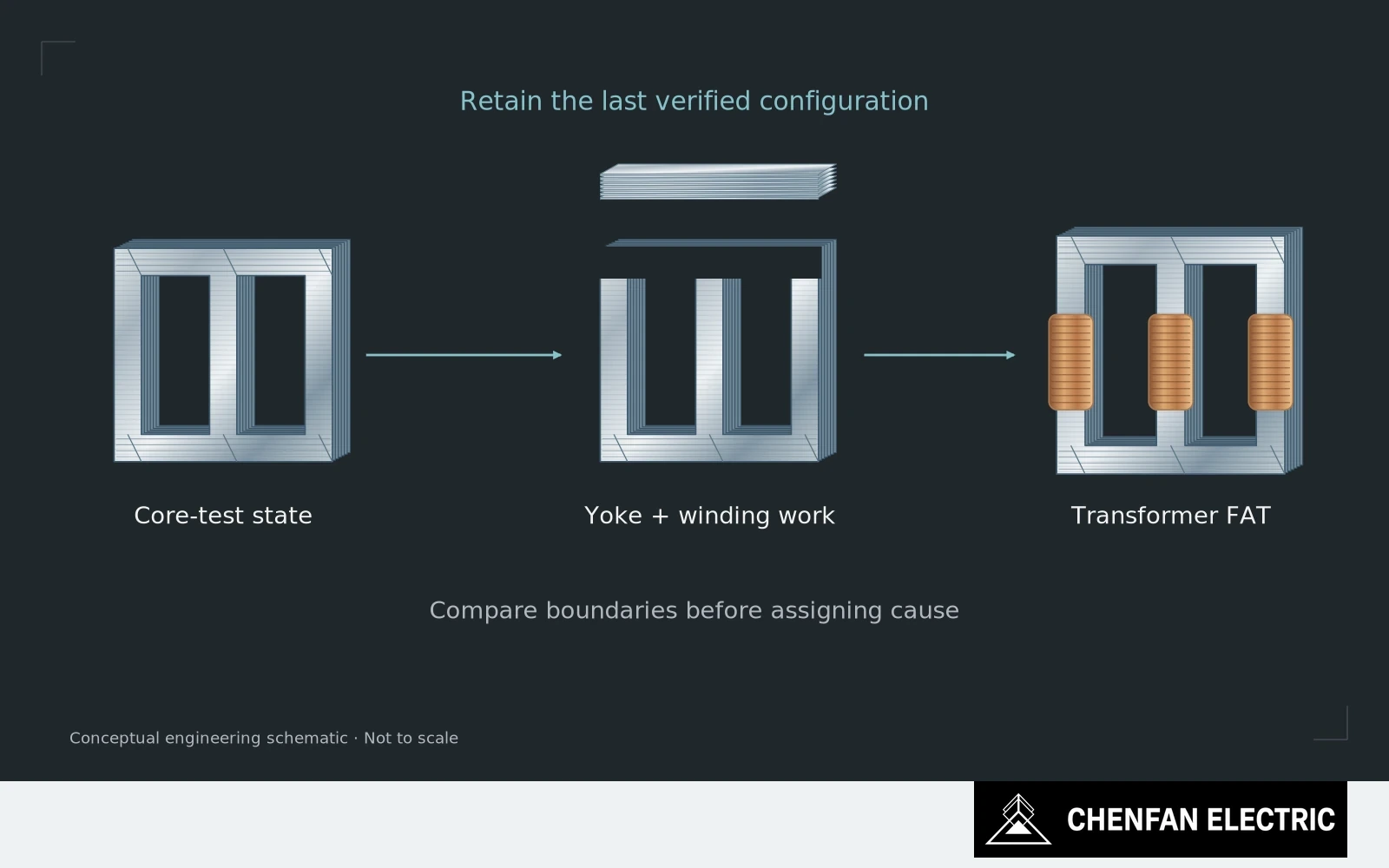
Freeze the final test and verify the design
Freeze the as-tested configuration and retain the raw data. Confirm the winding connection, tap, frequency, applied voltage basis, supply waveform and temperature. Check the calibration and corrections required by the applicable test method. A completed-transformer result must be interpreted on its own defined boundary.
Then compare the final build with the design used for the loss prediction. Verify turns, effective iron area and the approved material allocation. If the volts per turn or iron area differs, the operating induction may differ even though the transformer carries the intended nameplate rating.
Next locate the last known conforming state. Was there a finished-core test? Was it before top-yoke removal, turning or winding installation? A lower earlier result is informative only after allowing for the different test winding, fixture and measurement scope. It is not automatically the final transformer’s expected loss.
Separate material, manufacture and integration
Build separate hypotheses for material, core manufacture and integration. Material evidence includes traceable coils and comparable retained-sample measurements. Manufacturing evidence includes joint sequence, edge condition and alignment. Integration evidence includes reassembly, clamp changes, core insulation and unintended conductive connections.
Keep other contributors visible. The energized transformer contains windings, structural parts and an insulation system that are absent from a bare material test. The relative contribution of those elements must be assessed rather than assuming that every additional watt is intrinsic steel loss.
Choose the next investigation by its ability to discriminate. A repeat test can challenge a measurement hypothesis. An approved localized inspection can challenge a suspected assembly condition. A comparable sample test can challenge a material hypothesis. Several simultaneous repairs may remove the symptom without identifying the cause.
Test the explanation before closing the investigation
Document predictions before intervention. What result should change, in which direction, and what observation would contradict the proposed explanation? That prevents a successful retest from being used to justify whichever story was preferred beforehand.
Release and root-cause closure are separate decisions. A corrected transformer may meet the contract while the supplier-control issue still needs action on related orders.
The useful FAT investigation connects the failed measurement to a verified change in design, material, process or test. It should leave the next transformer less dependent on guesswork.
Practical takeaway
Component certificates cannot resolve a system-level failure without a chronology and evidence map.
Chenfan Electric manufactures custom transformer cores according to customer drawings. Where applicable to the specified material and core design, agreed process controls include burr height below 0.02 mm and stacking factor above 97%. Measurement methods and acceptance conditions are defined for each order.