

A loaded tertiary participates in the magnetic balance as well as terminal power balance. Its current can alter the high-side current and common-section current needed for the same low-side load. A two-port transformed-power fraction no longer captures that duty.
Define an ideal single-phase circuit with common turns NC, series turns NS and tertiary turns NT. Let IH enter the high terminal, IL leave the low terminal, and IT enter the tertiary’s dotted terminal. Choose winding polarities so that NSIH + NCIC + NTIT = 0, with IC = IH − IL.
Derive the internal map
Combining the equations gives IH = (NCIL − NTIT)/(NC + NS), and IC = IH − IL. These are phasor equations. The series current is IH. They apply only to this defined topology and polarity.
Use illustrative turn counts NC = 80, NS = 20 and NT = 10, with corresponding ideal voltages 80, 100 and 10 kV. Hold IL = 100∠0° A. Let tertiary current be aligned or opposed according to power direction.
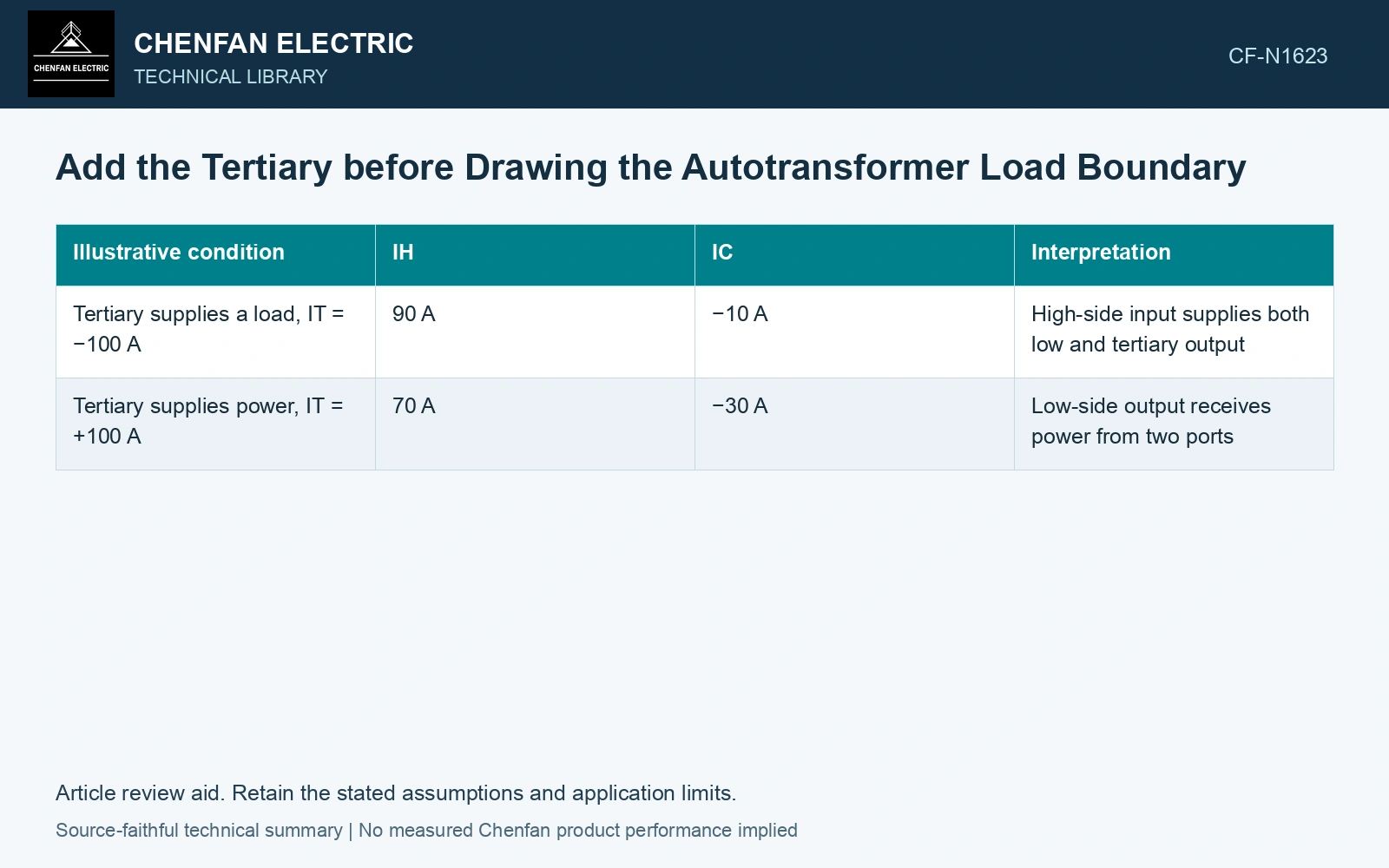
| Illustrative condition | IH | IC | Interpretation |
|---|---|---|---|
| Tertiary supplies a load, IT = −100 A | 90 A | −10 A | High-side input supplies both low and tertiary output |
| Tertiary supplies power, IT = +100 A | 70 A | −30 A | Low-side output receives power from two ports |
With an illustrative common-section limit of 25 A, the second condition fails that internal limit while the first passes. The example’s external duties are no more than 9 MVA at H, 8 MVA at L and 1 MVA at T. Those port values alone do not reveal the common-section overload. This is a hypothetical limit demonstration, not a rating statement. All numerical inputs and limits in the illustrative cases are assumptions unless a catalogue or standard source is explicitly identified.
Draw a feasible region from winding limits
Apply constraints to the mapped currents: |IH| ≤ IS,limit, |IC| ≤ IC,limit and |IT| ≤ IT,limit. Add the relevant external, insulation and thermal constraints. For complex currents, the boundary depends on power factors and relative phase as well as active power.
Repeat at the actual taps because turns and permitted currents can change. Specify temperature and cooling state with every continuous capability map.
Check terminal complex-power closure using the same voltage and current references. A mismatch can reveal a polarity error before it reaches the thermal assessment.
Express the permitted operating region as simultaneous port conditions constrained by the internal currents, losses and other verified duties. Three independent terminal MVA limits cannot describe a boundary that changes with combined loading.
Set the permitted tertiary-current interval
The stated 100:80:10 connection and all numerical duties are assumptions at 50 Hz. For IL = 100 A and a real, signed IT, the map reduces to IC = −20 − 0.1IT A. An assumed common-section limit of 25 A requires −25 ≤ −20 − 0.1IT ≤ 25, giving −450 ≤ IT ≤ 50 A before other limits. Thus +100 A tertiary input fails, whereas −100 A output passes this one constraint. Intersect this interval with series, tertiary, dielectric and cooling limits; it is a one-dimensional slice, not a full nameplate capability. Record rated quantities and test conditions on the general power-transformer basis of IEC 60076-1 [1]. Assess the relevant measured quantities with a defined measurement model and propagated uncertainty [2]. Keep connection, tapping and network assumptions explicit in the application assessment [3].
References
- IEC, IEC 60076-1:2011, Power transformers – Part 1: General.
- JCGM, JCGM 100:2008, Evaluation of measurement data — Guide to the expression of uncertainty in measurement, 2008.
- IEC, IEC 60076-8:1997, Power transformers – Part 8: Application guide, 1997, official public scope.