

A connection that produces a desired voltage ratio does not necessarily preserve the autotransformer’s original capacity. Connected turns, section currents, insulation potentials and fault behavior can all change. Emergency use does not remove those dependencies.
Start with verified design information and an equipment-specific engineering proposal. A feasible ratio is only the first check; conductor, cooling, fault and dielectric duties must be reassessed on the proposed connection.
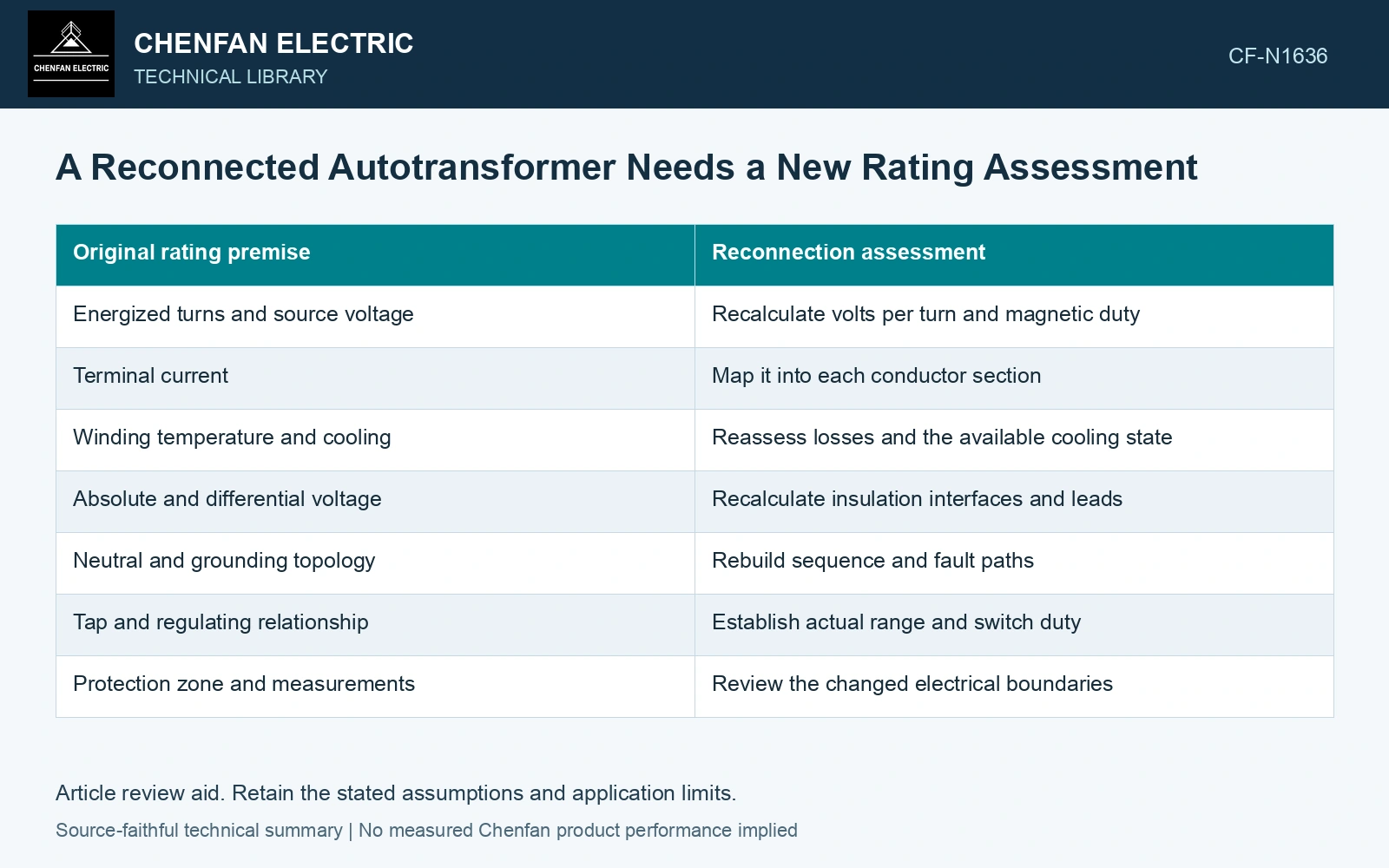
Rebuild the rating premises
| Original rating premise | Reconnection assessment |
|---|---|
| Energized turns and source voltage | Recalculate volts per turn and magnetic duty |
| Terminal current | Map it into each conductor section |
| Winding temperature and cooling | Reassess losses and the available cooling state |
| Absolute and differential voltage | Recalculate insulation interfaces and leads |
| Neutral and grounding topology | Rebuild sequence and fault paths |
| Tap and regulating relationship | Establish actual range and switch duty |
| Protection zone and measurements | Review the changed electrical boundaries |
For the ideal step-down two-port connection with 0 < VL/VH < 1, transformed duty is the through-duty multiplied by 1 − VL/VH. A changed ratio therefore changes the winding-duty fraction. Holding the original through-MVA while increasing that fraction can increase section duty beyond its original premise.
This algebra is a screening check, not a complete rating calculation. A tertiary, auxiliary regulator or different tapped section can require another model.
Reject invalid equivalence early
Do not treat a shared common winding as two isolated windings merely because a proposed diagram redraws the terminals. The physical electrical continuity and insulation system remain. An equivalence used for system calculation must preserve the relevant connections and ratings.
Likewise, a terminal no longer carrying normal load can remain energized internally. Its bushing, leads and clearances still need assessment in the proposed state.
Use actual conductor sections when mapping current. A tapped connection can place current through a portion whose area or lead arrangement differs from the original full-winding path. The original terminal current rating cannot be assigned to it without evidence. Assess the relevant measured quantities with a defined measurement model and propagated uncertainty [1].
Separate analytical feasibility from authorization
A calculated feasible voltage relationship is one input to a modification review. Mechanical arrangement, insulation qualification, manufacturing access, testing and system coordination remain part of the equipment-specific decision.
Record unresolved information as a limit. If the internal tap structure is unknown, a terminal ratio test cannot fill every missing conductor and insulation detail.
Identify which original ratings remain supported, which need recalculation and which remain unverified. Reconnection requires an approved equipment-specific engineering basis; the ideal ratio example does not establish a field procedure or a new nameplate rating. Keep connection, tapping and network assumptions explicit in the application assessment [2].
Screen the transformed-duty increase after reconnection
Assume an ideal single-phase 10 MVA transfer at 50 Hz, without tertiary load. Changing VL/VH from 0.80 to 0.70 changes transformed duty from (1 − 0.80)×10 = 2.0 MVA to 3.0 MVA. That is a 50% increase despite unchanged terminal MVA. If an assumed winding-duty ceiling remains 2.0 MVA, the new transfer screening ceiling is 2.0/(1 − 0.70) = 6.67 MVA. Use that result to flag the proposal for a new conductor, dielectric and cooling assessment; it does not itself establish a revised equipment rating [3]. Record rated quantities and test conditions on the general power-transformer basis of IEC 60076-1 [3].
References
- JCGM, JCGM 100:2008, Evaluation of measurement data — Guide to the expression of uncertainty in measurement, 2008.
- IEC, IEC 60076-8:1997, Power transformers – Part 8: Application guide, 1997, official public scope.
- IEC, IEC 60076-1:2011, Power transformers – Part 1: General.