

An external load disconnected from a delta tertiary removes one use of that winding. It does not open the internal delta loop. Components driven by magnetic excitation or unbalanced system conditions may still circulate within it.
Define the tertiary connection and its accessible terminals. Distinguish winding branch currents from terminal line currents before interpreting a zero external reading.
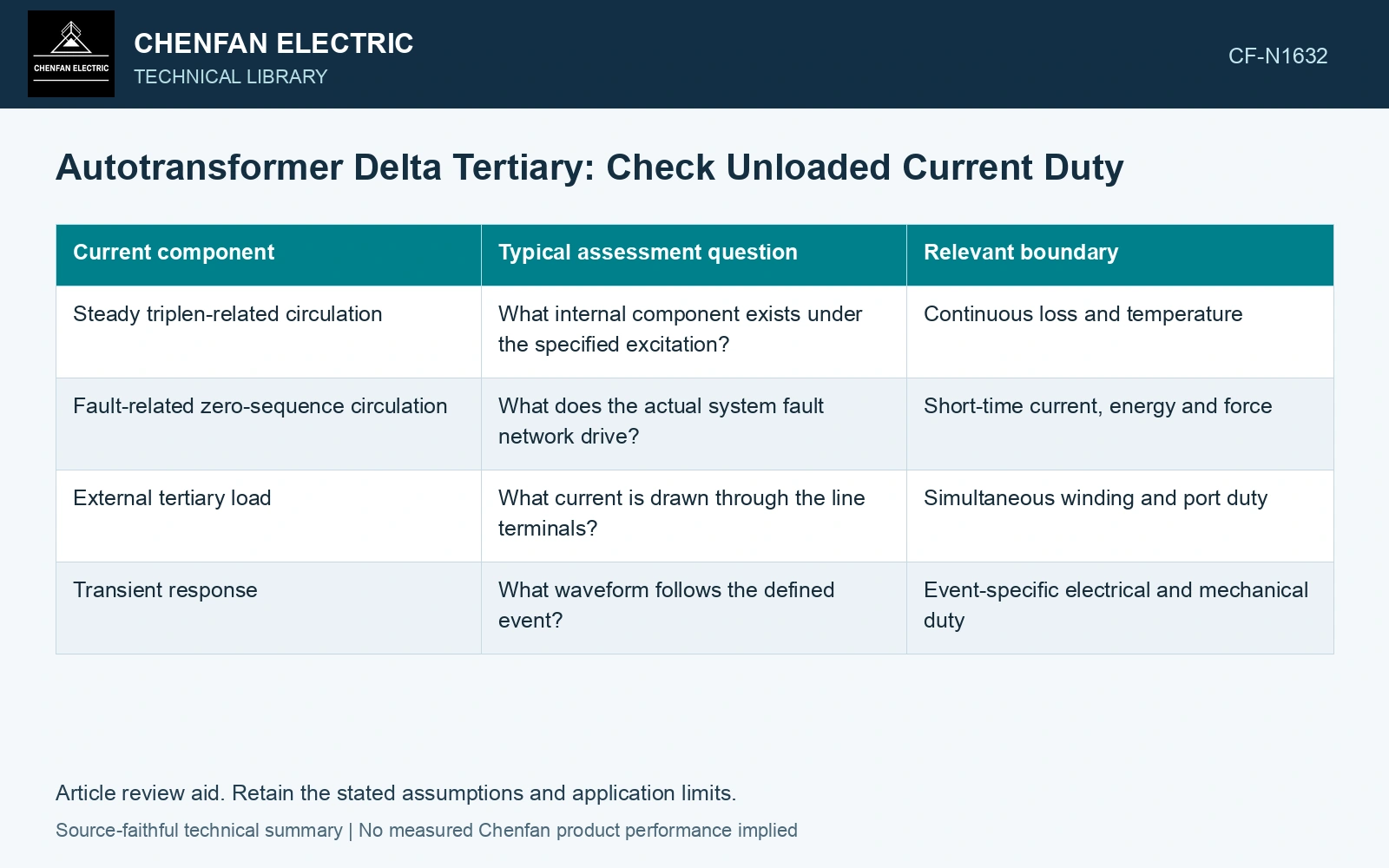
Separate the current tasks
| Current component | Typical assessment question | Relevant boundary |
|---|---|---|
| Steady triplen-related circulation | What internal component exists under the specified excitation? | Continuous loss and temperature |
| Fault-related zero-sequence circulation | What does the actual system fault network drive? | Short-time current, energy and force |
| External tertiary load | What current is drawn through the line terminals? | Simultaneous winding and port duty |
| Transient response | What waveform follows the defined event? | Event-specific electrical and mechanical duty |
The categories are not numerically independent in every operating state. Use a model that combines them consistently where simultaneous duty matters. Record rated quantities and test conditions on the general power-transformer basis of IEC 60076-1 [1].
For an ideal equal circulating component in the three delta branches, each line current is the difference of its adjacent branch currents. Equal phasors cancel at the lines while the branch current remains nonzero. Thus an external line-current measurement can miss that particular internal component.
Treat continuous and short-time heating separately
Continuous RMS current and harmonic content contribute to steady losses. Fault-related current may have a different waveform and duration. A short-time withstand statement does not automatically permit the same current continuously.
Calculate or measure branch current using an appropriate qualified method. Do not infer it solely from tertiary terminal MVA, especially when the terminals carry no load. Include frequency-dependent loss behavior where harmonic currents matter. Assess the relevant measured quantities with a defined measurement model and propagated uncertainty [2].
Use the actual grounding and source network for zero-sequence fault duty. The presence of a delta alone does not determine how large the internal current becomes.
Combine duties with a defined method
If steady and fault components occur together, preserve their waveform or spectral relationship. RMS values from unrelated time intervals should not simply be added. Orthogonal frequency components can be combined by squared magnitudes under the relevant stationary assumptions; correlated same-frequency components require phase information. Keep connection, tapping and network assumptions explicit in the application assessment [3].
Check winding and lead force as well as thermal duty where the load case requires it. An externally quiet port can still have internal electromagnetic loading.
The tertiary specification should identify continuous circulation, external load capability and short-time event duty separately. “Unloaded tertiary” is a terminal condition. It is not a complete statement about the conductor current, heating or mechanical demand inside the closed delta.
Quantify a current that terminal meters cannot see
Assume a balanced 150 Hz circulating component of 10 A RMS in every delta branch, corresponding to the third harmonic of a 50 Hz supply. Adjacent equal branch phasors give zero external line current, but an assumed effective branch resistance of 0.20 Ω at 150 Hz and an assumed conductor temperature of 20 °C gives P = 3I²R = 60 W. Doubling that circulation to 20 A increases this loss to 240 W, four times the original value. Specify the frequency-dependent branch current and resistance when reviewing continuous heating; a zero terminal current reading cannot demonstrate zero tertiary loss.
References
- IEC, IEC 60076-1:2011, Power transformers – Part 1: General.
- JCGM, JCGM 100:2008, Evaluation of measurement data — Guide to the expression of uncertainty in measurement, 2008.
- IEC, IEC 60076-8:1997, Power transformers – Part 8: Application guide, 1997, official public scope.