

Interpret a small thermal-test margin with the agreed conformity rule. In the illustration, 64.2 K against a 65 K limit leaves 0.8 K nominal margin, while 1.4 K expanded uncertainty materially affects that comparison. [1]
The limit in this example is chosen for illustration, not taken from an unaccessed standard clause. Whether the result is accepted depends on the applicable test requirements and the decision rule agreed for reporting conformity.
Build the budget for the reported rise
Define the measurand first: which component temperature, which ambient reference and which reference time? Include the effects that influence that defined result. Resistance conversion, shutdown extrapolation, ambient placement, calibration and acquisition timing can belong to different parts of the chain.
Correct recognized significant systematic effects where the method supports doing so, then estimate the remaining uncertainty of those corrections. Repeating readings reduces neither an unidentified placement bias nor an unverified time-origin offset automatically.
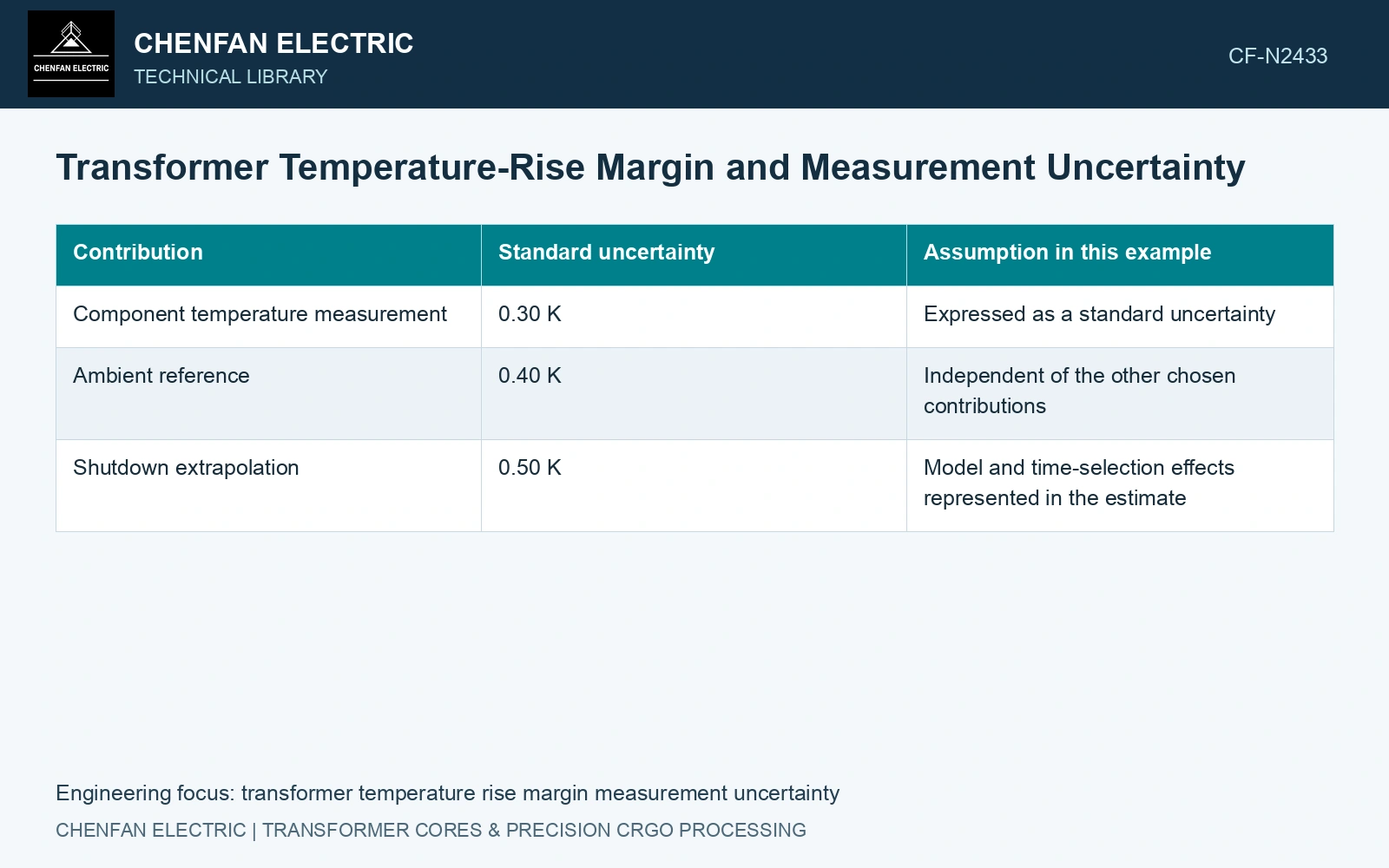
| Contribution | Standard uncertainty | Assumption in this example |
|---|---|---|
| Component temperature measurement | 0.30 K | Expressed as a standard uncertainty |
| Ambient reference | 0.40 K | Independent of the other chosen contributions |
| Shutdown extrapolation | 0.50 K | Model and time-selection effects represented in the estimate |
For these chosen independent inputs, uc = √(0.30² + 0.40² + 0.50²) =0.707K. With an illustrative coverage factor of2, U =1.414K. The interval64.2±1.414K extends from62.786K to65.614K and crosses the example limit.
Apply the agreed conformity decision rule
A factor of2 corresponds to a commonly used coverage level only under appropriate distribution and uncertainty-estimation conditions. Report the factor and the supporting assumptions. Do not label every doubled budget an unconditional95% confidence interval.
The parties may have agreed to evaluate the reported value, to apply a specified guard band or to use another documented rule. These approaches can yield different conformity statements near a limit. The rule should be identified before interpreting the result; it should not be selected afterwards to produce a preferred outcome.
Keep the actual temperature-rise measurand and method [2] distinct from the contractual conformity decision. The method’s standard identity does not supply the assumed 65 K criterion or authorize a decision rule not established for this test.
Apply the chosen rule to the unrounded interval
Under an assumed rule accepting a reported rise ≤65 K, 64.2 K meets the numerical criterion. Under a different assumed rule requiring y + U ≤65 K, the unrounded upper value 65.6142 K does not meet it. This contrast uses the same measurement and budget; declare the governing rule before testing rather than selecting between them after seeing the margin.
References
- B. N. Taylor and C. E. Kuyatt, NIST Technical Note 1297, Guidelines for Evaluating and Expressing the Uncertainty of NIST Measurement Results, 1994, sections 5 and 6.
- IEC, IEC 60076-2:2011, Power transformers — Part 2: Temperature rise for liquid-immersed transformers.