

Define the oil-temperature quantity before averaging channels. Inventory temperature, mixed-stream temperature and a prescribed heat-run reference use different regions and weights, especially in a stratified tank. [1]
Stratification makes this distinction consequential. A bulk inventory average concerns oil stored throughout the equipment. A cooling-stream average concerns oil moving through an interface. A temperature-rise procedure may define another specific quantity for its calculations.
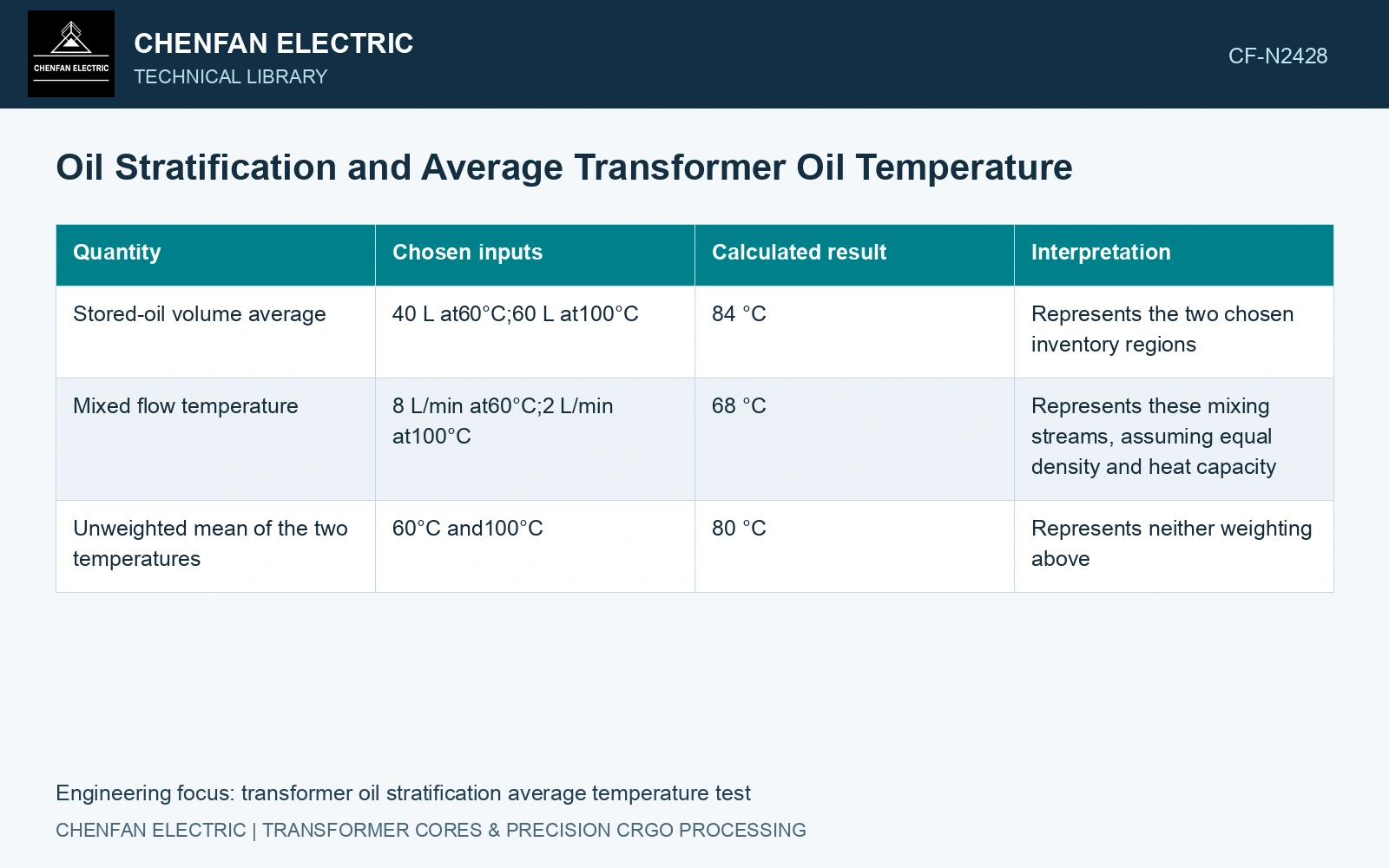
Choose the weighting that matches the physical question
For discrete regions, a volume-weighted temperature is Σ(ViTi)/ΣVi. If density varies materially, mass weighting is a different calculation. Stored thermal energy requires the relevant mass and heat-capacity behavior, not temperature averaging alone.
For streams that mix at a common outlet, an enthalpy balance determines the mixed temperature when losses and phase changes are negligible. It reduces to mass-flow and heat-capacity weighting where the relevant heat capacities can be treated as constant. With approximately equal density and heat capacity, volume-flow weighting reduces to Σ(qiTi)/Σqi. That simplifying assumption must be recorded.
| Quantity | Chosen inputs | Calculated result | Interpretation |
|---|---|---|---|
| Stored-oil volume average | 40 L at60°C;60 L at100°C | 84 °C | Represents the two chosen inventory regions |
| Mixed flow temperature | 8 L/min at60°C;2 L/min at100°C | 68 °C | Represents these mixing streams, assuming equal density and heat capacity |
| Unweighted mean of the two temperatures | 60°C and100°C | 80 °C | Represents neither weighting above |
The inventory and flow inputs in this example are independently chosen to show the definitions. They are not measurements from one transformer. Calling all three numbers “average oil temperature” would hide the reason they differ.
Map each probe to the region or stream it samples
Record height, oil-circuit location, immersion and the relation to inlet, outlet or mixing regions. A top pocket can follow hot oil in a local path rather than a representative volume of the entire tank. A cooler outlet probe may provide a useful heat-transfer boundary while saying little about a stagnant interior region.
Check that the weighting inputs exist. A flow-weighted calculation needs credible flow measurements or a justified distribution model. Adding more temperature probes does not supply missing flow information. A volume-weighted calculation needs an appropriate region definition and representative temperatures within each region.
Use the energy balance, rather than a sensor count, to choose a mixed-stream quantity [2]. The heat-run method [1] remains the basis for its specified oil reference; an independently defined inventory average cannot silently replace it.
Use the average belonging to the decision
The chosen inventory gives (40×60+60×100)/100 = 84 °C, while the independent equal-property stream example gives (8×60+2×100)/10 = 68 °C. Their 16 K difference follows from different weights. Retain each definition and use the prescribed heat-run oil quantity for qualification rather than substituting either diagnostic average.
References
- IEC, IEC 60076-2:2011, Power transformers — Part 2: Temperature rise for liquid-immersed transformers.
- U.S. Department of Energy, DOE-HDBK-1012/2-92, Thermodynamics, Heat Transfer, and Fluid Flow, Volume 2, 1992.