

Anchor the resistance timeline to physical shutdown. A software arming event can occur later than de-energization; using it as the origin mislabels the elapsed cooling time. [1]
A hot-winding temperature estimate needs a defined physical zero time. Operator command, breaker operation, disappearance of heating current, connection change and first valid resistance sample are separate events. Naming all of them “test start” creates an avoidable ambiguity.
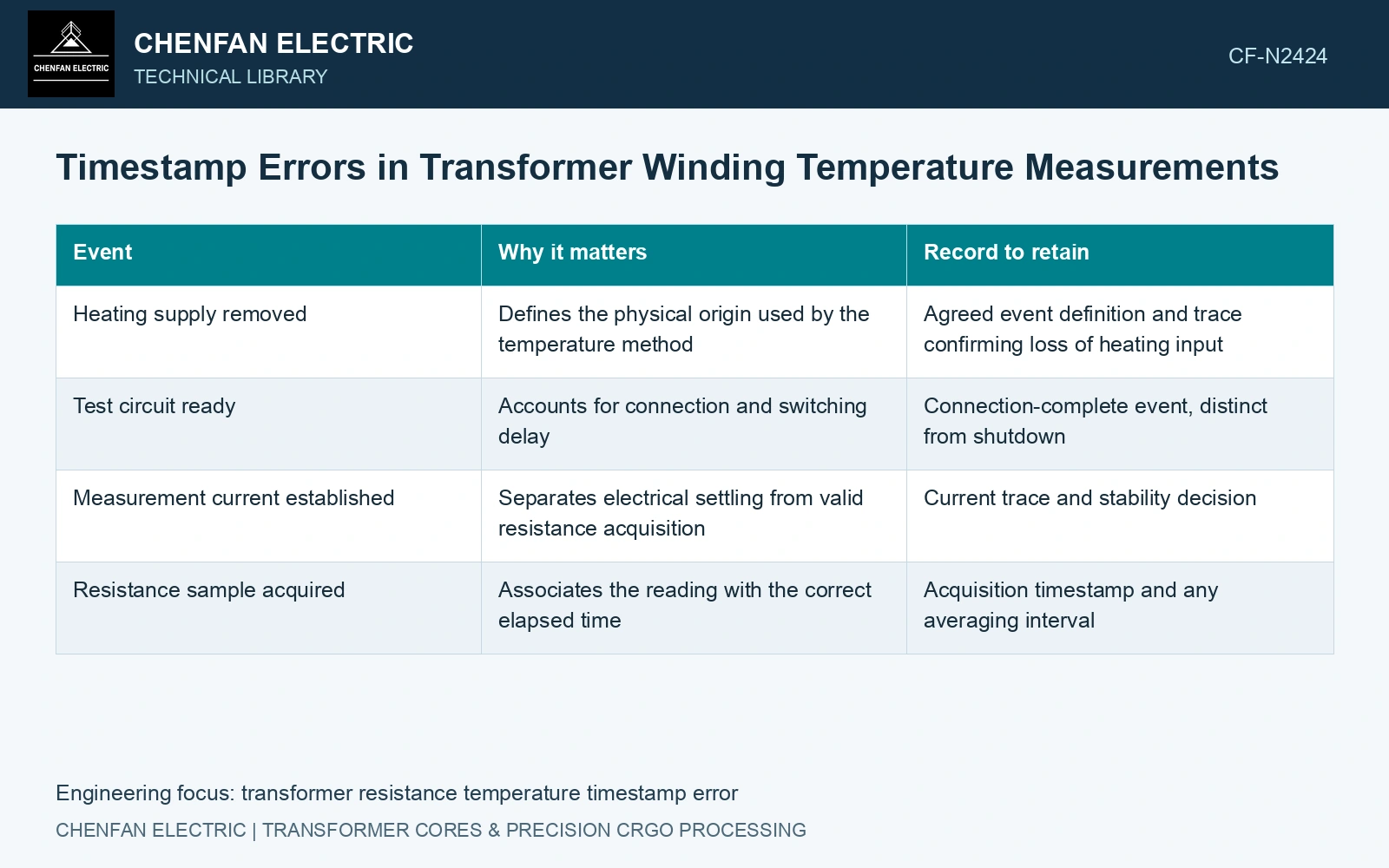
Build the timeline from the shutdown event
| Event | Why it matters | Record to retain |
|---|---|---|
| Heating supply removed | Defines the physical origin used by the temperature method | Agreed event definition and trace confirming loss of heating input |
| Test circuit ready | Accounts for connection and switching delay | Connection-complete event, distinct from shutdown |
| Measurement current established | Separates electrical settling from valid resistance acquisition | Current trace and stability decision |
| Resistance sample acquired | Associates the reading with the correct elapsed time | Acquisition timestamp and any averaging interval |
A file creation time or screen update time is not necessarily the acquisition time. For an averaged reading, document whether the assigned timestamp refers to the start, center or end of the averaging interval. The choice matters more where the resistance changes rapidly.
Convert a timing offset into a temperature effect
Assume a near-origin cooling slope dR/dt = −0.00010 Ω/s over the comparison interval. If the adopted zero is 15 s later than true shutdown, linear extrapolation to that adopted origin estimates a resistance 0.00150 Ω lower than the true zero-time value.
Using the illustrative conversion T = (R/Rcold)(k + Tcold) − k, with Rcold = 1.000 Ω, Tcold = 20 °C and k = 234.5 °C, the temperature bias is 254.5 × (−0.00150) = −0.38175 °C. These chosen values demonstrate sensitivity; they are not a universal cooling rate or conductor temperature basis.
The opposite origin offset reverses the sign. An uncertain offset also contributes uncertainty rather than a known correction. For approximately independent small timing and slope uncertainties, their effects can be propagated through the selected model; correlated acquisition and fitting effects require their covariance to be considered.
A demonstrated time-origin offset requires correction before residual timing uncertainty is propagated [2]. Shared acquisition clocks, averaging and fitted slope can correlate; a small repeatability estimate does not remove their common origin error.
Recalculate the time-origin bias with the copper basis
Using the handbook copper constant 234.5 °C [1], assumed 20 °C cold reference, 1.000 Ω cold resistance and −0.00010 Ω/s cooling slope, a +15 s origin shift changes the inferred shutdown temperature by −0.38175 K. Correct a demonstrated offset and rerun the fit; an unresolved origin offset belongs in the uncertainty budget.
References
- U.S. Bureau of Reclamation, FIST Volume 3-31, Transformer Diagnostics, June 2003.
- B. N. Taylor and C. E. Kuyatt, NIST Technical Note 1297, Guidelines for Evaluating and Expressing the Uncertainty of NIST Measurement Results, 1994, sections 5 and 6.