

Treat an oil-pump trip as a changed hydraulic boundary. USBR’s maintenance guidance calls for checking pump operation and flow [1]. Record the affected circuit and local temperatures through trip and restart; a remote probe can lag the changed circulation.
The review should start with the actual cooling event and the test procedure. A trip duration alone cannot decide validity. The affected circuit, heating duty, initial temperatures and recovery behavior determine which observations still represent the intended cooling condition.
Record the cooling change as a test event
Identify the pump and oil circuit involved, its operating indication, the trip and restart times, and any supporting flow or pressure measurements. A motor command is not proof of oil circulation. Record whether heating remained applied and whether other pumps, fans or controls changed state during the interruption.
Distinguish loss of a redundant parallel unit from loss of the only pump supplying a directed cooling path. They cannot be assigned the same thermal meaning simply because the recorded outage lasted the same number of seconds.
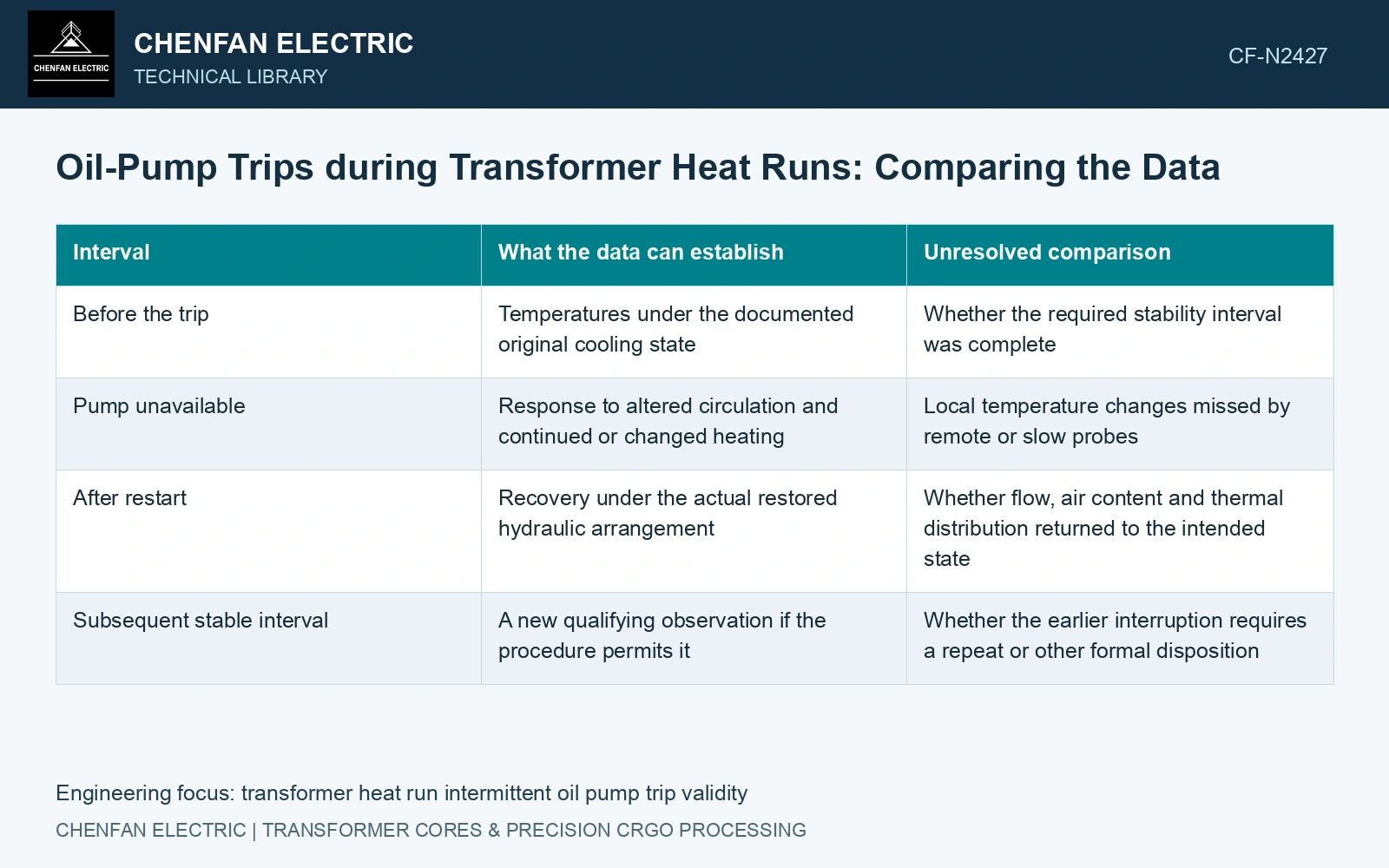
| Interval | What the data can establish | Unresolved comparison |
|---|---|---|
| Before the trip | Temperatures under the documented original cooling state | Whether the required stability interval was complete |
| Pump unavailable | Response to altered circulation and continued or changed heating | Local temperature changes missed by remote or slow probes |
| After restart | Recovery under the actual restored hydraulic arrangement | Whether flow, air content and thermal distribution returned to the intended state |
| Subsequent stable interval | A new qualifying observation if the procedure permits it | Whether the earlier interruption requires a repeat or other formal disposition |
Keep each cooling history intact
A recovered top-oil reading does not prove that every winding region has recovered its former temperature distribution. Check relevant winding or local sensors, cooling inlet and outlet readings, and the applied-loss history. Preserve the interruption in plots; removing the segment can make a continuous stability interval appear to exist when it did not.
Likewise, a brief local maximum during reduced circulation may be useful diagnostic evidence without representing the specified steady cooling duty. Its purpose and test condition should be stated separately from the reported qualification result.
Resolve test disposition under the governing temperature-rise method [2] and the approved cooling-fault plan. Confirm actual circulation using the installed pump and flow evidence [1] before assigning a post-restart interval to the intended cooling state.
Compare a pump-loss interval with stored heat
Assume that, relative to the intact-cooling trajectory, heat removal from a local lumped region is 5 kW lower throughout a 120 s interval, with identical generation and other heat transfers. Its extra stored energy is 600 kJ; at an assumed constant 300 kJ/K effective capacity, it is 2 K warmer. This conditional comparison does not predict actual recovery. Review flow and local traces; adding 120 s to the run does not restore the former state automatically.
Resolve validity through the procedure and the recovered state
Follow the approved response to cooling faults and applicable equipment limits. Have the acceptance authority define continuation, evidence of recovered circulation and the stability interval to repeat under the governing procedure.
References
- U.S. Bureau of Reclamation, FIST Volume 3-30, Transformer Maintenance, 2000.
- IEC, IEC 60076-2:2011, Power transformers — Part 2: Temperature rise for liquid-immersed transformers.