

Check stability across the required component channels and their heating and cooling conditions. A faster node can plateau while another region continues to store heat [1]. Apply the governing temperature-rise test definition [2] with enough measurement coverage to interpret those states.
The practical difficulty is deciding whether an apparent plateau represents steady operation, a temporary balance or a change in the test environment. The answer requires the heating input, cooling state and relevant component temperatures to be viewed together.
Separate fast response from long thermal memory
A thermal system contains heat capacities connected by different heat-transfer paths. An exposed part can respond quickly while a region separated by insulation or weak circulation responds more slowly. Some sensor traces also contain their own response delay, which must be distinguished from the equipment’s thermal behavior.
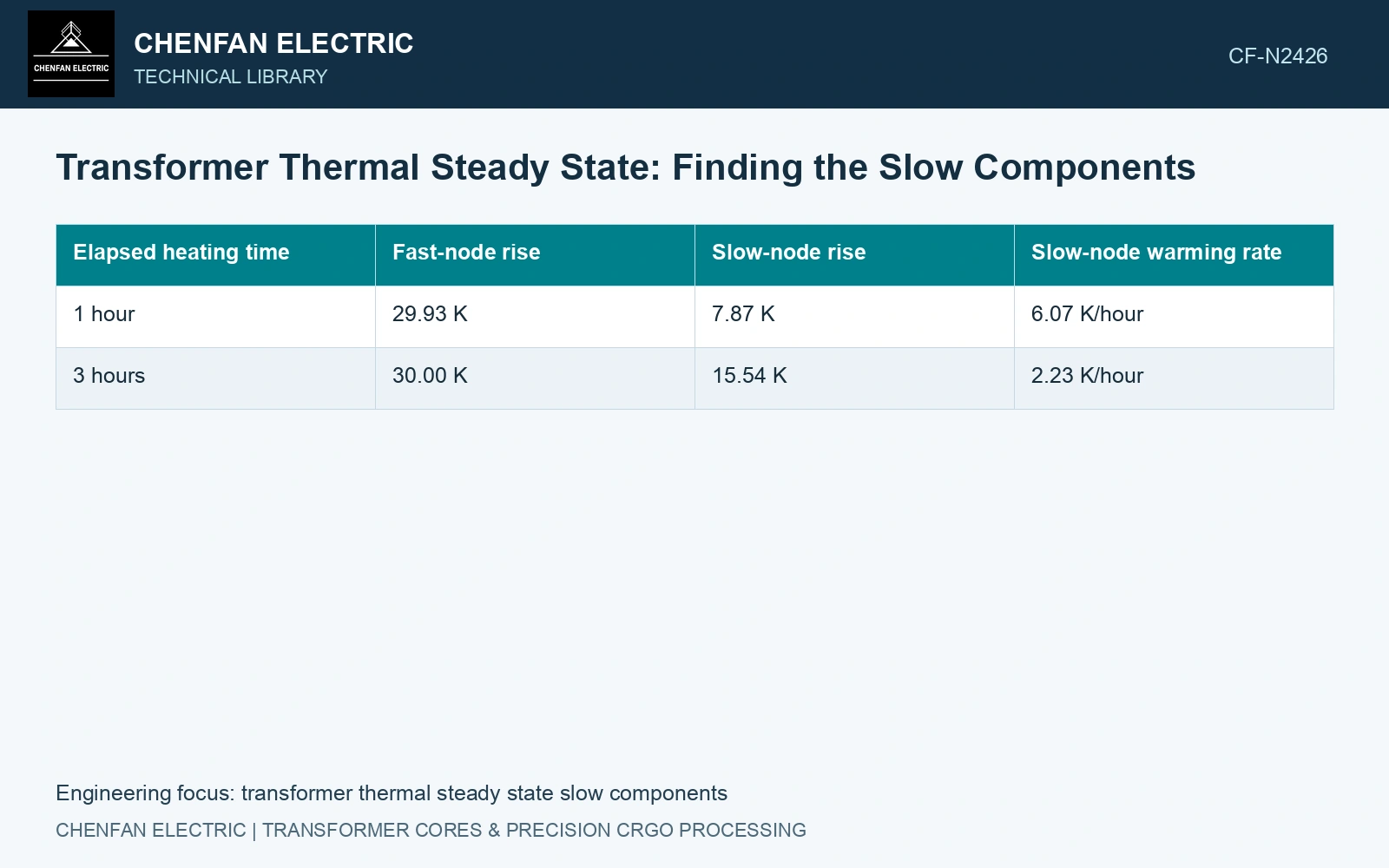
For an illustrative step-heating model, let a fast node rise by 30(1 − e−t/600) K and a slow node by 20(1 − e−t/7200) K. Time is in seconds. The independent expressions illustrate different time constants; they do not identify actual oil, winding or core parameters.
| Elapsed heating time | Fast-node rise | Slow-node rise | Slow-node warming rate |
|---|---|---|---|
| 1 hour | 29.93 K | 7.87 K | 6.07 K/hour |
| 3 hours | 30.00 K | 15.54 K | 2.23 K/hour |
At one hour the fast node is almost at its modeled final rise, while the slow node has accumulated less than half of its eventual rise. Ending the illustration at that point would miss substantial stored heat. No time constant or slope in this example is a prescribed test criterion.
Check whether the plateau is maintained by changing conditions
A falling ambient temperature can offset continuing equipment warming in an absolute-temperature trace. Increasing fan output can create a temporary plateau while a different cooling state is being established. A small drift in applied losses can have the same masking effect.
Plot the relevant ambient channels, input losses, current, voltage and cooling events against the component temperatures. Inspect both absolute temperatures and the rise quantities required by the procedure. A trace held level by changing inputs is not the same observation as a stable response to fixed inputs.
The fast and slow nodes have separate storage and heat-removal paths [1]. Do not infer that an unmeasured insulated region has equilibrated solely because an exposed reference channel is nearly flat.
Check the slow-node rate as well as its rise
For the stated assumed fast/slow model, the slow node rises 7.869 K after 1 h and 15.537 K after 3 h, while still warming at 6.065 and 2.231 K/h respectively. A nearly flat fast node does not close that unobserved slow response. Apply the actual procedure’s stability rule with adequate measurement coverage.
Apply the agreed stability rule to an adequate measurement set
The governing test procedure supplies the stability definition and required channels. An engineering investigation can add channels that test a specific slow-response concern, but it should not replace the contractual criterion with an arbitrary percentage of a fitted final temperature.
References
- U.S. Department of Energy, DOE-HDBK-1012/2-92, Thermodynamics, Heat Transfer, and Fluid Flow, Volume 2, 1992.
- IEC, IEC 60076-2:2011, Power transformers — Part 2: Temperature rise for liquid-immersed transformers.