

Record winding geometry before teardown changes its restraints. Fault forces can damage a support, and later handling can enlarge the resulting displacement; the sequence needs measurements tied to each retained constraint. [1]
Capture geometry before the boundary changes
Document accessible winding and support positions while the original constraints remain. Tie measurements and photographs to fixed references. Record occluded regions rather than guessing their initial alignment from later images.
Identify which supports, spacers or restraints are intact, damaged or already removed. A component can have suffered original damage without developing its final visible displacement until a restraint changes.
Use a staged deformation ledger
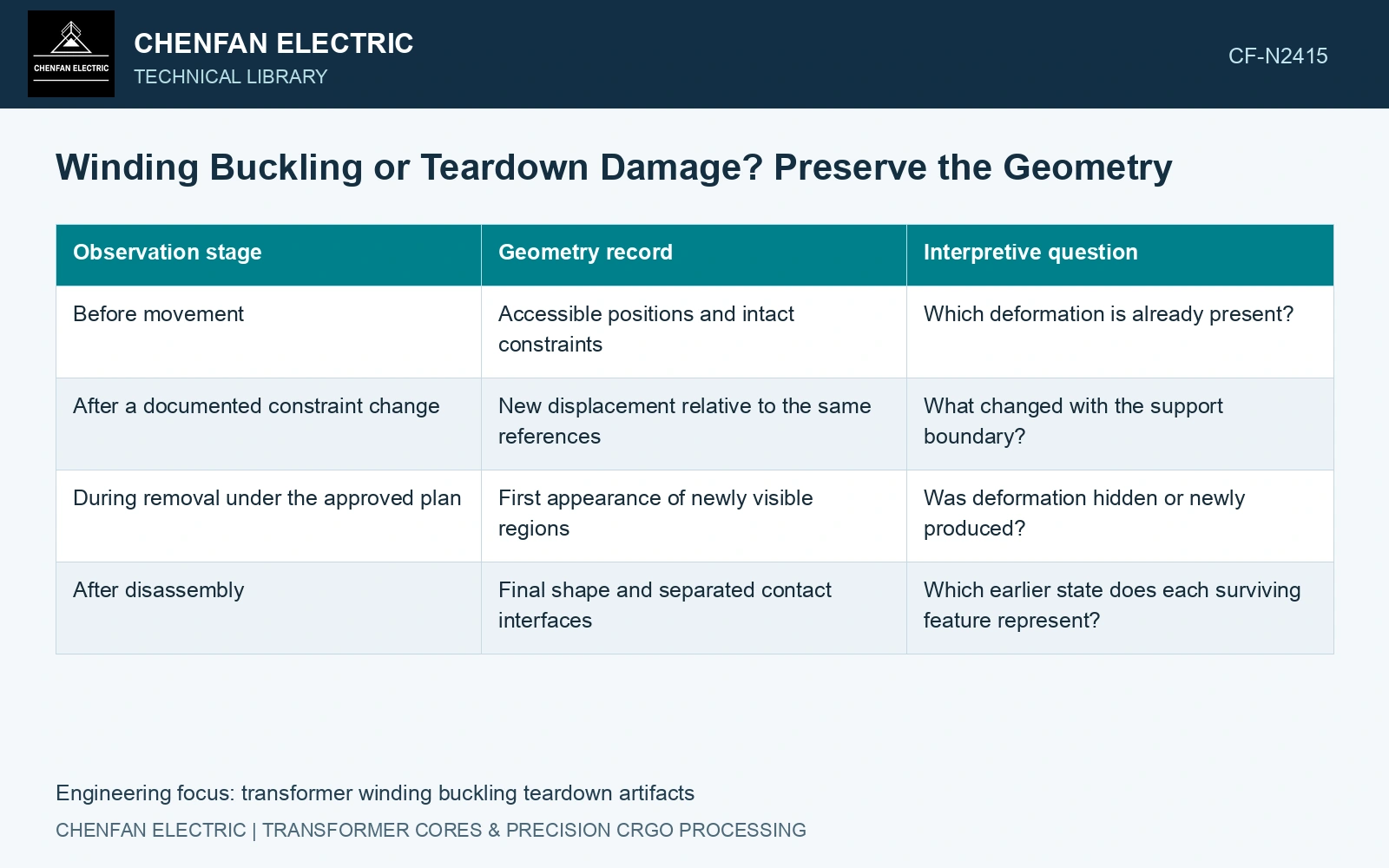
| Observation stage | Geometry record | Interpretive question |
|---|---|---|
| Before movement | Accessible positions and intact constraints | Which deformation is already present? |
| After a documented constraint change | New displacement relative to the same references | What changed with the support boundary? |
| During removal under the approved plan | First appearance of newly visible regions | Was deformation hidden or newly produced? |
| After disassembly | Final shape and separated contact interfaces | Which earlier state does each surviving feature represent? |
Read marks as relationships
Compression imprints, displaced spacers, rubbing and contact marks may constrain a mechanical explanation. Their interpretation depends on the paired surfaces and direction of relative movement. A mark photographed without its counterpart can lose that relationship.
Compare a hypothesis of electromagnetic compression during the fault with one of later handling deformation. Ask whether the original circuit could produce the proposed force direction and whether the surviving constraints would permit the observed mode. Then ask whether the documented handling changes could produce the same pattern.
This comparison does not require inventing a force from the photograph. Where structural calculations are used, their geometry, material state and loads must be independently supported. Post-fault material weakening can change the response during later movement.
Preserve paired surfaces, their orientation and the distinction between original damage and examination-created material; preparation must retain the features needed to test chronology. [2]
Separate restraint release from earlier deformation
Assume winding offset is measured as 2 mm before lifting and 7 mm after one documented support release, using the same datums. The observed increment is 5 mm. Attribute that increment to the changed-boundary interval while retaining the earlier 2 mm as an as-found observation; neither alone dates the original support damage.
Allow a mixed history
The alternatives need not be exclusive. Fault loading may damage a restraint, and teardown may then amplify displacement. The investigation should separate the initial damage from the later geometric change rather than assign every visible millimeter to one event.
References
- U.S. Bureau of Reclamation, FIST Volume 3-31, Transformer Diagnostics, June 2003.
- J. A. Newman, R. S. Piascik and R. A. Lindenberg, Failure Analysis of a Helicopter External Fuel-Tank Pylon, NASA/TM-2002-211645 and ARL-TR-2711, April 2002.