

Link the recovered transformer part to its design revision, material lot and installation history before using a certificate as causal evidence. Preserve each physical marking and record transition so the association can be checked. [1]
Separate four identities: the recovered item, its intended part design, its material lot and its individual installation history. A strong link at one level does not repair a missing link at another.
Start with the physical item
Record markings, dimensions, orientation, coatings and mating geometry before preparation removes them. Identify whether the recovered object is a complete part, a fragment or a group of fragments provisionally associated with one part.
Compare it with the applicable assembly drawing and revision. Similar dimensions may fit several revisions, while a later field replacement may match the drawing without belonging to the original manufacturing lot.
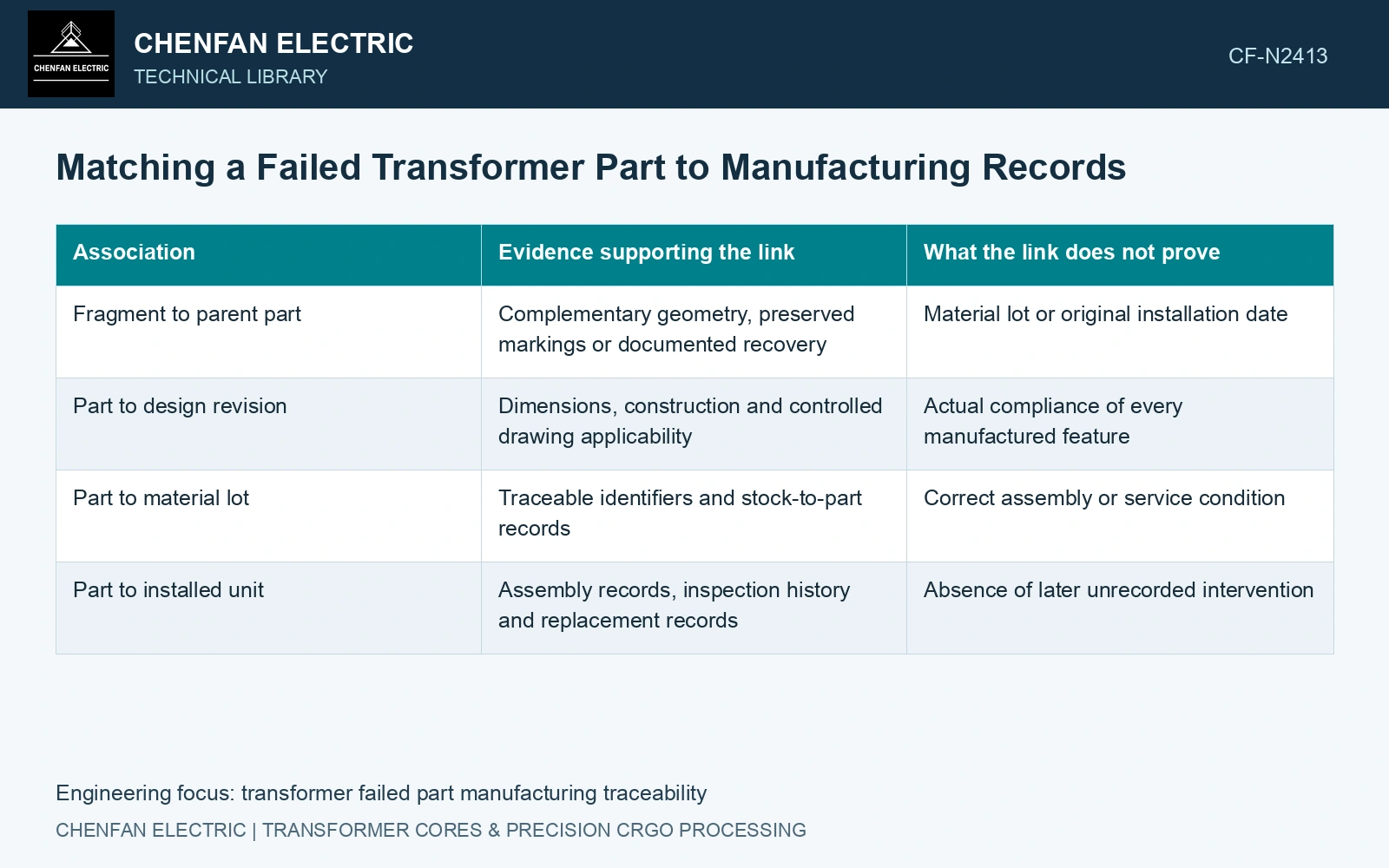
Build a record-association tree
| Association | Evidence supporting the link | What the link does not prove |
|---|---|---|
| Fragment to parent part | Complementary geometry, preserved markings or documented recovery | Material lot or original installation date |
| Part to design revision | Dimensions, construction and controlled drawing applicability | Actual compliance of every manufactured feature |
| Part to material lot | Traceable identifiers and stock-to-part records | Correct assembly or service condition |
| Part to installed unit | Assembly records, inspection history and replacement records | Absence of later unrecorded intervention |
Follow changes as well as original production
Review rework, substitutions, repairs and replacements. A component may have been manufactured from one stock item, reworked to another revision and installed after a previous part was removed. Each transition should have a record or an explicitly unresolved gap.
Keep document dates and effective revisions separate. A drawing issued after production is not automatically evidence of the construction used at that time. Likewise, a certificate copied into a final dossier may be relevant to a batch rather than uniquely to this unit.
NASA’s failure-analysis workflow combines background records, physical examination and techniques such as SEM/EDS [2]. Those observations can test a proposed material class; they do not reconstruct a missing stock-to-part or installation transition without records.
Close a certificate-to-fragment contradiction
Assume a recovered part is positively linked to drawing revision C, while its attached material certificate is traceable only to revision B’s stock record. Dimensional similarity does not close that transition. Reconcile the actual lot and rework/installation records before using the certificate to exclude a material cause; otherwise retain the association as provisional.
Use material testing to constrain identity
Measured composition can contradict a proposed material association or support a material class. It rarely proves a unique lot by itself. Several lots may share essentially the same composition, and surface alteration may limit what a local measurement represents.
References
- NASA, NASA Systems Engineering Handbook, section 6.5, Configuration Management, official online text.
- L. Ochs, NASA Goddard Space Flight Center, Basics of Failure Analysis, NASA Parts 101, December 4, 2024.