

Select witness samples for a defined contrast: original composition, service aging or local accident exposure. Traceable stock, neighboring components and preserved insulation control different variables in a transformer investigation. [1]
Choose the contrast first
If the question concerns original material composition, retained stock from a traceable lot may be appropriate. If it concerns service aging, an unused sample is a poor substitute for material that experienced the transformer’s operating history. If it concerns local accident heating, a nearby region may be useful but could also have been heated by the same event.
State the intended contrast before selecting samples. This prevents the control from becoming whatever intact material happens to be easiest to remove.
Use a pairing plan
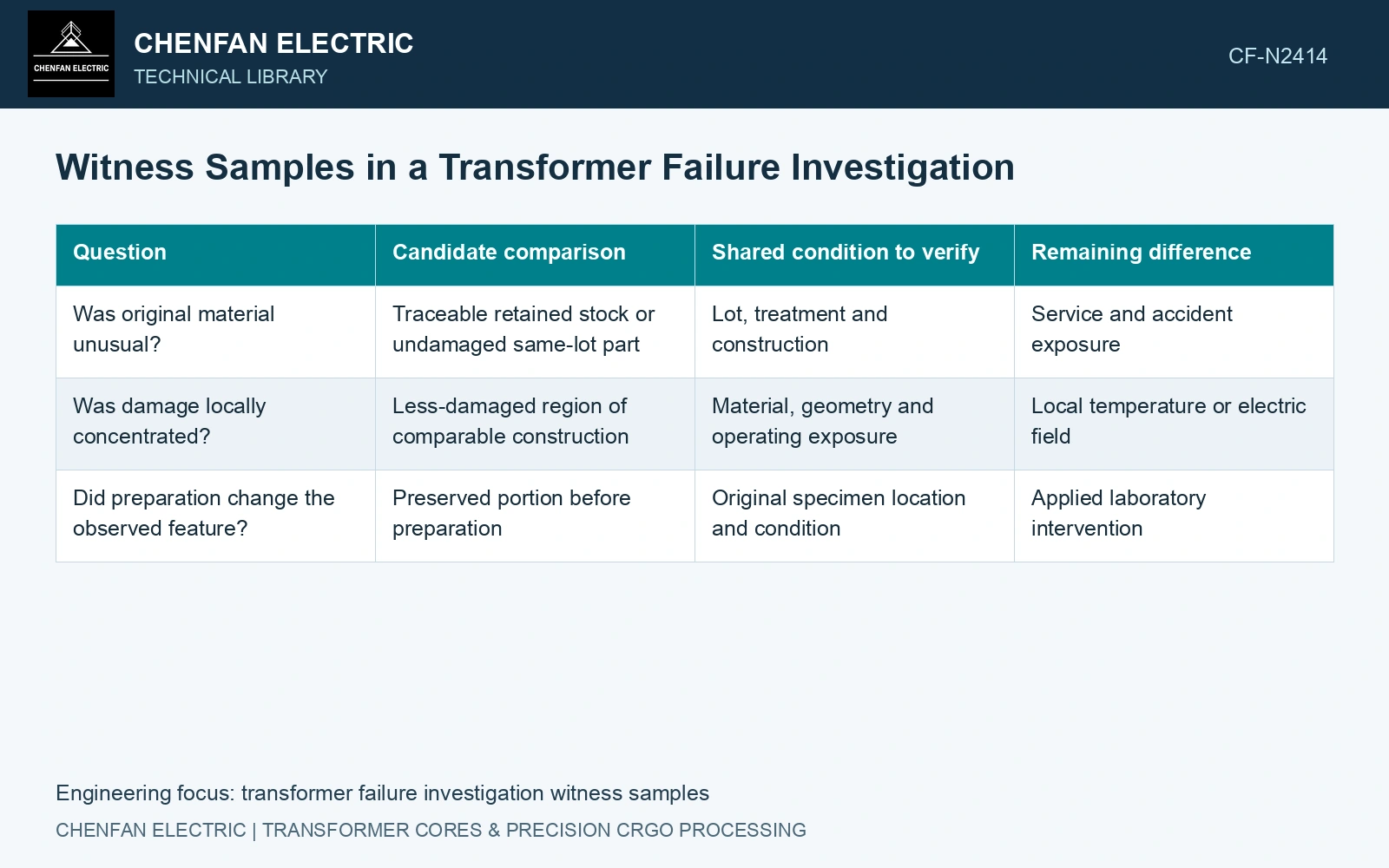
| Question | Candidate comparison | Shared condition to verify | Remaining difference |
|---|---|---|---|
| Was original material unusual? | Traceable retained stock or undamaged same-lot part | Lot, treatment and construction | Service and accident exposure |
| Was damage locally concentrated? | Less-damaged region of comparable construction | Material, geometry and operating exposure | Local temperature or electric field |
| Did preparation change the observed feature? | Preserved portion before preparation | Original specimen location and condition | Applied laboratory intervention |
Preserve orientation and exposure history
Record sample faces, direction, thickness and position relative to conductors or supports. A cross section through one plane may not capture an elongated feature in another. Comparison samples should use compatible orientation and analytical preparation where the question requires it.
Document whether the proposed witness was exposed to firewater, cleaning, drainage, lifting or storage. An intact appearance does not establish an unaffected chemical state.
Moisture exposure can alter the witness comparison. The water-content review distinguishes oil and cellulose inventories and temperature-dependent transfer [2]. A sampled oil value therefore does not establish that target and witness paper shared the same moisture history.
Interpret a paired sample without assigning chronology
Assume comparable sampled paper gives polymerization values 600 and 300 under one laboratory method. The second value is half the first, establishing unequal sampled chain condition. It does not distinguish prior local ageing from accident heat. Check location, preparation and service exposure against preserved controls before attributing the difference to one stage.
Interpret a difference without assigning it automatically
Suppose, illustratively, paper near the fault has lower measured polymerization than paper farther away. The difference supports unequal sampled condition. It does not alone distinguish years of local hot-spot aging from heat received during the accident.
The Bureau of Reclamation describes several processes that shorten cellulose chains, including heat, acids, oxygen and water. Pairing must therefore be combined with spatial evidence and operating history to attribute the observed difference.
References
- U.S. Bureau of Reclamation, FIST Volume 3-31, Transformer Diagnostics, June 2003.
- S. R. Arsad et al., Water Content in Transformer Insulation System: A Review on the Detection and Quantification Methods, Energies 16, 1920, 2023. DOI: 10.3390/en16041920.