

Model a short breaker-to-transformer connection with its local inductance, capacitance and terminal discontinuities. Those elements interact with gap recovery and can produce a fast switching response in a compact circuit. [1] [2]
Short distance reduces some propagation delays but does not eliminate stored-energy or high-frequency effects.
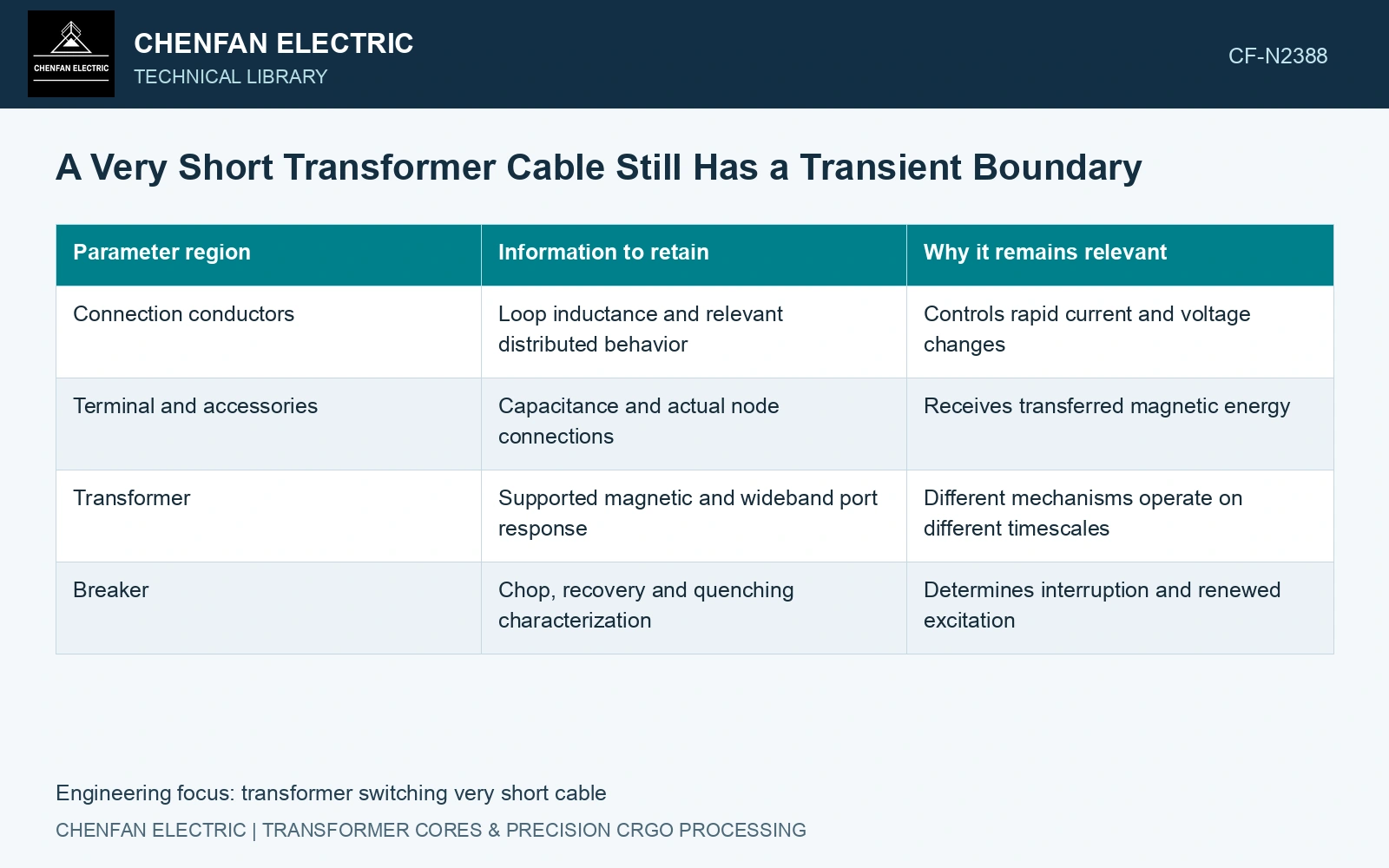
Retain the local storage parameters
| Parameter region | Information to retain | Why it remains relevant |
|---|---|---|
| Connection conductors | Loop inductance and relevant distributed behavior | Controls rapid current and voltage changes |
| Terminal and accessories | Capacitance and actual node connections | Receives transferred magnetic energy |
| Transformer | Supported magnetic and wideband port response | Different mechanisms operate on different timescales |
| Breaker | Chop, recovery and quenching characterization | Determines interruption and renewed excitation |
Do not set the cable capacitance to zero while retaining the rest of the current-chopping mechanism. Other terminal and equipment capacitances remain, and their magnitude can materially affect the resulting voltage. [2]
Choose a model from the relevant timescale
Compare propagation delay with the wavefront and response times being studied. A lumped approximation may be suitable when delay is negligible for those features, but it still needs the correct lumped parameters. The same approximation may fail for a faster event or higher-frequency band.
As an illustration, a local linear combination of 20 μH and 2 nF has a natural frequency of about 795.8 kHz. These assumed values describe a calculation only. They show that a compact circuit can have a fast oscillatory response without a long travel path.
A transformer’s power-frequency magnetizing inductance is not necessarily the appropriate inductance for every fast local mode. Keep the magnetic and wideband boundaries separate.
Compare actual breaker and termination behavior
Small load-side capacitance can change recovery-voltage rise and the competition with gap recovery. Whether it leads to reignition depends on the complete breaker and circuit model; a cable-length label cannot answer it. [2]
Retain protection branches and their lead geometry. Omitting the connection of a nearby snubber or arrester can overstate its effectiveness in the very band made important by the compact circuit.
Compare supported parasitic ranges and the resulting waveform features, including later events rather than one ideal opening peak. Where uncertainty in a small capacitance changes the result materially, obtain better geometry or measurement evidence.
Choose the short-connection model by comparing propagation delay with the studied wavefront, then retain the local storage and protection-loop parameters. Test the uncertain parasitic ranges against the required waveform features and obtain measurements where those ranges change the result.
References
- M. Popov, R. P. P. Smeets, L. van der Sluis, H. de Herdt and J. Declercq, Experimental and Theoretical Analysis of Vacuum Circuit Breaker Prestrike Effect on a Transformer, IEEE Transactions on Power Delivery 24, 2009. DOI: 10.1109/TPWRD.2009.2013383.
- B. Kondala Rao and G. Gajjar, Development and Application of Vacuum Circuit Breaker Model in Electromagnetic Transient Simulation, IEEE, 2006. DOI: 10.1109/POWERI.2006.1632503.