

Include an electrically connected spare cable in the proposed reflection map. In a line model, a wave can enter the unloaded branch and return from its termination to the common node. Verify that path from the actual connection and far-end state.
Propagation and termination behavior, rather than the operating label, determine whether the branch matters.
Verify which end is connected and what the far end contains
Record the actual junction, cable length and far-end condition. A nominally open end can include termination capacitance, equipment or other connected structures. Those details change its high-frequency impedance.
For an ideal open circuit, voltage reflection coefficient is +1 at that end. The local end voltage can reach twice the incident traveling-wave amplitude under that ideal first-arrival condition. This does not mean the transformer terminal doubles: the returning wave encounters a junction with its own transmission and reflection relationships.
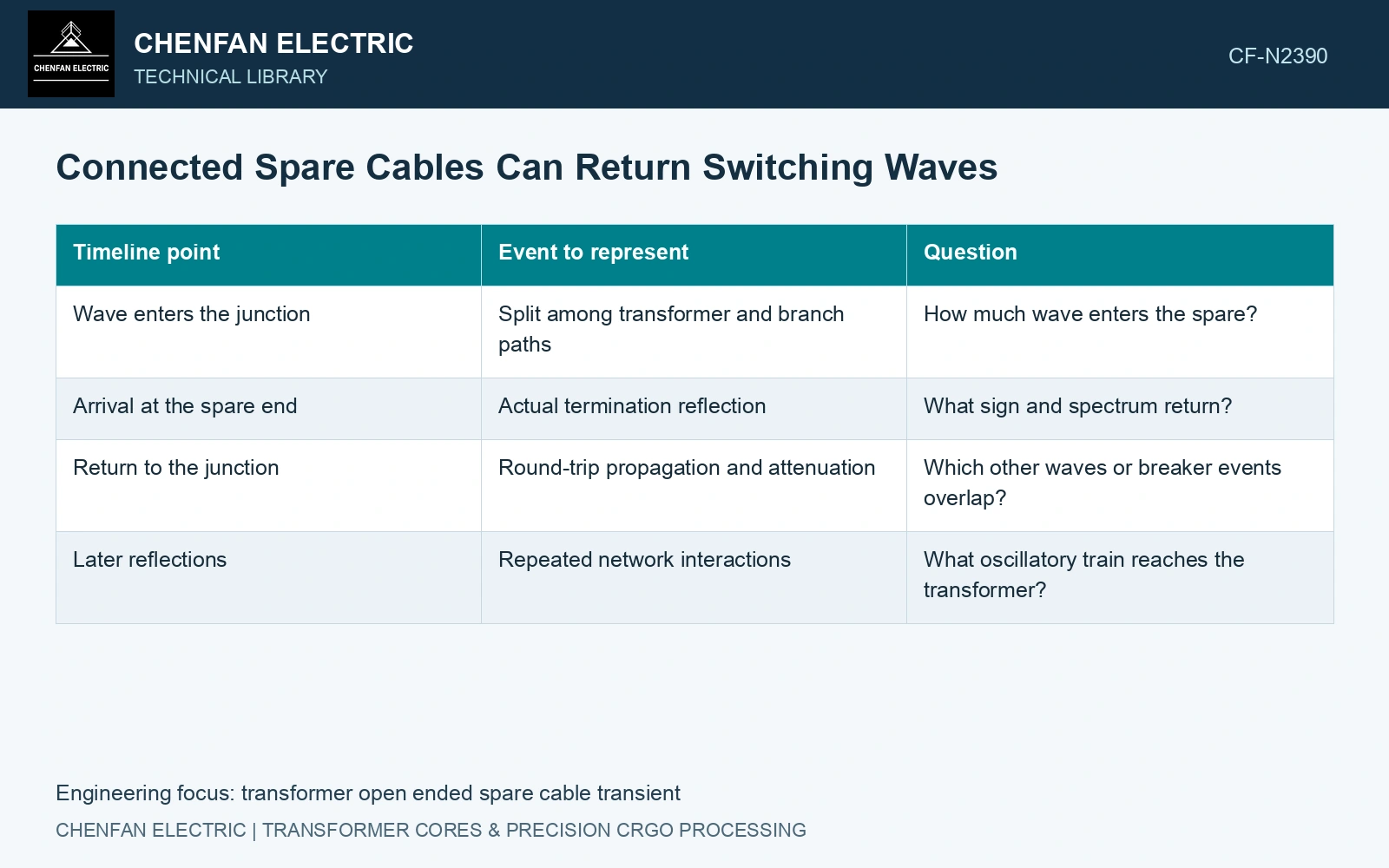
Build the branch-return timeline
| Timeline point | Event to represent | Question |
|---|---|---|
| Wave enters the junction | Split among transformer and branch paths | How much wave enters the spare? |
| Arrival at the spare end | Actual termination reflection | What sign and spectrum return? |
| Return to the junction | Round-trip propagation and attenuation | Which other waves or breaker events overlap? |
| Later reflections | Repeated network interactions | What oscillatory train reaches the transformer? |
For an illustrative 200 m spare with assumed velocity 1.6 × 10⁸ m/s, the round trip is 2.5 μs. These values are teaching assumptions, not surveyed cable data. A delay of that scale can be material to a fast switching sequence even though it is negligible on a power-frequency display.
Compare connected and absent-branch cases
Use the same supported breaker, main cable and transformer models. Popov measured different terminal/internal responses with and without a cable [1]; Rao and Gajjar model the intervening breaker events [2]. Neither validates this spare branch: compare its returned wave and gap-voltage contribution explicitly.
Do not replace the branch with its total capacitance if the relevant study band depends on propagation. Verify a reduced model against arrival timing and waveform features before using it.
Keep uncertainty in the far-end impedance and branch length. A small termination capacitance can make the reflection frequency-dependent rather than an ideal +1 across all frequencies.
If the spare is disconnected from the relevant circuit, represent that verified state and any remaining supported coupling instead. Neither including nor excluding it should follow from its name alone.
Calculate the returned wave at the actual common node for the verified branch and far-end state. Use that contribution and its overlap with breaker events to decide whether the spare needs detailed representation in the switching assessment.
References
- M. Popov, R. P. P. Smeets, L. van der Sluis, H. de Herdt and J. Declercq, Experimental and Theoretical Analysis of Vacuum Circuit Breaker Prestrike Effect on a Transformer, IEEE Transactions on Power Delivery 24, 2009. DOI: 10.1109/TPWRD.2009.2013383.
- B. Kondala Rao and G. Gajjar, Development and Application of Vacuum Circuit Breaker Model in Electromagnetic Transient Simulation, IEEE, 2006. DOI: 10.1109/POWERI.2006.1632503.