

Treat magnetic history as an input to every ferroresonance run. Identical voltage, capacitance and switching time can produce different responses when the preceding run leaves a different remanent state. [1] [2]
Ferracci identifies remanent flux and capacitor charge as response-selection inputs. Control and record those states before comparing the waveforms.
Record what the previous run leaves behind
Retain the preceding response, how its excitation ended and the supported evidence about remaining charge and magnetic history. A zero voltage display after shutdown does not necessarily establish zero remanence. Likewise, an AC-current observation does not determine every stored electric state. [1]
Use only the facility’s approved conditioning and discharge procedures. The experimental record should identify what those procedures control and what remains uncertain, without assuming that a procedure name proves an identical state every time.
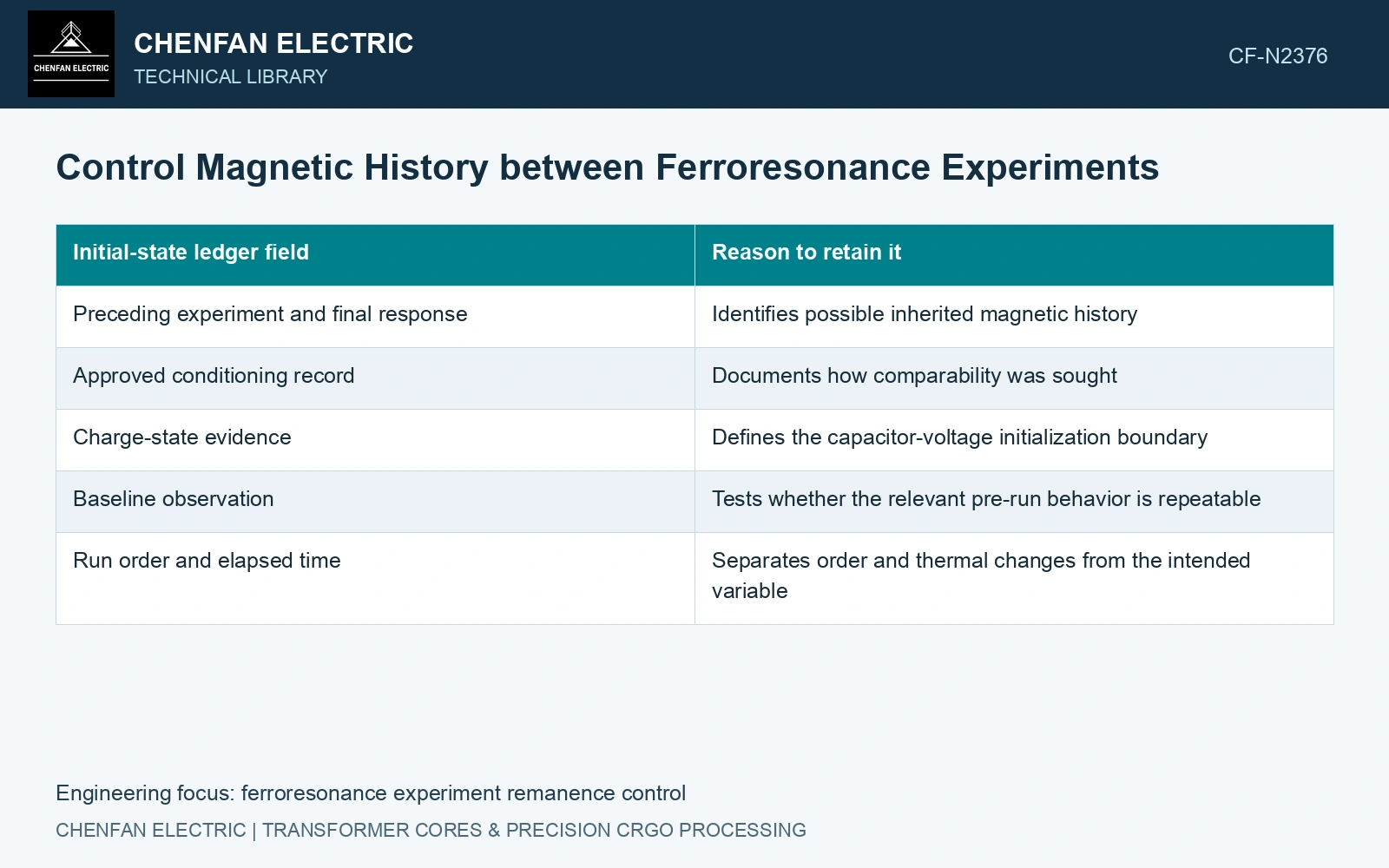
| Initial-state ledger field | Reason to retain it |
|---|---|
| Preceding experiment and final response | Identifies possible inherited magnetic history |
| Approved conditioning record | Documents how comparability was sought |
| Charge-state evidence | Defines the capacitor-voltage initialization boundary |
| Baseline observation | Tests whether the relevant pre-run behavior is repeatable |
| Run order and elapsed time | Separates order and thermal changes from the intended variable |
Check whether order changes the apparent result
Consider two nominal test cases A and B. Compare supported repetitions in which A precedes B with repetitions in which B precedes A, using the same approved initial-state controls. These labels describe an experimental comparison, not actual measured cases. [1]
If B’s response changes with its predecessor, the intended A/B parameter difference is confounded by history. Do not average that effect away. Investigate the initial-state control and retain the order dependence as a result.
Randomizing run order can help expose systematic order effects, but it does not physically reset remanence or trapped charge. A randomized experiment still needs a defined initialization boundary.
Verify the relevant baseline before comparing runs
Compare the supported pre-run excitation observations under matched voltage, frequency and temperature. Retain the uncertainty and repeatability of that comparison. A matched average loss alone may not establish the same phase-specific magnetic history. [1]
Keep thermal state separate from magnetic state. Waiting for oil temperature recovery does not automatically restore magnetic equivalence, while different temperature can change loss and measurement behavior even after comparable conditioning.
Where initial state cannot be made reproducible, represent it as an experimental factor and assess a supported range rather than report one deterministic response.
Report the effects that persist after verified baseline control, and identify those that track run order. Use that separation to decide whether capacitance or damping changed the response, or whether the previous run supplied a different initial state.
References
- P. Ferracci, Schneider Electric, Ferroresonance, Cahier Technique No. 190, March 1998.
- D. A. N. Jacobson, Examples of Ferroresonance in a High Voltage Power System, IEEE PES General Meeting, 2003. DOI: 10.1109/PES.2003.1270499.