

Build the ferroresonance screening case from verified topology and supported excitation data. A rated excitation-current point constrains that operating point; the knee, deep-saturation slope, hysteresis and coupled paths need their own evidence.
Jacobson’s case modeling used manufacturer and recorded-event information to represent the magnetic response. Where comparable evidence is unavailable, the study should grade its conclusion rather than present an assumed curve as measured construction data. [1]
Establish what the network evidence supports
Reconstruct source coupling, capacitance, winding connections, grounding, loading and required switching states. These facts can identify a candidate nonlinear supply circuit or exclude a specific proposed path under the verified topology. [2]
Excluding one path is not proof that every path is absent. Record the network cases and inventory limits behind the screening result.
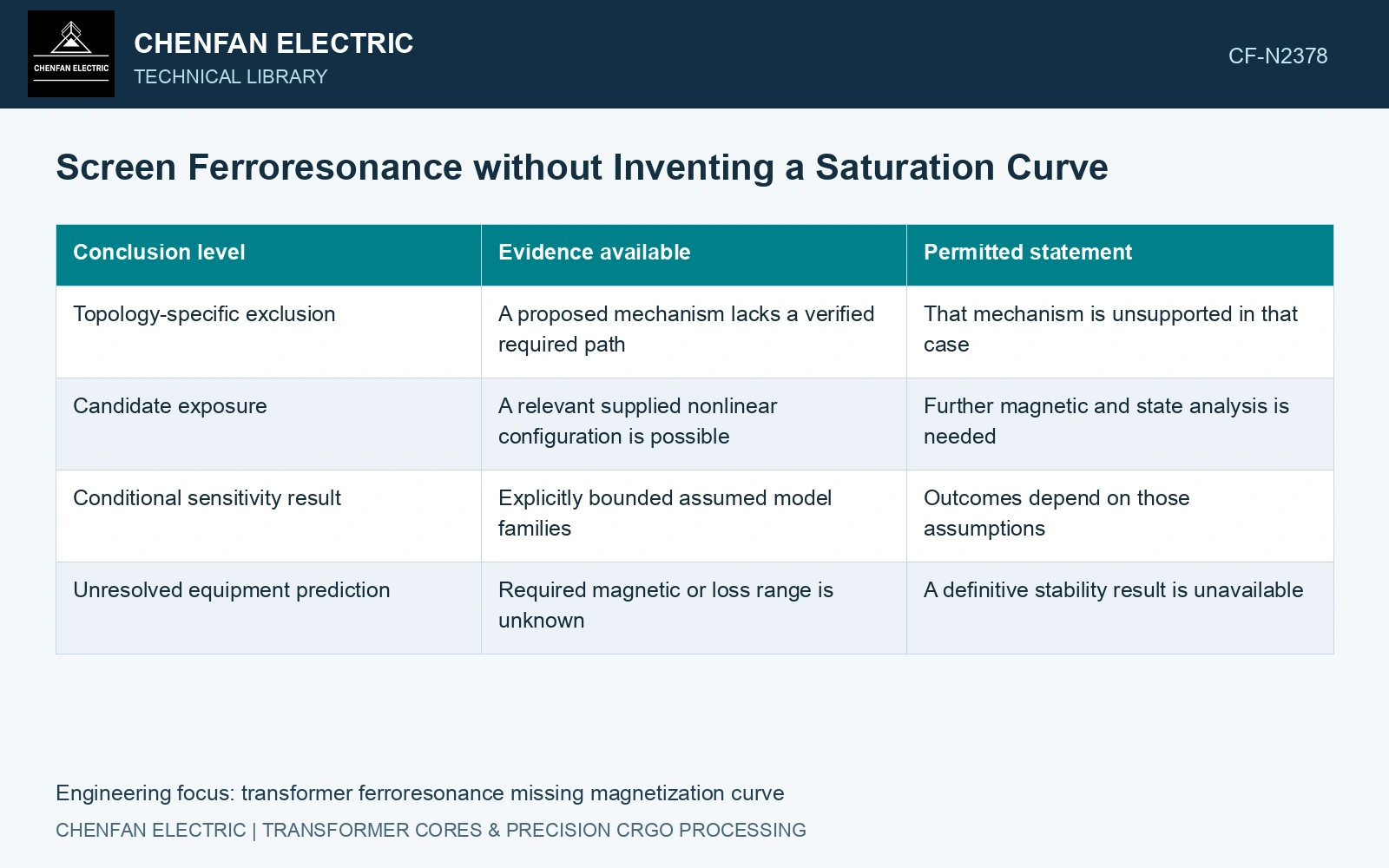
| Conclusion level | Evidence available | Permitted statement |
|---|---|---|
| Topology-specific exclusion | A proposed mechanism lacks a verified required path | That mechanism is unsupported in that case |
| Candidate exposure | A relevant supplied nonlinear configuration is possible | Further magnetic and state analysis is needed |
| Conditional sensitivity result | Explicitly bounded assumed model families | Outcomes depend on those assumptions |
| Unresolved equipment prediction | Required magnetic or loss range is unknown | A definitive stability result is unavailable |
Use bounds only where they have a basis
Available voltage/current excitation measurements can constrain a limited range under their actual frequency and waveform. Do not extend them into deep saturation without support. Core construction and material information may constrain a model family, but they do not automatically identify all installed joint and return-path effects. [2]
If plausible curve alternatives are used for sensitivity, retain their provenance and range. Show which response conclusions remain unchanged and which reverse across those alternatives. A curve selected only because it matches an expected answer is not a bound.
Keep loss-model uncertainty alongside magnetization uncertainty. Damping can determine persistence even when the saturation representation is similar.
Specify the information that resolves the decision
Identify the required excitation range, relevant phase coupling, hysteretic state and loss evidence. Request existing manufacturer characterization or an appropriately approved measurement plan, rather than a generic request for more transformer data. [2]
Prioritize the missing input that materially changes the outcome. If uncertain topology dominates the result, a more elaborate assumed core curve will not resolve it.
Issue a screening classification tied to the verified network cases and supported magnetic-data range. A credible nonlinear supply path warrants further assessment even before a peak is calculated. Obtain the saturation and loss evidence that changes the decision before using a numerical voltage to choose mitigation or declare stability.
References
- D. A. N. Jacobson, Examples of Ferroresonance in a High Voltage Power System, IEEE PES General Meeting, 2003. DOI: 10.1109/PES.2003.1270499.
- P. Ferracci, Schneider Electric, Ferroresonance, Cahier Technique No. 190, March 1998.