

Use a frozen-model, independent-event plan to test a ferroresonance model. Jacobson reports historical model-to-record comparisons [1], and Ferracci identifies topology, magnetic behaviour and initial-state sensitivity [2]. The holdout plan below extends those foundations; it is not a validation protocol prescribed by either publication.
Jacobson presents historical case modeling and recorded comparisons. Such evidence is valuable within its boundary, while a broader validation program needs to distinguish the events used for fitting from those used to challenge the model.
Freeze the equipment model before the holdout comparison
Record the magnetic and loss parameters, source representation and numerical settings selected during calibration. Preserve that version. Changing measured topology or actual load for a new event is appropriate; altering the magnetization curve to fit its outcome is a model revision.
Keep uncertain event inputs as supported ranges. Unknown pole timing or remanence should not become a hidden per-event tuning knob selected solely to match the waveform.
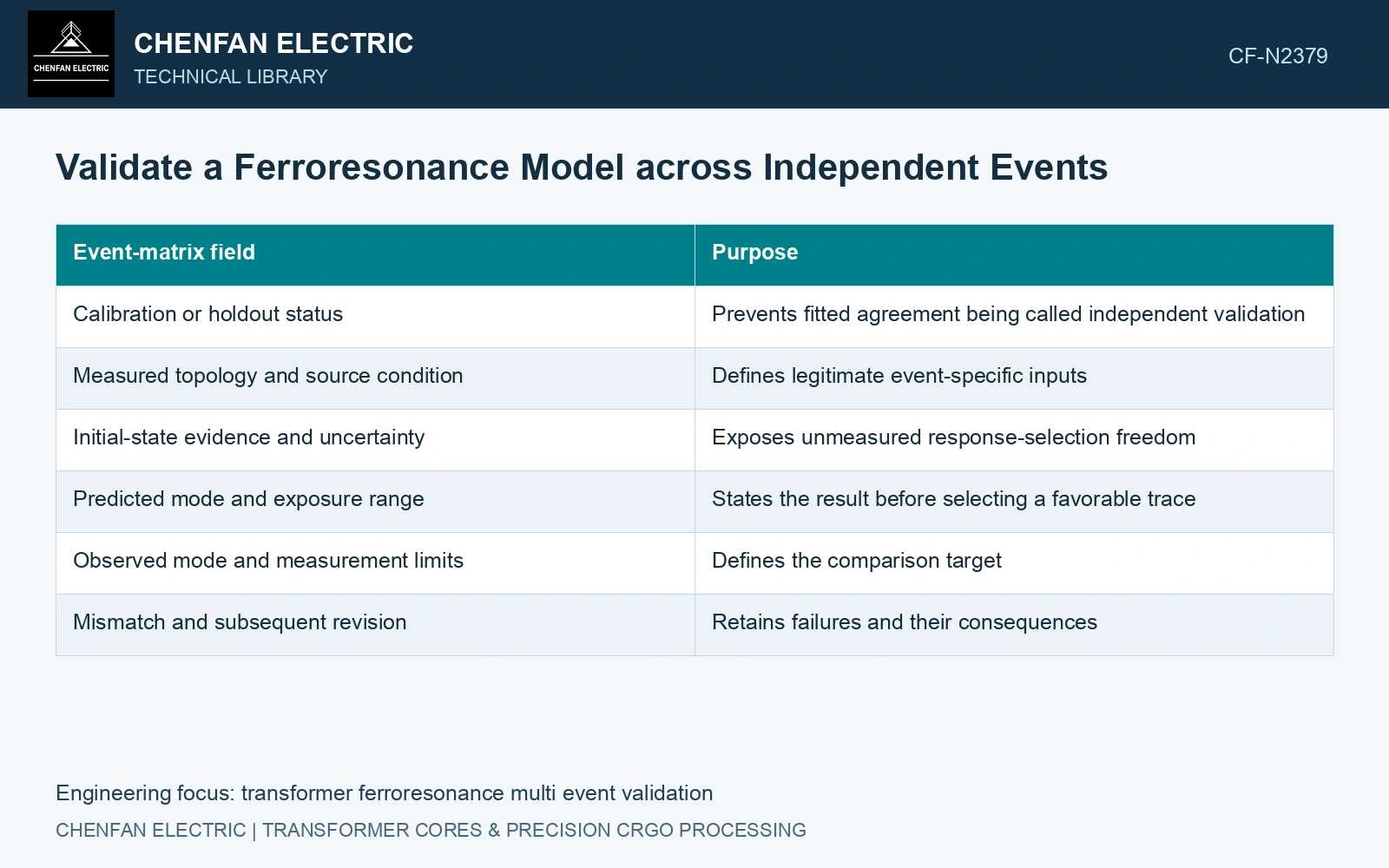
| Event-matrix field | Purpose |
|---|---|
| Calibration or holdout status | Prevents fitted agreement being called independent validation |
| Measured topology and source condition | Defines legitimate event-specific inputs |
| Initial-state evidence and uncertainty | Exposes unmeasured response-selection freedom |
| Predicted mode and exposure range | States the result before selecting a favorable trace |
| Observed mode and measurement limits | Defines the comparison target |
| Mismatch and subsequent revision | Retains failures and their consequences |
Include events that did not become abnormal
A model that predicts an abnormal response everywhere can match some severe events while failing useful discrimination. Include normal or decaying cases under related conditions. Compare missed abnormal responses and falsely predicted abnormal responses explicitly.
Check phase relationships, onset and persistence as well as peak magnitude. A peak fit can conceal the wrong supplied path or mode. Under transition-sensitive conditions, compare supported response ranges rather than insist on an exact trajectory from an unknown state.
Treat a failed prediction as information
Investigate whether the mismatch comes from measured input error, omitted topology, model structure or parameter inadequacy. Record the evidence supporting that explanation. Do not remove the event because it is inconvenient.
If the model is revised after examining a holdout event, that event becomes part of the development evidence. Test the revised version against further independent cases where possible and identify the new coverage boundary.
Retain the numerical convergence checks for the fixed model. Independent event agreement does not excuse a state selected by unstable solver settings.
Report the normal and abnormal events predicted by the fixed model, together with the conditions and failures encountered. Use each failed prediction to target an input measurement or model revision, then challenge the revised version with further independent events before relying on it for mitigation.
References
- D. A. N. Jacobson, Examples of Ferroresonance in a High Voltage Power System, IEEE PES General Meeting, 2003. DOI: 10.1109/PES.2003.1270499.
- P. Ferracci, Schneider Electric, Ferroresonance, Cahier Technique No. 190, March 1998.