

Drive backlash and position-sensor error can produce similar displayed behaviour while creating different electrical uncertainty. Sensor location relative to gears, couplings and mechanical play determines what the feedback actually measures. Use reversal traces to locate the source.
The manufacturer documentation provides position input and electrical response recording. Those signals are useful, but the display alone does not reveal which part of the mechanism it measures. Obtain the drive and sensor arrangement before attributing a mismatch to backlash.
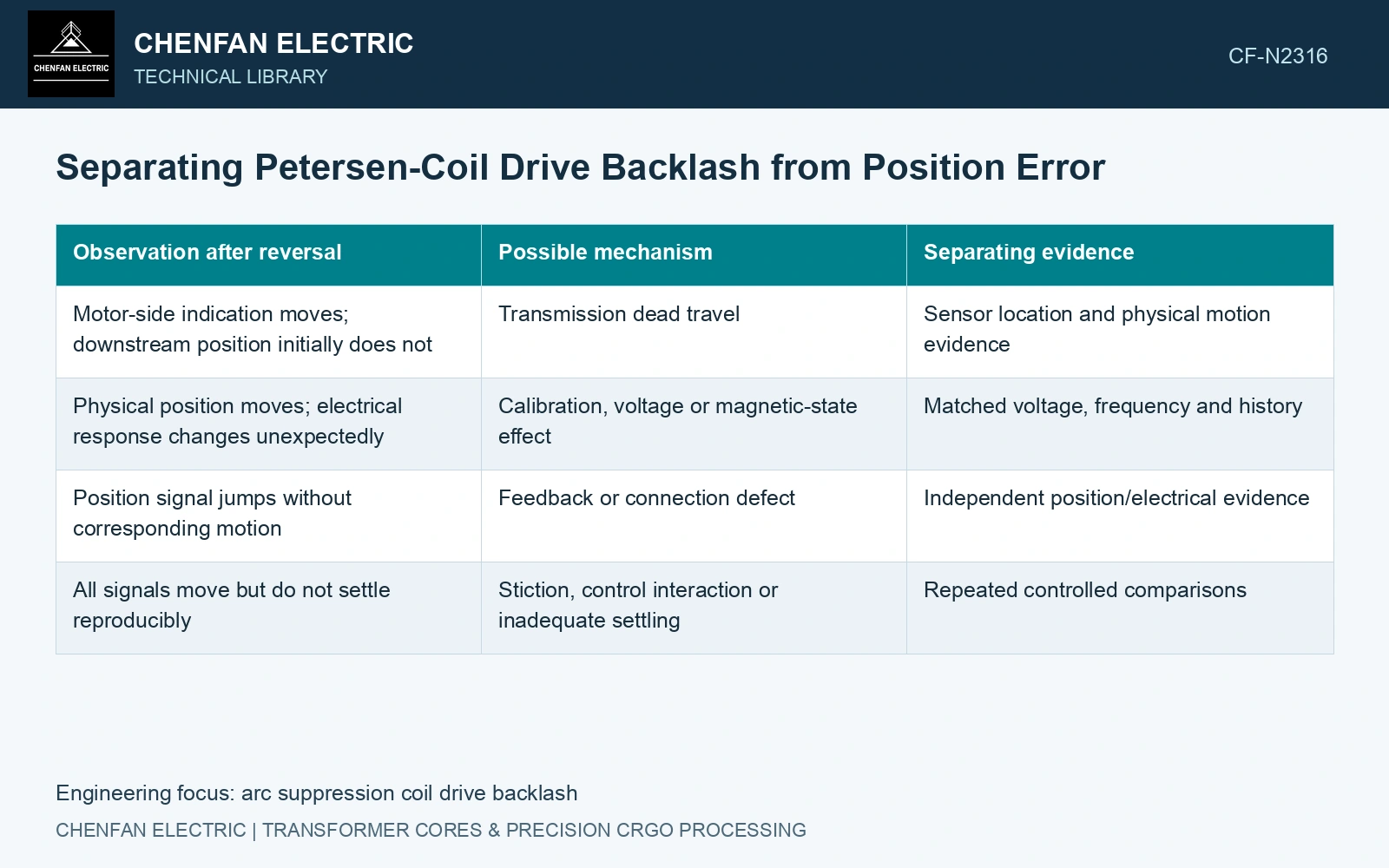
Track three different signals through a reversal
Record the commanded movement, the position signal and the coil’s electrical response. If accessible approved evidence provides downstream physical position, retain that separately from the existing sensor. Mark the direction and time of reversal on one common trace.
| Observation after reversal | Possible mechanism | Separating evidence |
|---|---|---|
| Motor-side indication moves; downstream position initially does not | Transmission dead travel | Sensor location and physical motion evidence |
| Physical position moves; electrical response changes unexpectedly | Calibration, voltage or magnetic-state effect | Matched voltage, frequency and history |
| Position signal jumps without corresponding motion | Feedback or connection defect | Independent position/electrical evidence |
| All signals move but do not settle reproducibly | Stiction, control interaction or inadequate settling | Repeated controlled comparisons |
Translate dead travel into compensation uncertainty
A mechanical coordinate uncertainty δx can create an electrical uncertainty even if it appears small on the display. Locally, δL ≈ (dL/dx)δx, where L is the chosen equivalent inductance in henries and x is the physical coordinate in metres or another explicitly defined unit. The derivative carries henries per coordinate unit.
The same δx can have a much larger consequence near a steep endpoint of the measured calibration curve than in its middle. Use the local electrical slope rather than converting all position errors through one average gain.
For tuning, convert the position uncertainty into branch-admittance or compensating-current uncertainty on the relevant electrical basis. That avoids reporting a mechanical tolerance as though it were already an electrical compensation tolerance.
Keep magnetic and measurement history controlled
Approach matched physical positions from both directions using comparable electrical conditions and settling. If the measured voltage changes, normalize through the appropriate complex response before comparing current. A current difference caused by voltage is not proof of plunger displacement.
Magnetic hysteresis and mechanical play can both produce direction-dependent curves. Evidence of a reversal dead interval in the physical transmission supports a mechanical explanation; an electrical difference at confirmed identical physical position points toward another mechanism. The two can coexist.
Convert a measured reversal interval into current uncertainty
Assumptions: local inductance L = 1.00 H, calibration slope dL/dx = 0.020 H/mm, downstream coordinate uncertainty ±0.50 mm, 10 kV RMS and 50 Hz. The corresponding inductance interval is ±0.010 H. Ideal branch current is 31.831 A at 1.00 H, ranging from 31.516 A at 1.01 H to 32.153 A at 0.99 H. Compare this asymmetric −0.315/+0.322 A interval with the required compensation margin [1] [2]. The calculation propagates the assumed mechanical interval; it cannot diagnose backlash from an electrical trace alone.
Review the reversal traces alongside the sensor position in the drive train. Correct the verified mechanical or measurement cause, then confirm the resulting position-to-compensation accuracy over both directions of travel.
References
- A. Eberle GmbH & Co. KG, The Petersen-Coil Regulator, REG-DP/REG-DPA, including Current Injection and High Power Current Injection, Operating Instructions, April 2017.
- B. N. Taylor and C. E. Kuyatt, NIST Technical Note 1297, Guidelines for Evaluating and Expressing the Uncertainty of NIST Measurement Results, 1994, sections 5 and 6.