

Lost position feedback can mean a failed sensor, a stale signal or a physically stalled plunger. Those conditions require different control responses. Diagnose the evidence available from the command, motion and electrical measurements before selecting the transition.
The manufacturer’s operating manual lists potentiometer cable-break indications and no-movement or wrong-direction states. These checks support defined failure cases; an in-range value can still be stale or unrelated to actual motion. Verify the installed feedback chain and configured response. [1]
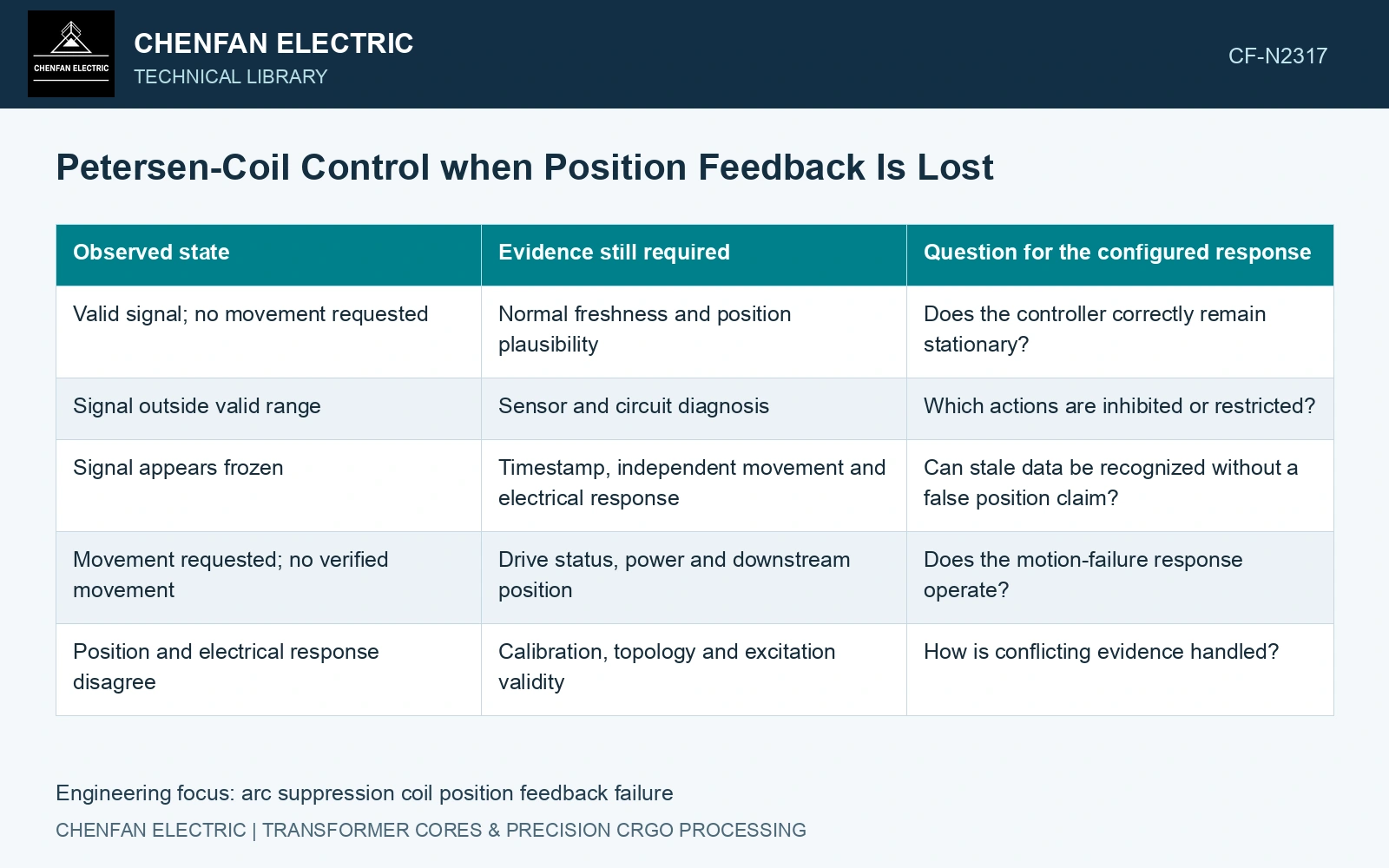
Classify the feedback evidence before issuing a diagnosis
| Observed state | Evidence still required | Question for the configured response |
|---|---|---|
| Valid signal; no movement requested | Normal freshness and position plausibility | Does the controller correctly remain stationary? |
| Signal outside valid range | Sensor and circuit diagnosis | Which actions are inhibited or restricted? |
| Signal appears frozen | Timestamp, independent movement and electrical response | Can stale data be recognized without a false position claim? |
| Movement requested; no verified movement | Drive status, power and downstream position | Does the motion-failure response operate? |
| Position and electrical response disagree | Calibration, topology and excitation validity | How is conflicting evidence handled? |
This is a verification state map rather than a universal control algorithm. The permitted movement, alarm, degraded mode and protection consequences must come from the approved installation design.
Use electrical response as evidence within its limits
A calibrated coil current or admittance can provide an independent indication of changed electrical state. It does not necessarily provide an unambiguous physical position. Voltage, frequency, magnetic history and network coupling also affect the response.
In a nearly symmetrical network, natural neutral voltage may be too small to identify a position-dependent change reliably. An electrical estimate from that weak signal cannot safely be promoted into confirmed position just because the mechanical sensor is unavailable. [2]
Where the design provides a validated independent measurement, record its own validity conditions and uncertainty. Two signals derived from the same failed transducer are not independent simply because they have different names in the display.
Verify the transition and recovery
Challenge the configured response with an interrupted sensor, a shorted sensor, a frozen in-range value and a commanded movement that fails. Check the relevant outputs and event record, preserving the difference between a feedback error and an actual drive defect. These are controlled verification scenarios, not instructions for altering an energized installation.
Also verify recovery after evidence becomes valid again. A restored signal should be reconciled with the actual coil and network state before the controller treats an old command or old tuning result as current.
Record the transition cause, supporting evidence, configured action and recovery conditions. Keep an unknown physical position distinct from a confirmed drive or sensor fault so the controller response matches the actual failure state.
References
- A. Eberle GmbH & Co. KG, The Petersen-Coil Regulator, REG-DP/REG-DPA, including Current Injection and High Power Current Injection, Operating Instructions, April 2017.
- Q. Yang, B. Zhang, J. Ran, S. Chen, Y. He and J. Sun, Measurement of Line-to-Ground Capacitance in Distribution Network Considering Magnetizing Impedance’s Frequency Characteristic, Energies 10, 2017. DOI: 10.3390/en10040477.