

Fluid conversion requires a component-level compatibility matrix alongside the transformer assessment. Trace pumps, seals, bushings, tap-changer compartments and sensors through their separate wetted and operating boundaries. [1]
Calculation basis. Project-specific values and gates in the illustrative screens below are assumptions; cited catalogue values retain their source test conditions.
Technical suitability and warranty coverage are separate records. A compatibility test may support operation without answering what an actual agreement covers. A warranty statement may contain conditions that are narrower than a general product brochure. Use the applicable component documents and written response rather than assuming either from a whole-transformer claim.
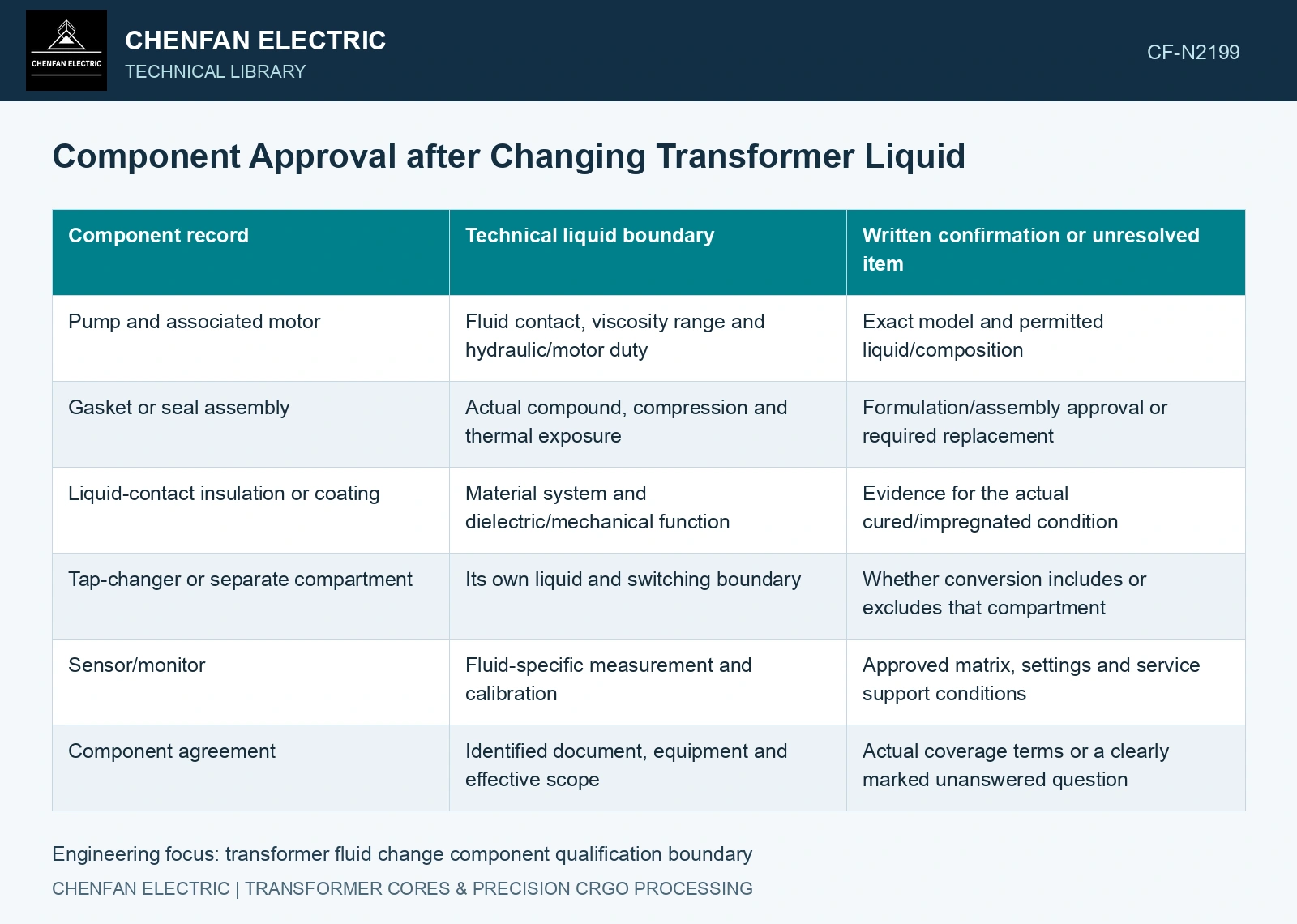
Build the component applicability matrix
| Component record | Technical liquid boundary | Written confirmation or unresolved item |
|---|---|---|
| Pump and associated motor | Fluid contact, viscosity range and hydraulic/motor duty | Exact model and permitted liquid/composition |
| Gasket or seal assembly | Actual compound, compression and thermal exposure | Formulation/assembly approval or required replacement |
| Liquid-contact insulation or coating | Material system and dielectric/mechanical function | Evidence for the actual cured/impregnated condition |
| Tap-changer or separate compartment | Its own liquid and switching boundary | Whether conversion includes or excludes that compartment |
| Sensor/monitor | Fluid-specific measurement and calibration | Approved matrix, settings and service support conditions |
| Component agreement | Identified document, equipment and effective scope | Actual coverage terms or a clearly marked unanswered question |
Name the chemistry change precisely
A request should identify the current liquid, proposed product and expected mixture range, including retained previous liquid. State the equipment temperatures and operating conditions relevant to the component. Asking whether a part is ester-compatible leaves too much unspecified.
Include the exact component model and material revision where known. A response for another construction or later design may not cover the installed item. If identification is incomplete, preserve that gap before relying on a supplier statement.
Separate evidence levels
A broad material-family recommendation is screening context. A coupon result is evidence for its specimen and exposure. A representative component qualification can cover another level. A written applicability statement should identify which of those supports the actual component.
Do not expand natural-ester evidence to synthetic ester or an arbitrary blend. Similarly, one component’s approved liquid range does not establish another’s electrical, chemical or mechanical suitability.
Close the actual document gaps
Record requested clarification, the received response and any condition such as changed seals, calibration or additional testing. Keep the wording tied to the identified equipment and proposed chemistry.
Where a response remains absent, mark the component as unconfirmed rather than interpreting silence as approval. Where technical evidence is complete but agreement coverage remains unclear, retain that separate document issue.
The conversion decision should carry the final component matrix alongside the whole-transformer assessment. Each unresolved liquid-contact or measurement boundary then has a defined next action, instead of being hidden beneath the general statement that the transformer has been approved for a new liquid.
Keep component approval distinct from liquid approval
IEC 63177 addresses construction-material/liquid compatibility; retain that scope when qualifying the actual contact system [2]. Retain the before/after sampling and changed component records in the retrofill handover [3].
Assume a change review lists eight wetted component families, six supported for the selected liquid and temperature history. Coverage is 75%; the two remaining families govern the unresolved conversion scope. Assume they are the installed pump and compressed seals: their unconfirmed hydraulic and sealing functions prevent closing those parts of the conversion scope. A compliant liquid batch does not close those component gaps. Obtain representative seal, adhesive or coating evidence for the actual outstanding families.
References
- M. Lyutikova, S. Korobeynikov, U. Mohan Rao and I. Fofana, Mixed Insulating Liquids with Mineral Oil for High Voltage Transformer Applications: A Review, IEEE Transactions on Dielectrics and Electrical Insulation, 2022. DOI: 10.1109/TDEI.2022.3157908.
- IEC, IEC 63177:2024, Test methods for compatibility of construction materials with electrical insulating liquids.
- Cargill, FR3 Fluid Retrofilling Power Class Transformers Guide, R2040, 2020.