

The transformer liquid inventory is a cumulative composition history. Record identified withdrawals, top-ups and retained quantities to keep the material boundary traceable for later conversion or diagnosis. [1]
Calculation basis. Project-specific values and gates in the illustrative screens below are assumptions; cited catalogue values retain their source test conditions.
Use one consistent quantity basis. A mass ledger can track component masses directly; a volume ledger needs appropriate reference-temperature and density treatment. Avoid combining kilograms, hot liters and nominal tank capacity without a justified conversion.
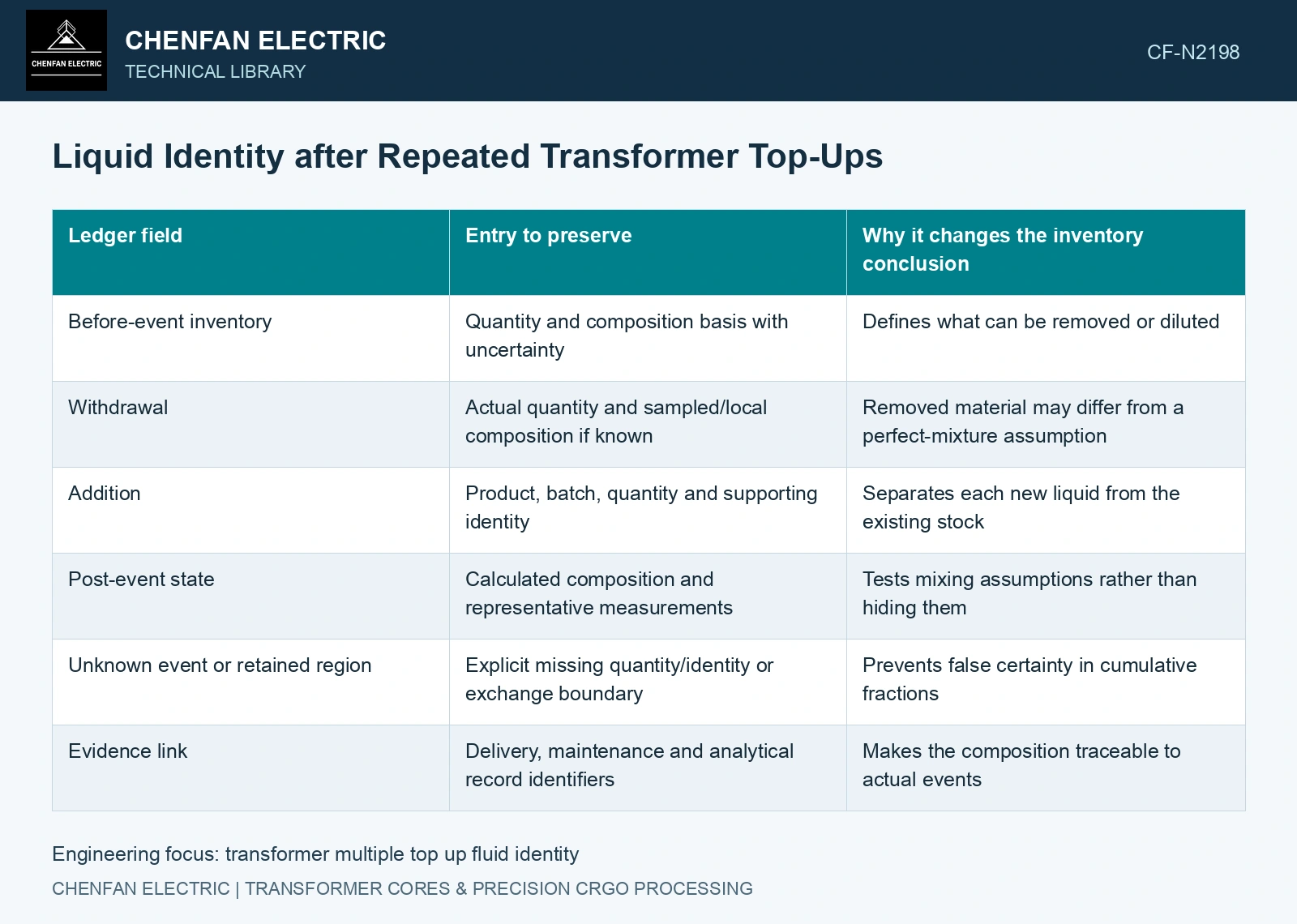
Retain the event-level record
| Ledger field | Entry to preserve | Why it changes the inventory conclusion |
|---|---|---|
| Before-event inventory | Quantity and composition basis with uncertainty | Defines what can be removed or diluted |
| Withdrawal | Actual quantity and sampled/local composition if known | Removed material may differ from a perfect-mixture assumption |
| Addition | Product, batch, quantity and supporting identity | Separates each new liquid from the existing stock |
| Post-event state | Calculated composition and representative measurements | Tests mixing assumptions rather than hiding them |
| Unknown event or retained region | Explicit missing quantity/identity or exchange boundary | Prevents false certainty in cumulative fractions |
| Evidence link | Delivery, maintenance and analytical record identifiers | Makes the composition traceable to actual events |
State the mixing condition in the inventory balance
For a perfectly mixed inventory M with component fraction c, withdrawal mout followed by addition min of fraction cin gives cnew = [(M − mout)c + mincin]/(M − mout + min). The withdrawal assumption is crucial; a local drain from a stratified or isolated region may remove another composition.
Illustratively, start with 1000 kg of liquid A. Remove 100 kg and add 100 kg B, giving 900 kg A and 100 kg B. After complete mixing, remove another 100 kg, leaving 810 kg A and 90 kg B. Add 100 kg C: the final assumed fractions are 81% A, 9% B and 10% C.
The last addition is C, yet C represents only 10% of this illustrative inventory. The calculation excludes retained paper liquid, unrecorded events and density-volume changes; it is not a measurement of a real transformer.
Keep unknowns instead of inventing closure
If a top-up identity is missing, assign that quantity to an unknown category or calculate a justified range. Do not silently identify it as the current preferred product. If withdrawal quantity is uncertain, preserve its range in the balance.
Compare calculated fractions with qualified representative composition measurements. A mismatch can reveal incomplete mixing, retained-liquid exchange, wrong quantities or an analytical boundary. The ledger should record the discrepancy rather than overwrite the measurement to fit the arithmetic.
Use the inventory for the relevant property claim
Match fire-point, viscosity, material-compatibility and monitoring evidence to the supported composition range. Each property can require its own blend-specific qualification; the ledger does not calculate those properties automatically.
Update quantities and uncertainty at each addition. Preserve the cumulative composition record for fluid-property, conversion and diagnostic decisions.
Carry an undocumented addition as a range
The preceding completely mixed calculation ends with 810 kg A, 90 kg B and 100 kg C. Assume an additional, unrecorded C top-up could be anywhere from 0 to 50 kg, with no withdrawal. The C fraction is then (100+m)/(1,000+m), ranging from 10.00% to 14.29%; A falls from 81.00% to 77.14%.
Recover the addition record or retain those composition bounds before matching property and material evidence [2]. Keep composition sampling and changed-liquid records in the handover [3]. A single commercial product name cannot resolve the missing inventory.
References
- M. Lyutikova, S. Korobeynikov, U. Mohan Rao and I. Fofana, Mixed Insulating Liquids with Mineral Oil for High Voltage Transformer Applications: A Review, IEEE Transactions on Dielectrics and Electrical Insulation, 2022. DOI: 10.1109/TDEI.2022.3157908.
- IEC, IEC 63177:2024, Test methods for compatibility of construction materials with electrical insulating liquids.
- Cargill, FR3 Fluid Retrofilling Power Class Transformers Guide, R2040, 2020.