

Staged conversion testing advances from materials to representative components and the complete system. Address each electrical, hydraulic and thermal function at the stage that can provide useful evidence. [1]
Calculation basis. Project-specific values and gates in the illustrative screens below are assumptions; cited catalogue values retain their source test conditions.
Define the proposed liquid, expected retained-fluid range and actual equipment condition before choosing specimens. The purpose of the early stage is to locate unsupported or adverse material interactions efficiently, while keeping the later equipment questions open.
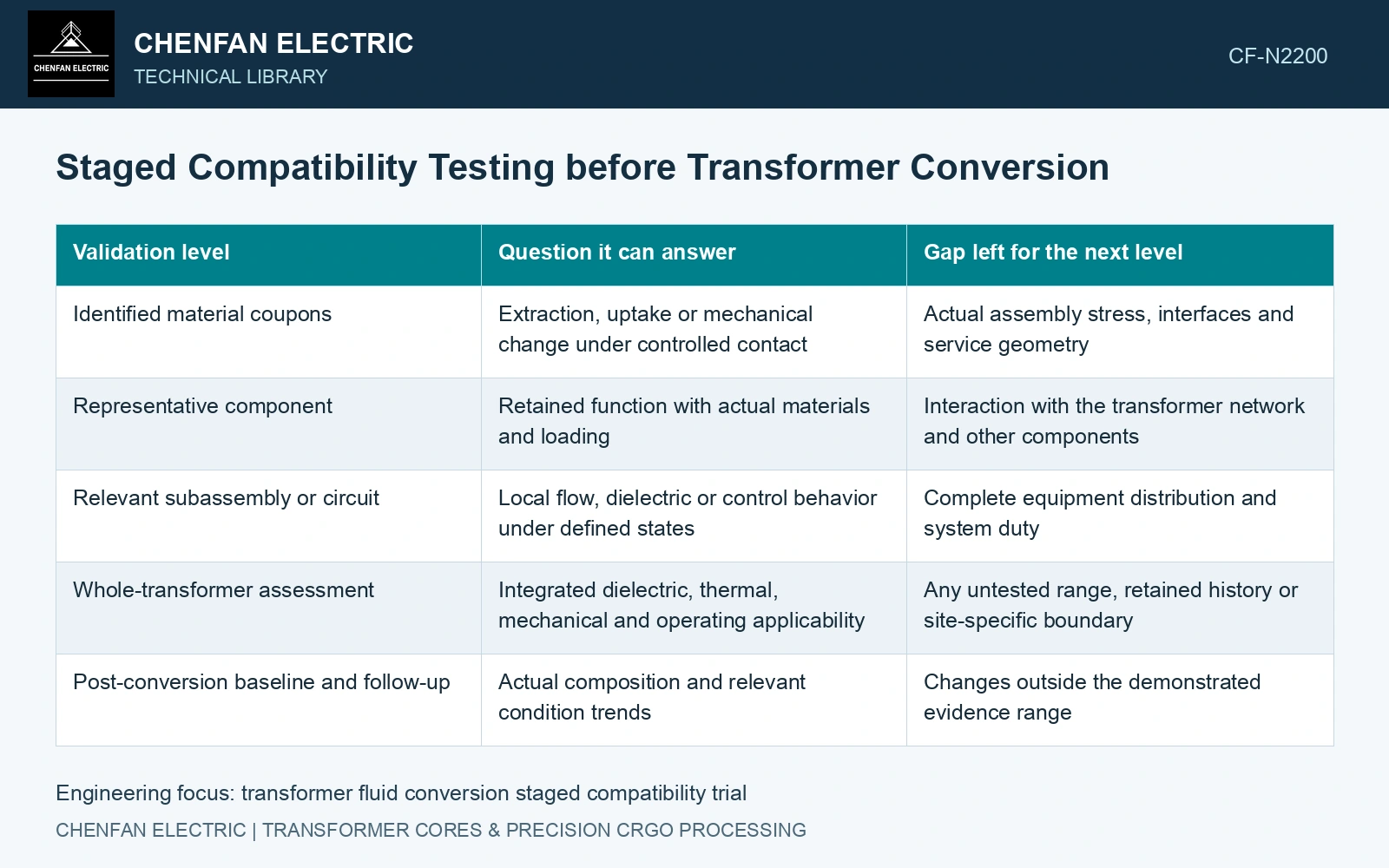
Use an evidence ladder with explicit transfer limits
| Validation level | Question it can answer | Gap left for the next level |
|---|---|---|
| Identified material coupons | Extraction, uptake or mechanical change under controlled contact | Actual assembly stress, interfaces and service geometry |
| Representative component | Retained function with actual materials and loading | Interaction with the transformer network and other components |
| Relevant subassembly or circuit | Local flow, dielectric or control behavior under defined states | Complete equipment distribution and system duty |
| Whole-transformer assessment | Integrated dielectric, thermal, mechanical and operating applicability | Any untested range, retained history or site-specific boundary |
| Post-conversion baseline and follow-up | Actual composition and relevant condition trends | Changes outside the demonstrated evidence range |
Choose specimens that represent the installed condition
New materials may not represent aged seals, repaired coatings or paper impregnated with the previous liquid. Record cure, prior exposure and component revision. If the service condition cannot be reproduced, identify the limitation instead of calling a fresh coupon representative.
Use matched liquid blanks and suitable methods at the material stage. Pair the material response with liquid contamination or property measurements where both directions matter. A single visible appearance result is too narrow for a broad compatibility conclusion.
Escalate according to the physical consequence
A changed gasket material needs a representative compressed sealing boundary. An adhesive needs the relevant cured joint and load. A pump needs its liquid-specific curve, motor condition and installed network. The next test should address the missing function rather than repeat the same immersion exposure at larger scale.
Define acceptance and uncertainty before comparing alternatives. Where the purpose is to detect a small difference, retain measurement capability and representative variation. A statistically distinguishable result is not automatically an engineering failure or improvement.
Keep whole-equipment questions open until addressed
Material compatibility alone does not establish cold circulation, temperature rise, dielectric coordination or monitoring interpretation. Retained previous liquid can also change composition over time. Carry these boundaries into the integrated assessment rather than treating them as details after approval.
Manufacturer conversion guidance provides context and equipment constraints, but it is not a substitute for the actual transformer records and applicable qualification.
Record the supported result and the specific next-stage question at each step. Reach the conversion decision by closing the material, component and system evidence in sequence.
Gate the conversion by material and system evidence
IEC 63177 addresses construction-material/liquid compatibility; retain that scope when qualifying the actual contact system [2]. Retain the before/after sampling and changed component records in the retrofill handover [3].
Assume a conversion matrix contains 12 critical material/liquid combinations: nine have representative aged specimens, two only unaged results and one no test. Aged coverage is 9/12 = 75%, although initial screening covers 91.7%. Close the three aging gaps before advancing this material evidence to representative component and system qualification; the unused-liquid specification alone does not establish system compatibility.
References
- M. Lyutikova, S. Korobeynikov, U. Mohan Rao and I. Fofana, Mixed Insulating Liquids with Mineral Oil for High Voltage Transformer Applications: A Review, IEEE Transactions on Dielectrics and Electrical Insulation, 2022. DOI: 10.1109/TDEI.2022.3157908.
- IEC, IEC 63177:2024, Test methods for compatibility of construction materials with electrical insulating liquids.
- Cargill, FR3 Fluid Retrofilling Power Class Transformers Guide, R2040, 2020.