

Antioxidant mixing begins with identified additives and a consistent assay basis. Use a mass balance to separate dilution from loss, then assess the blend’s required oxidation response. [1]
Calculation basis. Project-specific values and gates in the illustrative screens below are assumptions; cited catalogue values retain their source test conditions.
The following balance applies to one measured additive with a consistent mass-fraction definition. Different additive molecules should not be added as though their concentrations represented identical protection. Proprietary or unconfirmed constituents remain unconfirmed.
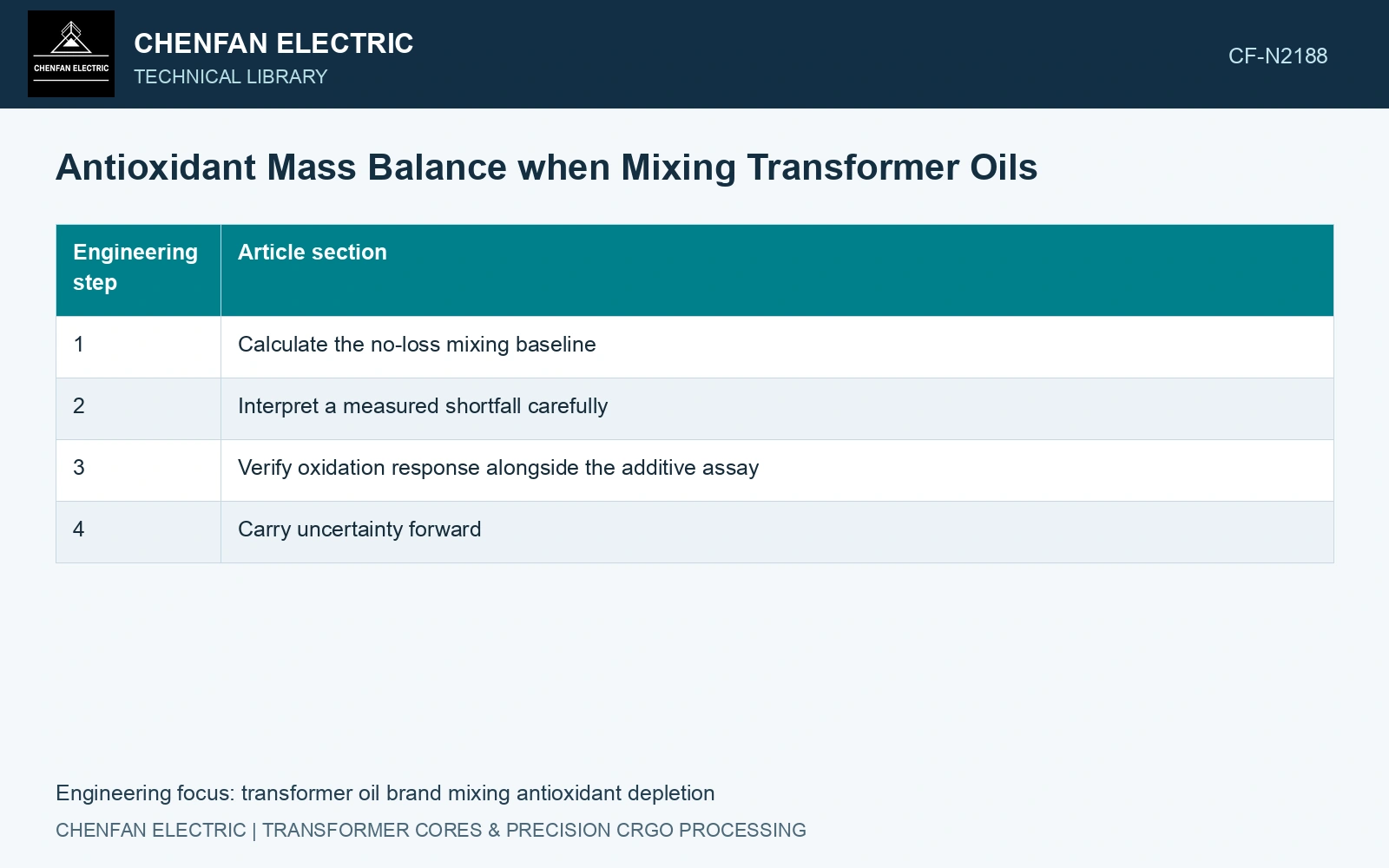
Calculate the no-loss mixing baseline
For masses mA and mB containing the same identified additive at mass fractions cA and cB, the ideal no-reaction mixture has cpred = (mAcA + mBcB)/(mA + mB). The model assumes no removal, reaction, unaccounted addition or change in assay recovery.
Illustratively, 100 kg of oil at 0.30% additive mixed with 25 kg at 0% contains 0.300 kg additive in 125 kg liquid, or 0.24%. The reduction from 0.30% to 0.24% is explained by dilution. These assumed quantities do not describe any commercial formulation.
- Identify each starting liquid and additive assay.
- Calculate the no-loss mass baseline for that additive.
- Measure the representative blend using a matrix-qualified method.
- Investigate departures from the baseline against material contact, treatment and reaction evidence.
- Evaluate oxidation response separately from additive concentration.
Interpret a measured shortfall carefully
A value below the prediction can reflect consumption, adsorption, treatment removal or an analytical matrix effect. It can also reflect wrong starting quantities or incomplete mixing. The difference is an investigation target, not automatic proof that the two oils reacted destructively.
Use blanks, recovery checks and representative samples as needed to separate those causes. If an adsorbent or filter was involved, retain its contact history. Comparing a post-treatment blend with a pre-treatment theoretical concentration without that boundary hides a possible removal path.
Verify oxidation response alongside the additive assay
Oxidation response depends on the base liquids, other constituents, contaminants and exposure environment as well as the identified antioxidant. An unchanged assay does not prove unchanged performance. A lower concentration does not by itself determine the service-life consequence.
Compare the relevant aging behavior using a qualified method appropriate to the liquids and intended equipment boundary. Accelerated results need a stated transfer limit; they do not directly give transformer life. Any proposed additive change requires an independently qualified composition and oxidation-performance basis.
Carry uncertainty forward
Where the formulation or previous top-ups are unknown, calculate only what is supported and name the missing component information. Where the measured concentration is consistent with dilution, preserve that conclusion rather than calling it depletion.
Compare the additive assay with the no-loss mixing prediction, confirm recovery in the blend matrix, and then assess the required oxidation response. A single additive percentage cannot answer all three questions.
Separate dilution from actual antioxidant depletion
IEC 63177 provides a construction-material/liquid compatibility scope [2]; retain the actual specimen and contact condition.
The assumed 100 kg at 0.30% additive plus 25 kg additive-free oil gives 0.300 kg additive and 0.24% blend concentration. If a later matched sample reads an assumed 0.20%, the liquid inventory contains 0.250 kg, leaving a 0.050 kg difference from the dilution-only balance. Investigate chemistry, sampling and inventory history before treating that difference as oxidation consumption.
References
- M. Lyutikova, S. Korobeynikov, U. Mohan Rao and I. Fofana, Mixed Insulating Liquids with Mineral Oil for High Voltage Transformer Applications: A Review, IEEE Transactions on Dielectrics and Electrical Insulation, 2022. DOI: 10.1109/TDEI.2022.3157908.
- IEC, IEC 63177:2024, Test methods for compatibility of construction materials with electrical insulating liquids.