

Coating compatibility has two results: the cured film’s retained function and the contacted liquid’s properties. Measure extraction and mechanical changes together to qualify the complete material–liquid interface. [1]
Calculation basis. Project-specific values and gates in the illustrative screens below are assumptions; cited catalogue values retain their source test conditions.
Use the actual paint system, substrate preparation, layer sequence and cure. A liquid-contact specimen taken from a freshly cured panel may not represent a repair patch with residual solvent or a coating aged in another liquid.
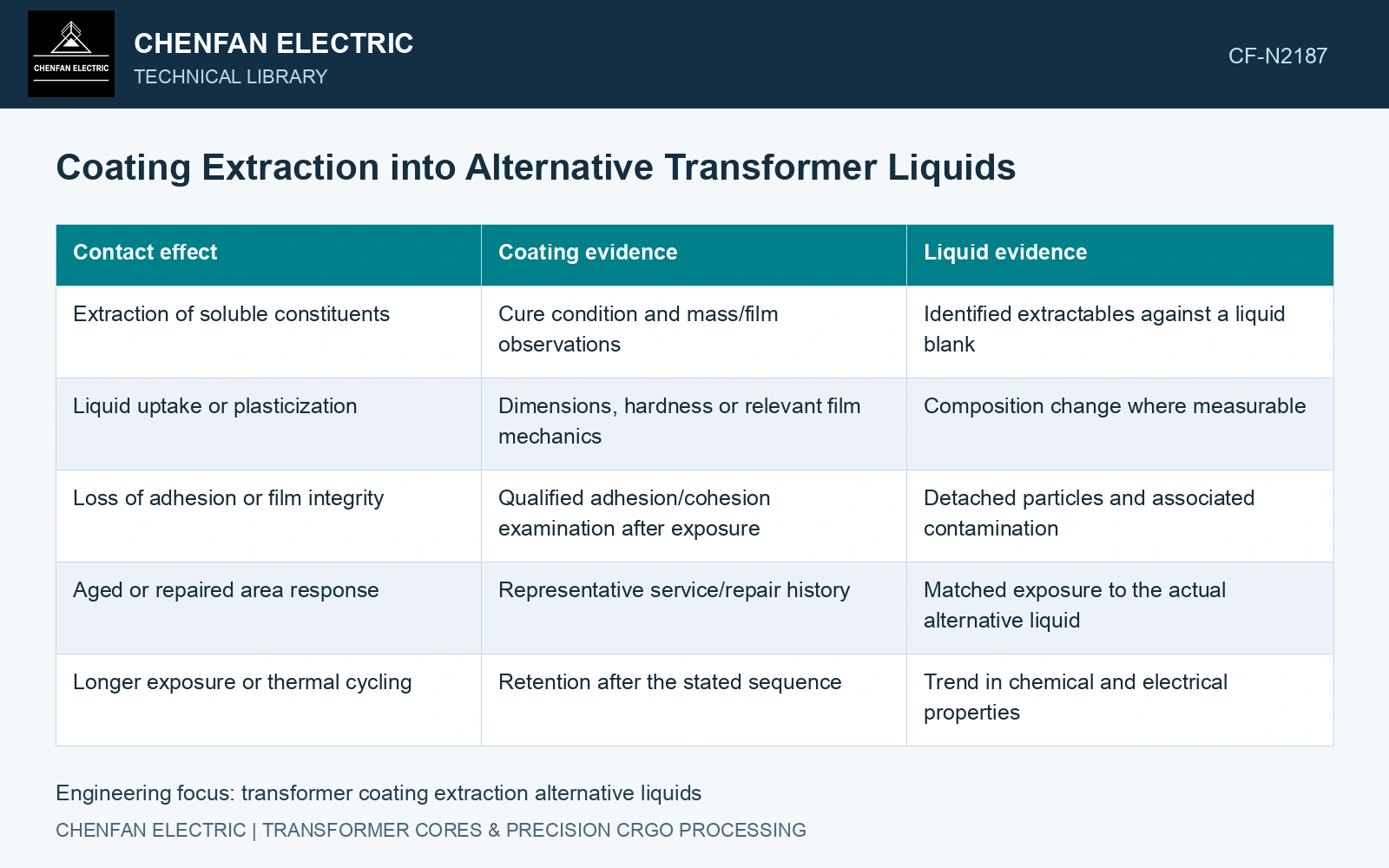
Define a two-way compatibility comparison
| Contact effect | Coating evidence | Liquid evidence |
|---|---|---|
| Extraction of soluble constituents | Cure condition and mass/film observations | Identified extractables against a liquid blank |
| Liquid uptake or plasticization | Dimensions, hardness or relevant film mechanics | Composition change where measurable |
| Loss of adhesion or film integrity | Qualified adhesion/cohesion examination after exposure | Detached particles and associated contamination |
| Aged or repaired area response | Representative service/repair history | Matched exposure to the actual alternative liquid |
| Longer exposure or thermal cycling | Retention after the stated sequence | Trend in chemical and electrical properties |
Fix the contact dose and specimen boundary
Retain exposed area per liquid volume, coating thickness and whether panel edges are sealed or exposed. A cut edge can expose a primer or uncured interface absent from the intended tank surface. Define such exposure as a screening condition if it is deliberately more severe.
Use a liquid-only blank with the same container, temperature, duration and atmosphere. Include an appropriate reference coating or liquid where it clarifies attribution. Without these controls, oxidation of the liquid or contamination from the vessel can be mistaken for coating extraction.
Identify the extracted material
Color or odor can prompt investigation but is not sufficient chemical identification. Select an analytical method suited to the suspected resin components, additives or residual solvents. Retain the method’s detection range and any preparation that can remove, transform or concentrate the analyte.
A nondetect means the stated method did not establish the substance above its relevant limit. It does not establish that every possible extractable is absent. Likewise, a positive result needs comparison with the blank and coating composition before it is assigned to one layer.
Connect film and liquid changes to the service duty
Electrical liquid tests require matched moisture and temperature conditions. Increased loss or conductivity can have more than one cause, so interpret it alongside the chemical findings. Film appearance alone cannot resolve that uncertainty.
After exposure, examine the coating under the qualified mechanical method needed for its duty. A dry inspection following recovery can miss softening that occurred while immersed. Record both the in-exposure boundary where feasible and the defined recovery state.
Verify film adhesion and the controlling liquid properties together. Approve the cured coating system, liquid composition and exposure range supported by both results.
Normalize extraction results to exposed area and liquid volume
IEC 63177 provides a construction-material/liquid compatibility scope [2]; retain the actual specimen and contact condition.
Assume a coating exposure releases 12 mg of an identified species from 0.020 m² into 0.50 L. The liquid concentration is 24 mg/L and area-normalized release is 600 mg/m². Doubling test liquid volume without changing extracted mass halves concentration to 12 mg/L. Compare equivalent exposure geometry before ranking coating compatibility.
References
- M. Lyutikova, S. Korobeynikov, U. Mohan Rao and I. Fofana, Mixed Insulating Liquids with Mineral Oil for High Voltage Transformer Applications: A Review, IEEE Transactions on Dielectrics and Electrical Insulation, 2022. DOI: 10.1109/TDEI.2022.3157908.
- IEC, IEC 63177:2024, Test methods for compatibility of construction materials with electrical insulating liquids.