

Blend sludge stability develops through aging and temperature history. Track deposits beyond the initial clear state to distinguish changed solvent conditions from later chemical production. [1]
Calculation basis. Project-specific values and gates in the illustrative screens below are assumptions; cited catalogue values retain their source test conditions.
Retain the starting liquids’ age and contamination history. A blend of two fresh liquids is not representative of adding a fresh product to aged transformer oil containing dissolved degradation products. Composition and condition both belong in the stability trial.
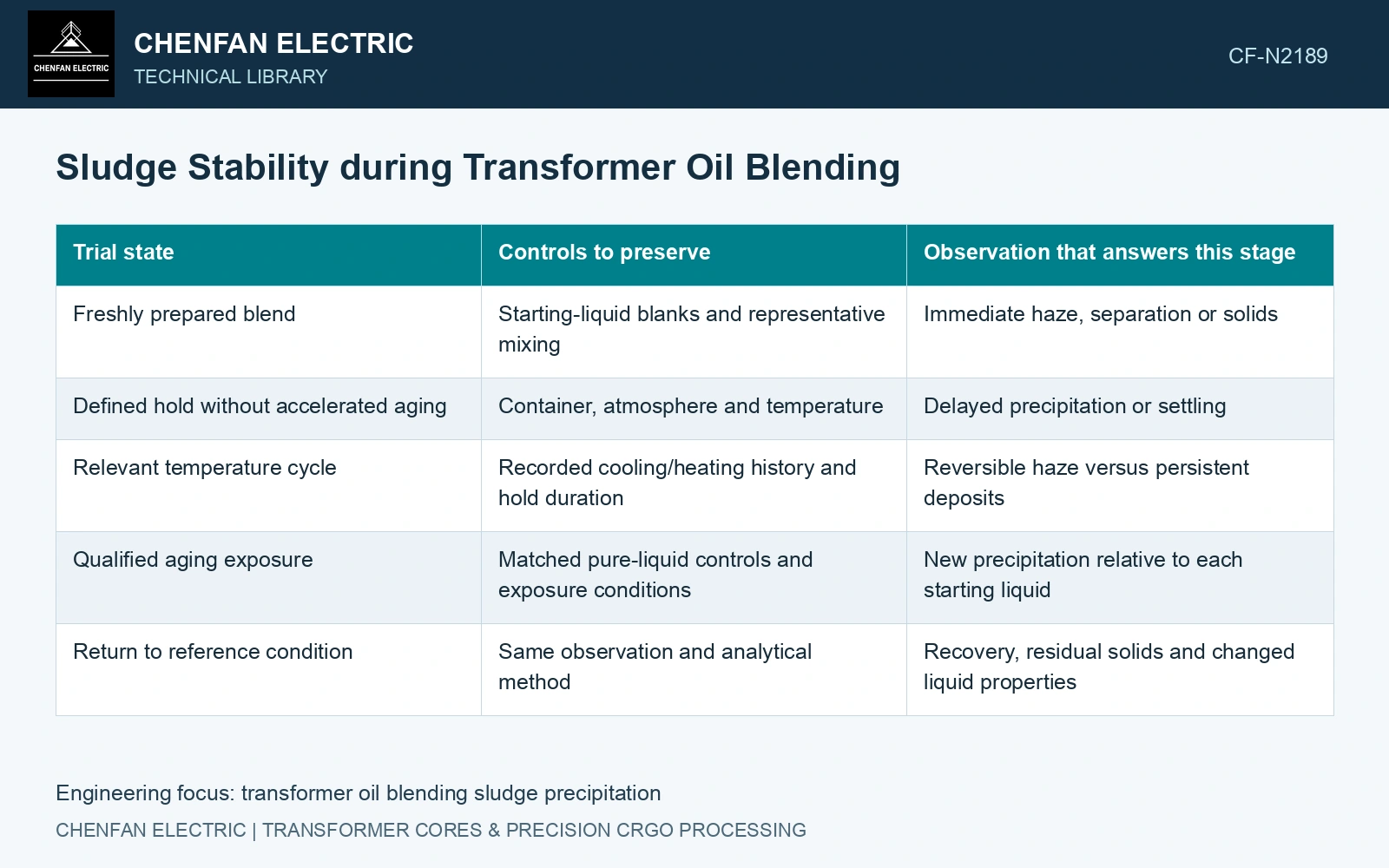
Separate immediate, delayed and cycling effects
| Trial state | Controls to preserve | Observation that answers this stage |
|---|---|---|
| Freshly prepared blend | Starting-liquid blanks and representative mixing | Immediate haze, separation or solids |
| Defined hold without accelerated aging | Container, atmosphere and temperature | Delayed precipitation or settling |
| Relevant temperature cycle | Recorded cooling/heating history and hold duration | Reversible haze versus persistent deposits |
| Qualified aging exposure | Matched pure-liquid controls and exposure conditions | New precipitation relative to each starting liquid |
| Return to reference condition | Same observation and analytical method | Recovery, residual solids and changed liquid properties |
Use a repeatable solids observation
Visual clarity is useful screening evidence, but it depends on lighting, sample depth and particle size. Record those conditions or use a suitable quantitative method. A transparent sample can contain particles or dissolved precursors below visual detection.
If solids are collected for analysis, identify the separation method and its limits. A filter can capture selected particle sizes while allowing smaller material to pass; handling can introduce contamination or change the equilibrium. A retained mass is meaningful only with the blank, sample quantity and method boundary.
Distinguish precipitation from the origin of its material
An immediate precipitate can arise from a changed solvent condition for pre-existing substances. A later precipitate can involve newly formed degradation products, release from contacted materials or temperature-dependent solubility. The timing alone does not uniquely identify its chemistry.
Compare the composition of the deposit and the remaining liquid where the decision needs attribution. Include actual metals, coatings or other contacting materials when they are relevant, but keep those specimens identified. Otherwise the trial can confuse liquid blending with extraction from the test assembly.
Transfer the trial to the intended circuit
Laboratory oxygen exposure and temperature history should represent or deliberately bound the service question. An open vessel and a sealed transformer have different oxidation boundaries. Severe accelerated conditions can be a screen, but their deposit formation cannot be converted directly into a service interval.
Assess whether deposits could affect the actual circulation and insulation interfaces using the identified particle/material evidence. A bottle’s settling layer does not establish where material will accumulate in a flowing transformer.
Report the states examined through aging and temperature cycles. Identify deposit origin and reversibility before selecting treatment or approving the blend.
Track deposits and suspended material separately
IEC 63177 provides a construction-material/liquid compatibility scope [2]; retain the actual specimen and contact condition.
Assume a blend trial begins with 0.80 g deposited sludge and ends with 0.30 g deposit plus 0.45 g suspended solids on a common recovered-mass basis. Total recovered material is 0.75 g, or 93.75% of the initial 0.80 g; 0.05 g remains unaccounted for, so disappearance of visible deposit does not demonstrate its removal. Assess the 0.45 g transported fraction and recovery uncertainty before approving circulation through insulation and coolers.
References
- M. Lyutikova, S. Korobeynikov, U. Mohan Rao and I. Fofana, Mixed Insulating Liquids with Mineral Oil for High Voltage Transformer Applications: A Review, IEEE Transactions on Dielectrics and Electrical Insulation, 2022. DOI: 10.1109/TDEI.2022.3157908.
- IEC, IEC 63177:2024, Test methods for compatibility of construction materials with electrical insulating liquids.