

Oil–ester compatibility is specific to the elastomer compound and installed seal. Compare formulation, exposure and compression state to establish swelling, recovery and retained sealing function. [1]
Calculation basis. Project-specific values and gates in the illustrative screens below are assumptions; cited catalogue values retain their source test conditions.
Identify the supplied compound and its service role. A free specimen can swell without demonstrating that a compressed seal remains leak-tight. The seal’s geometry, compression history and temperature cycle determine whether the material change helps or harms its actual function.
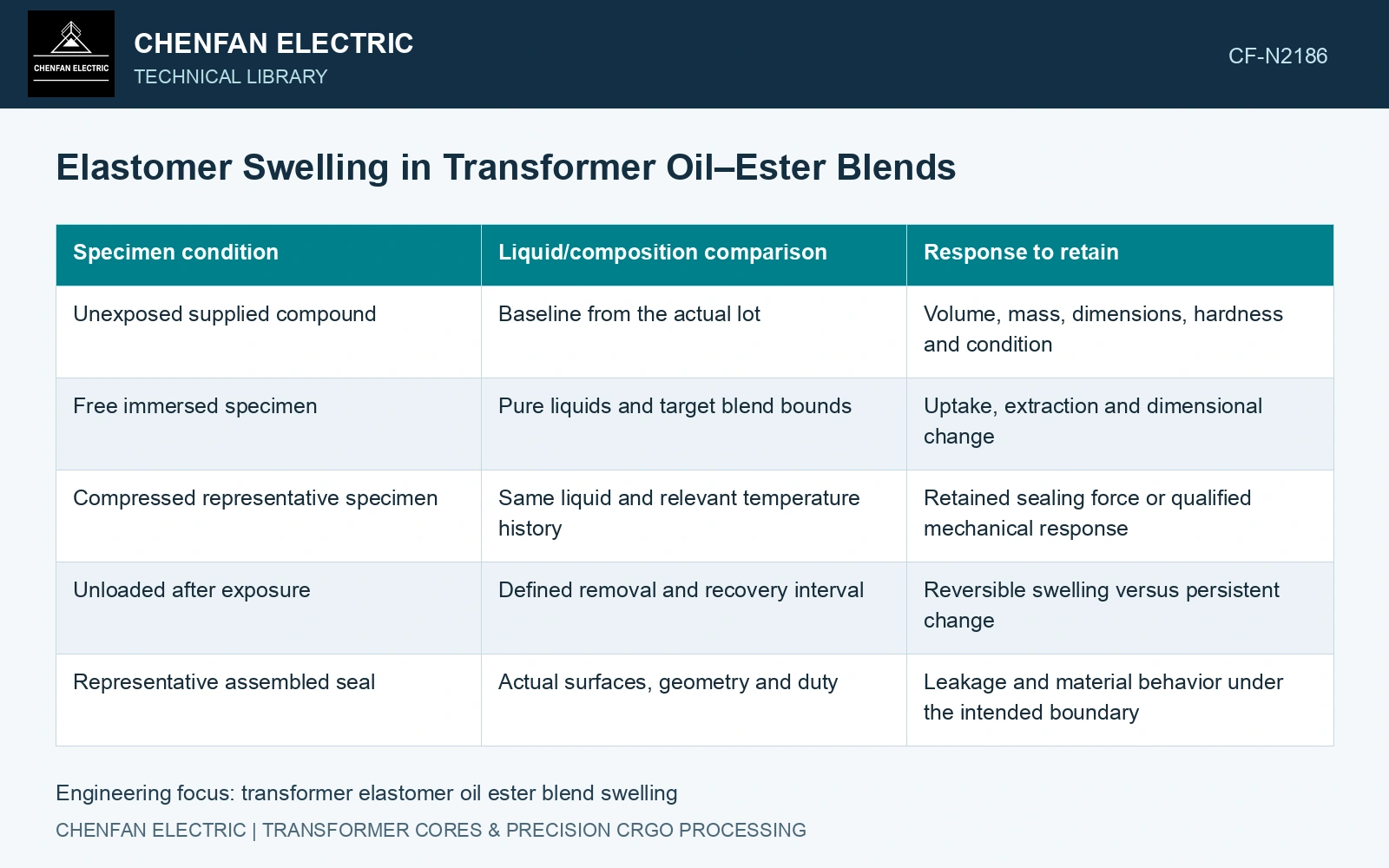
Compare composition and loading together
| Specimen condition | Liquid/composition comparison | Response to retain |
|---|---|---|
| Unexposed supplied compound | Baseline from the actual lot | Volume, mass, dimensions, hardness and condition |
| Free immersed specimen | Pure liquids and target blend bounds | Uptake, extraction and dimensional change |
| Compressed representative specimen | Same liquid and relevant temperature history | Retained sealing force or qualified mechanical response |
| Unloaded after exposure | Defined removal and recovery interval | Reversible swelling versus persistent change |
| Representative assembled seal | Actual surfaces, geometry and duty | Leakage and material behavior under the intended boundary |
Measure more than one property
A restricted volume-change indicator is ΔV/V0 = (Vafter − Vbefore)/Vbefore. State the conditioning and measurement method. Surface liquid, absorbed liquid and extraction can complicate mass interpretation, and a volume measurement must use the correct method and liquid-density inputs where applicable.
Track hardness and relevant mechanical behavior alongside swelling. Increased volume is not automatically improved sealing: it can overfill a groove, distort a part or accompany loss of strength. Small volume change is not automatically compatibility if the compound becomes brittle or loses retained force.
Control the recovery boundary
Compare specimens at a defined time and temperature after removal. A material may partially recover as absorbed liquid leaves, while extracted constituents or chemical changes may not reverse. Different recovery times can make nominally similar results disagree.
The installed seal may never experience the same unloaded recovery as a laboratory coupon. If the test removes compression before measuring, record that limitation. A freely recovered shape cannot prove the force retained while the seal stayed compressed in service.
Use the blend range actually expected
Include composition drift from retained mineral liquid and later top-ups where relevant. The response need not vary linearly between pure-liquid endpoints. Prior aging and a previously absorbed liquid can also affect an existing seal differently from a new specimen.
Manufacturer retrofill guidance can identify gasket review as necessary, but a broad material recommendation is not qualification of every compound within that category. Obtain evidence tied to the actual formulation and component construction.
Let the compressed component result govern its sealing duty. Retain in-exposure mechanical changes and approve the identified compound and arrangement across supported mixture, temperature and load conditions.
Carry seal swelling into the gland fill calculation
IEC 63177 provides a construction-material/liquid compatibility scope [2]; retain the actual specimen and contact condition. Retain the before/after sampling and changed component records in the retrofill handover [3].
Assume a seal initially occupies 80% of a fixed gland volume and its conditioned volume rises by 15%. Occupancy becomes 80% × 1.15 = 92%, leaving 8% unfilled volume instead of 20%. Compare the actual swell, compression and thermal expansion with the approved seal design; mass gain alone cannot establish usable clearance.
References
- M. Lyutikova, S. Korobeynikov, U. Mohan Rao and I. Fofana, Mixed Insulating Liquids with Mineral Oil for High Voltage Transformer Applications: A Review, IEEE Transactions on Dielectrics and Electrical Insulation, 2022. DOI: 10.1109/TDEI.2022.3157908.
- IEC, IEC 63177:2024, Test methods for compatibility of construction materials with electrical insulating liquids.
- Cargill, FR3 Fluid Retrofilling Power Class Transformers Guide, R2040, 2020.