

Water concentration in an ester–mineral blend must be interpreted against saturation, temperature and solid insulation. Keep those states together to assess the actual moisture condition after liquid mixing. [1]
Calculation basis. Project-specific values and gates in the illustrative screens below are assumptions; cited catalogue values retain their source test conditions.
A liquid sample describes its water concentration at the sampling boundary. It does not directly measure the water held throughout the paper, and it does not prove that the liquid and solid have reached equilibrium after conversion.
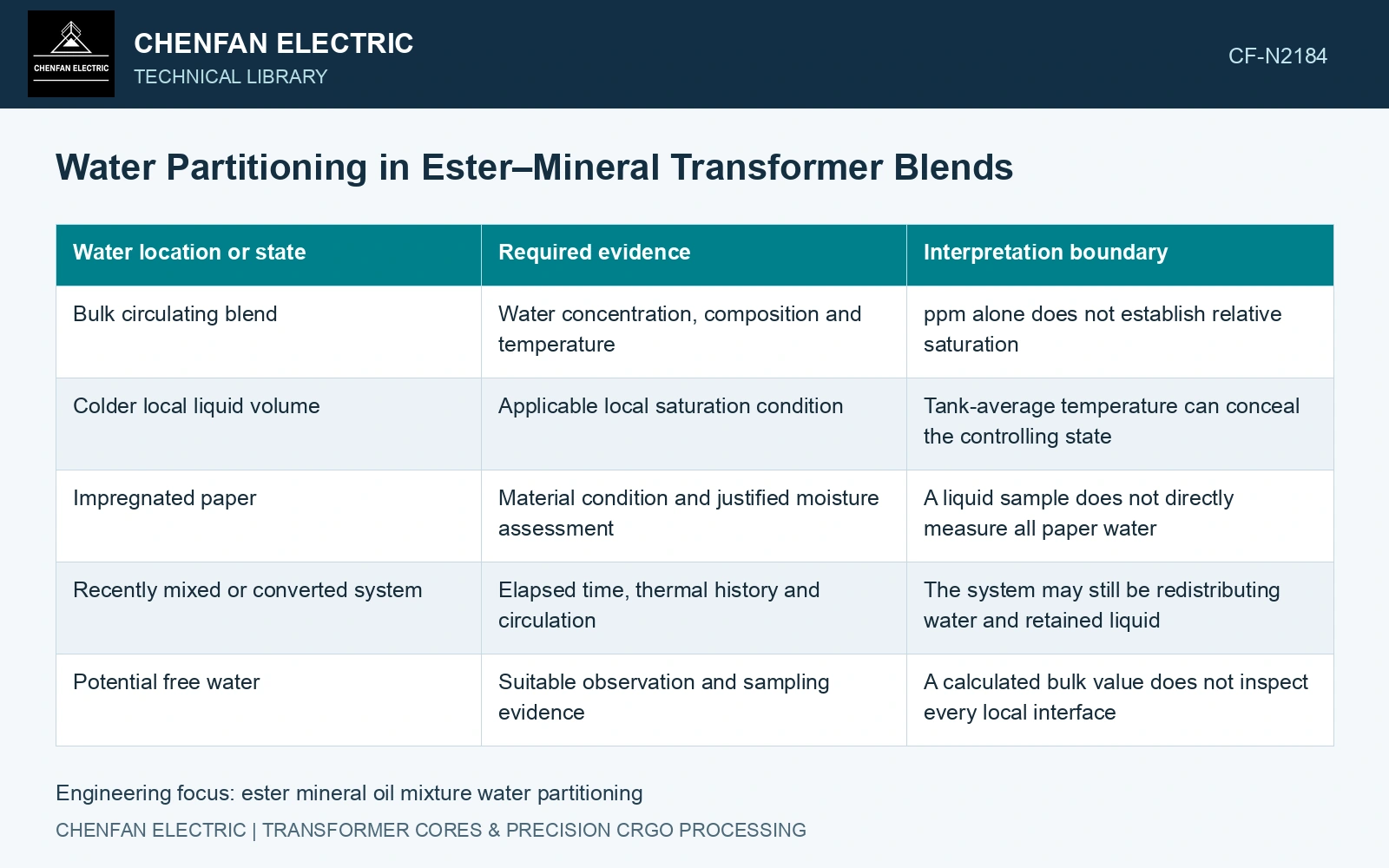
Separate concentration from relative saturation
A restricted liquid indicator is relative saturation = Cwater/Csat(T, composition), when both concentrations use the same basis and the saturation relationship is valid. A blend needs its own applicable saturation evidence; the pure-liquid curves cannot automatically be linearly combined.
For illustration, assume two identified liquid states each contain 50 mg/kg water, but their saturation concentrations at the same temperature are 100 and 1000 mg/kg. Their calculated relative saturations are 50% and 5%. These assumed values demonstrate the distinction; they are not mineral-oil or ester acceptance limits.
| Water location or state | Required evidence | Interpretation boundary |
|---|---|---|
| Bulk circulating blend | Water concentration, composition and temperature | ppm alone does not establish relative saturation |
| Colder local liquid volume | Applicable local saturation condition | Tank-average temperature can conceal the controlling state |
| Impregnated paper | Material condition and justified moisture assessment | A liquid sample does not directly measure all paper water |
| Recently mixed or converted system | Elapsed time, thermal history and circulation | The system may still be redistributing water and retained liquid |
| Potential free water | Suitable observation and sampling evidence | A calculated bulk value does not inspect every local interface |
Follow water movement without assuming instant drying
Changing the liquid alters the environment in contact with the paper. Water can redistribute between phases as the system seeks a new condition, but diffusion and thermal history determine the progress. An increased water concentration in the liquid can coexist with movement out of paper; it can also have other causes.
Distinguish redistribution from total water removal. Moving water into liquid is not the same as extracting it from the transformer. Use a complete moisture balance where such a claim is needed, including introduced water, leaks, processing and chemical changes.
Compare samples under matched conditions
Retain location, temperature, load/circulation state and sampling technique. A warmer sample period can produce a different liquid concentration and equilibrium boundary. A value measured before mixing and one measured after a warm operating interval are not automatically like-for-like.
Use a measurement method valid for the liquid matrix and account for uncertainty. A saturation calculation based on the wrong blend curve can create precise-looking but unsupported percentages.
Target the missing cold location or solid-insulation phase when bulk readings leave them unresolved. Combine that evidence with the blend moisture result for the complete assessment.
Close the water balance before calling redistribution drying
Liquid-paper water exchange depends on the identified material and conditioning [2]. Assume 1,000 kg liquid initially at 50 mg/kg water and 100 kg dry-paper basis initially holding 2.00 kg water. Their total is 0.050+2.000 = 2.050 kg.
If 0.200 kg transfers from paper to liquid without removal or chemical change, paper water becomes 1.800 kg and liquid water becomes 0.250 kg, or 250 mg/kg. Total water remains 2.050 kg despite drier paper. To reach an assumed total-inventory target of 1.850 kg, the process must actually remove 0.200 kg, rather than merely repartition it. Verify the blend-specific saturation and equilibrium state separately before interpreting either liquid concentration.
References
- M. Lyutikova, S. Korobeynikov, U. Mohan Rao and I. Fofana, Mixed Insulating Liquids with Mineral Oil for High Voltage Transformer Applications: A Review, IEEE Transactions on Dielectrics and Electrical Insulation, 2022. DOI: 10.1109/TDEI.2022.3157908.
- E. Pagger, M. Muhr, R. Braunstein, M. Tieber, K. Rapp and A. Sbravati, Natural Ester FR3 Insulating Liquid — Very Paper Friendly, technical paper, 2018.