

A human–robot core handover needs a physical map of the finished limbs, incomplete yoke and alignment work. Confirm that starting state so automation resumes at the correct layer and pose.
Mark completion by region
Identify each relevant limb, yoke and joint region, with its confirmed layer or packet state. Record the intended next sequence position and any parts already prepared but not installed. Keep loose replacement parts separate from installed material so they cannot be counted twice.
Include orientation, datums and support arrangement. The cell’s target frame is meaningful only if the transferred assembly occupies the verified pose. A support moved to make manual access easier can change the position or flexibility of the starting stack.
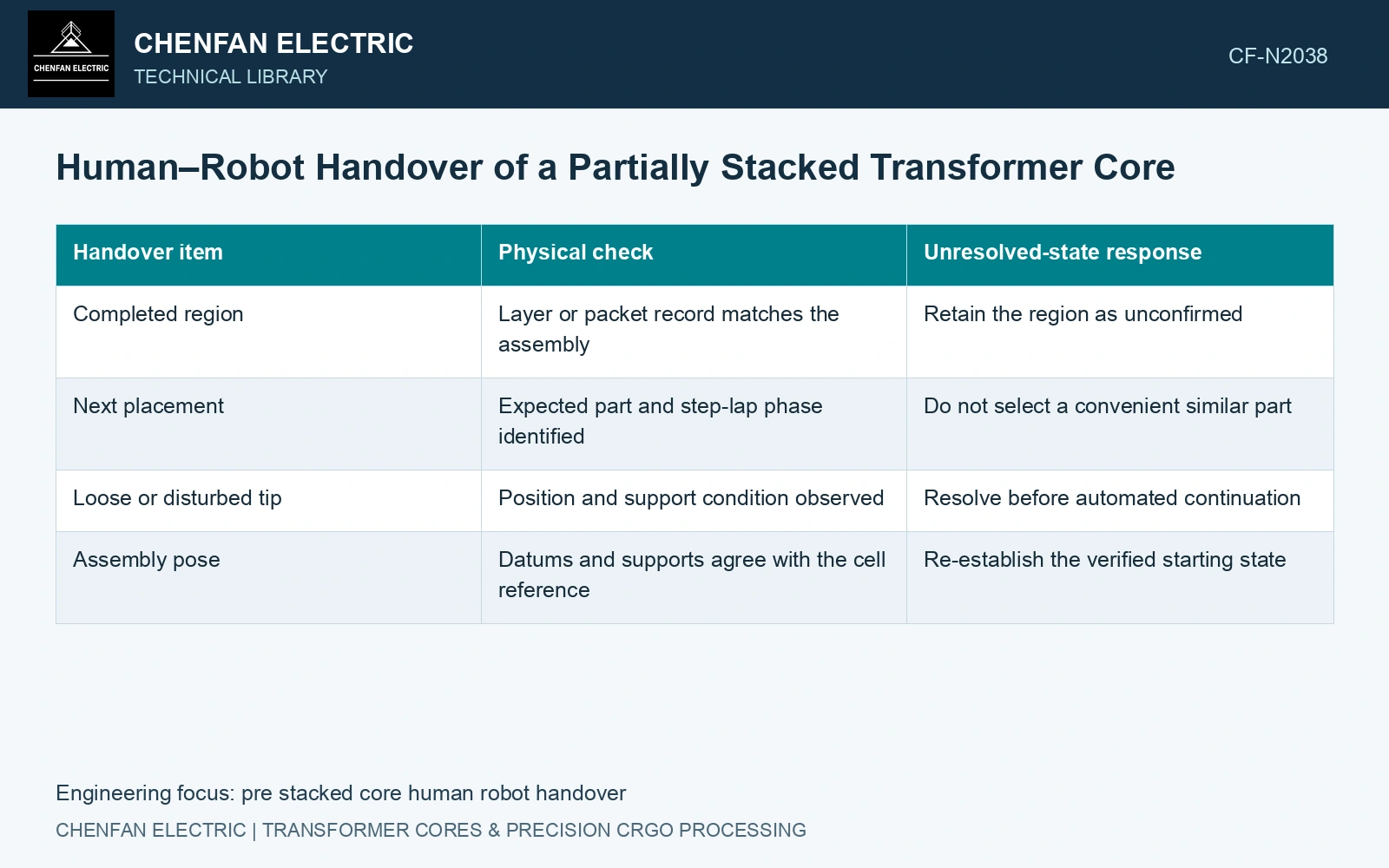
| Handover item | Physical check | Unresolved-state response |
|---|---|---|
| Completed region | Layer or packet record matches the assembly | Retain the region as unconfirmed |
| Next placement | Expected part and step-lap phase identified | Do not select a convenient similar part |
| Loose or disturbed tip | Position and support condition observed | Resolve before automated continuation |
| Assembly pose | Datums and supports agree with the cell reference | Re-establish the verified starting state |
Inspect the first automated interaction
Examine where the robot will approach, grip or place at the handover boundary. An otherwise complete region can leave a tip projecting into that path. The first automated motion should be validated against the actual partial-stack geometry rather than an ideal fully assembled model.
Use defined observation criteria for gaps, missing parts and duplicate parts at the boundary. A photograph can support the record, but buried sequence identity may require the retained placement history. If evidence conflicts, resolve the physical discrepancy instead of choosing whichever record allows the quickest restart.
Keep assembly acceptance and safe access distinct
Perform the handover through the machine’s approved procedure, including its authorized access and restart conditions. A correct layer count or signed production checklist does not establish that personnel are clear or that the cell’s safety conditions are satisfied.
The handover record must describe the physical partial stack and the controller state separately. Tool-position evidence and measured uncertainty can support reconciliation, but they do not establish the safety function or the identity of a hidden sheet. [1]
For a handover reconciliation, use the catalogue nominal sheet gauge of 0.23 mm. [2] Assume the accepted sequence requires 800 sheets at the handover boundary: nominal steel thickness sums to 184.0 mm. A recorded physical count of 798 corresponds to 183.54 mm, a two-sheet or 0.46 mm deficit before coating and compression. Do not repair that difference by changing the robot’s software counter alone. Locate the actual layer and step-lap state, reconcile the two missing identities, then authorise the resumed sequence. Height is a cross-check, not proof of sheet identity.
Handover control must retain sheet identity, rolling direction, lap position and partial-stack restraint. Record what the human physically added or removed before transferring control back to the automated sequence.
Record the accepted starting region, next part and verified assembly pose. Leave unresolved work identified in that map so continuation follows a reconciled physical state.
References
- G. Qiao and B. A. Weiss, Industrial Robot Accuracy Degradation Monitoring and Quick Health Assessment, Journal of Manufacturing Science and Engineering 141, 2019. DOI: 10.1115/1.4043649.
- Nippon Steel Corporation, Grain-Oriented Electrical Steel Sheets, catalogue D004je, April 2020, specification and typical-property tables.