

Challenge core-stacking software with known missing, duplicate and out-of-order laminations in a controlled test environment. Defined expected outcomes reveal whether the sequence checks intercept each exception. Keep challenge stock and datasets separate from released production. [1]
Define the error classes
Start from a verified reference sequence and alter one known property. Preserve the original, the mutation and the expected interception point. A corrupted file that is merely unreadable tests input handling; a plausible sequence with one wrong step tests the assembly logic more directly.
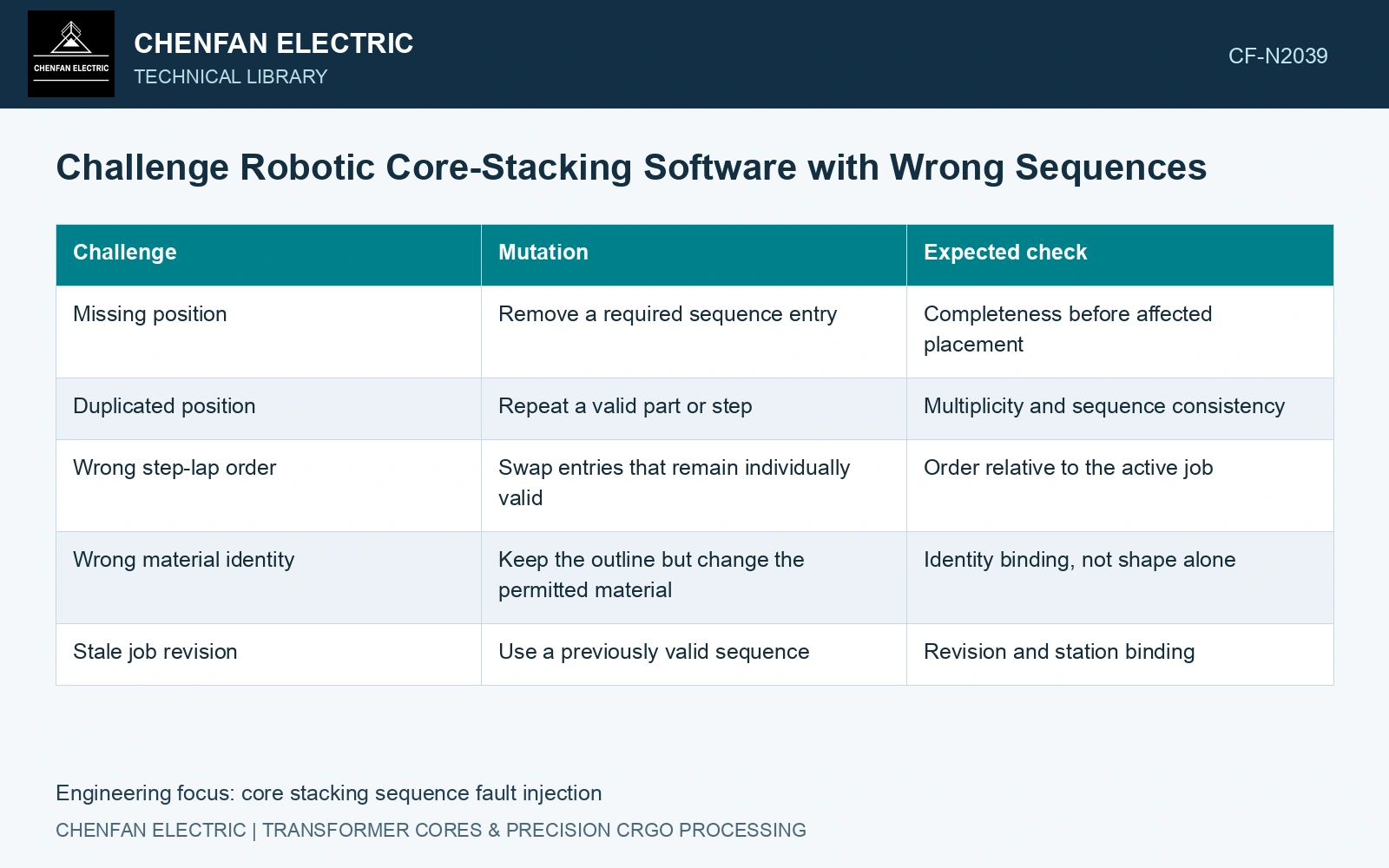
| Challenge | Mutation | Expected check |
|---|---|---|
| Missing position | Remove a required sequence entry | Completeness before affected placement |
| Duplicated position | Repeat a valid part or step | Multiplicity and sequence consistency |
| Wrong step-lap order | Swap entries that remain individually valid | Order relative to the active job |
| Wrong material identity | Keep the outline but change the permitted material | Identity binding, not shape alone |
| Stale job revision | Use a previously valid sequence | Revision and station binding |
Specify where rejection must occur
Record whether the error should be detected during job loading, feeder allocation, picking or placement confirmation. An alarm after the wrong part has entered the core is not equivalent to a pre-placement rejection. Check that the rejected state preserves the physical part location and the correct next sequence requirement.
Use a software test environment first where appropriate, then an authorized commissioning method to validate the relevant physical interfaces. A simulated sensor event can test logic but does not establish that the production sensor detects the actual condition.
Add interactions after isolated tests
Test relevant combinations such as a stale revision after a tool change, a replacement part following an interrupted cycle or a duplicated entry while a reject buffer is occupied. NIST’s combinatorial-testing work explains why interactions between parameters deserve explicit coverage. It does not imply that a selected set of combinations is exhaustive. [1]
Record constraints that prevent impossible test combinations, and list the valid combinations not exercised. State the interaction strength or selected risk cases actually covered. “All sequence tests passed” is incomplete without identifying what the test set contained.
Keep the result reproducible
Retain software version, reference job, test mutation, input conditions, expected response and observed response. Re-run the affected challenge set after a change to sequence parsing, identity binding or recovery logic. Unrelated passed cases need not be repeated merely to inflate a validation count.
Use 0.23 mm catalogue-gauge sheets for an assumed software fault challenge. [2] The required sequence has 100 sheets of variant A and 100 of variant B. Replacing one A with one B leaves total count at 200 and nominal steel thickness at 46 mm, so both count and height checks can pass. If A and B differ by an assumed 20 mm in tip length, the misplaced joint feature remains 20 mm wrong. The test passes only when variant/position checking detects and quarantines the substitution before release; aggregate stack thickness is intentionally non-discriminating in this challenge.
Use real drawing-controlled variant differences, lap offsets and rolling-direction labels in the fault library. Challenge skipped, duplicated and exchanged sheets without allowing the software to silently reclassify a physical part.
Document which wrong sequences were intercepted, where detection occurred and which interactions require further tests. This challenge record defines the demonstrated coverage of the software checks.
References
- NIST, Combinatorial Testing, programme and method overview.
- Nippon Steel Corporation, Grain-Oriented Electrical Steel Sheets, catalogue D004je, April 2020, specification and typical-property tables.