

Demand response can postpone rather than eliminate energy. PNNL’s thermostatic end-use model distinguishes instantaneous electrical demand from the duration needed to deliver heat [1]. Keep each service’s recovery obligation after the event ends.
Carry an energy backlog beyond the event boundary
Define the evaluation period before reporting relief. It should include the curtailment, the release and the subsequent recovery. For each participating load, distinguish energy that was genuinely avoided from energy that was postponed. A control command alone cannot establish that distinction; the device response and later use are needed.
For a simple bookkeeping example, deferred energy is Eᵈ = ∫(pᵇ − pᵃ)dt over the event, where the baseline pᵇ and actual power pᵃ are in kW and time is in hours. Eᵈ is in kWh. This difference is uncertain because the baseline is uncertain, and it is not automatically the energy that must return. Some services change their total demand when interrupted.
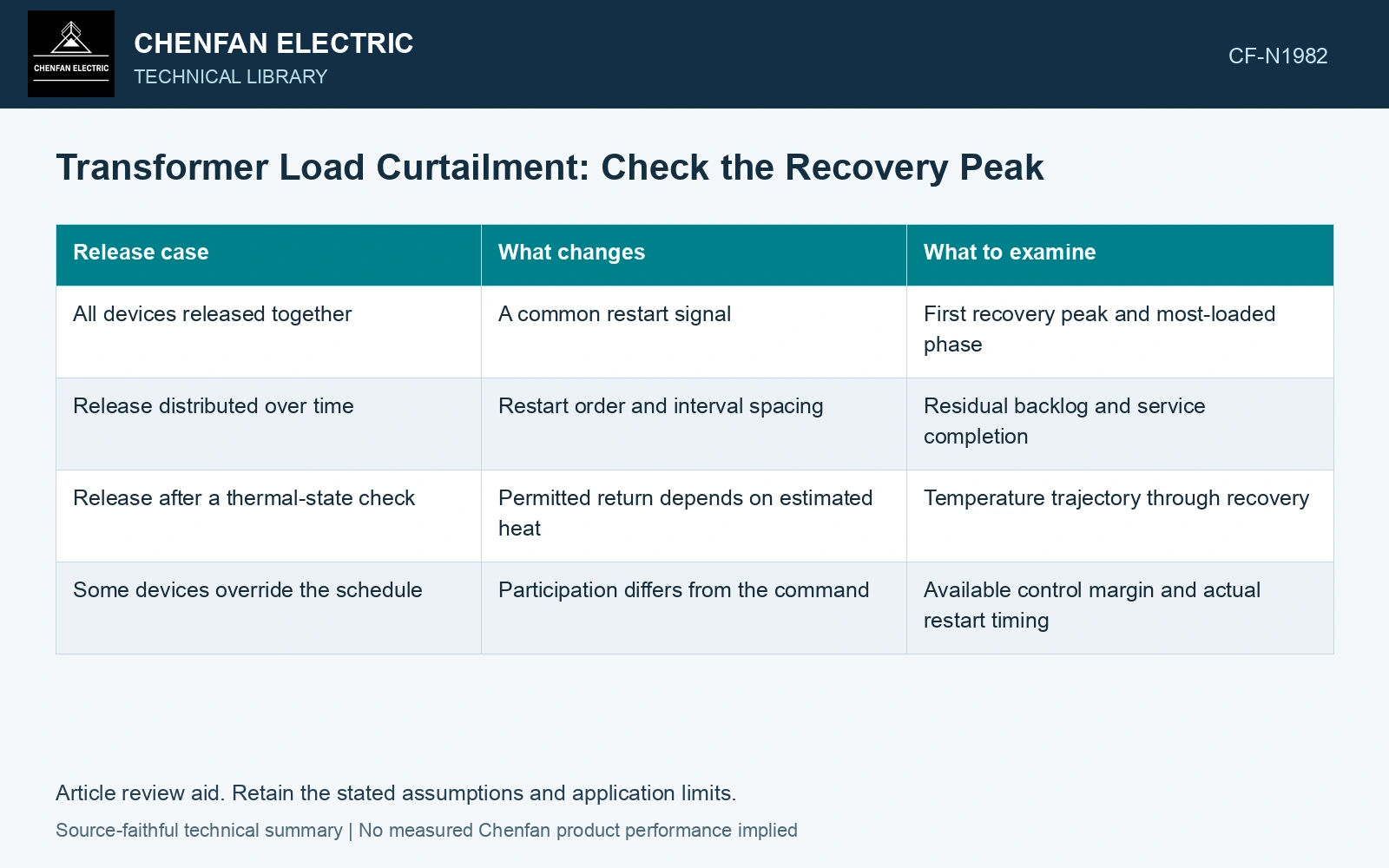
| Release case | What changes | What to examine |
|---|---|---|
| All devices released together | A common restart signal | First recovery peak and most-loaded phase |
| Release distributed over time | Restart order and interval spacing | Residual backlog and service completion |
| Release after a thermal-state check | Permitted return depends on estimated heat | Temperature trajectory through recovery |
| Some devices override the schedule | Participation differs from the command | Available control margin and actual restart timing |
The transformer’s recovery need not match the event clock
An event ending does not imply thermal recovery. Advance oil/winding heat-storage states through the actual current and cooling histories [2]. Recovery time scales depend on the asset model, not the dispatch clock.
Compare simultaneous and staged release with the same service requirements and starting conditions. Otherwise the apparently better schedule may simply leave more charging or heating unfinished. Check both the largest current and the time spent near the operating envelope. A smaller sharp peak can still conceal a prolonged recovery load.
Report the event and its aftermath together
The useful result is a paired load history with the release policy marked, followed by service completion and thermal-state checks. Report unresolved energy requests explicitly. Where the baseline has a range, repeat the backlog calculation across that range instead of assigning false precision to the recovered energy.
Assume a 60 kW curtailment lasts 30 min, postponing 30 kWh. Recovering that energy in 15 min adds 120 kW above the recovery baseline; spreading it over 60 min adds 30 kW, before losses and service constraints. If baseline is assumed to be 400 kW and the active-power envelope 450 kW, the short recovery reaches 520 kW and fails while the longer recovery reaches 430 kW. Check phase apparent current and thermal carry-over before selecting the recovery interval.
This is different from cold-load pickup after an outage. Here the initiating cause is coordinated control, and the recovery order can often be designed. The next trial should change the release rule while retaining the same requested services, so that any claimed improvement comes from better recovery coordination rather than a smaller obligation.
References
- K. P. Schneider, J. C. Fuller, F. K. Tuffner and R. Singh, Evaluation of Conservation Voltage Reduction (CVR) on a National Level, PNNL-19596, July 2010.
- U.S. Department of Energy, DOE-HDBK-1012/2-92, Thermodynamics, Heat Transfer, and Fluid Flow, Volume 2, 1992.