

A transformer inherits oil and winding states from previous load intervals. Jain’s transformer-aware EV study evaluates a thermal history [1]; a lumped heat-storage model also requires its initial condition [2].
The initial condition is part of the available capacity
Record the recent phase-current history, ambient conditions and available temperature measurements before calculating a charging allowance. Distinguish measured top-oil temperature from an estimated winding hot spot. They describe different locations; treating one as a direct measurement of the other hides the uncertainty that the controller needs.
A useful scheduling model advances its thermal state through each interval using the proposed load. Its parameters should represent the installed transformer and cooling arrangement. A published study can demonstrate a control concept, but its transformer parameters cannot establish the available capacity of another installation.
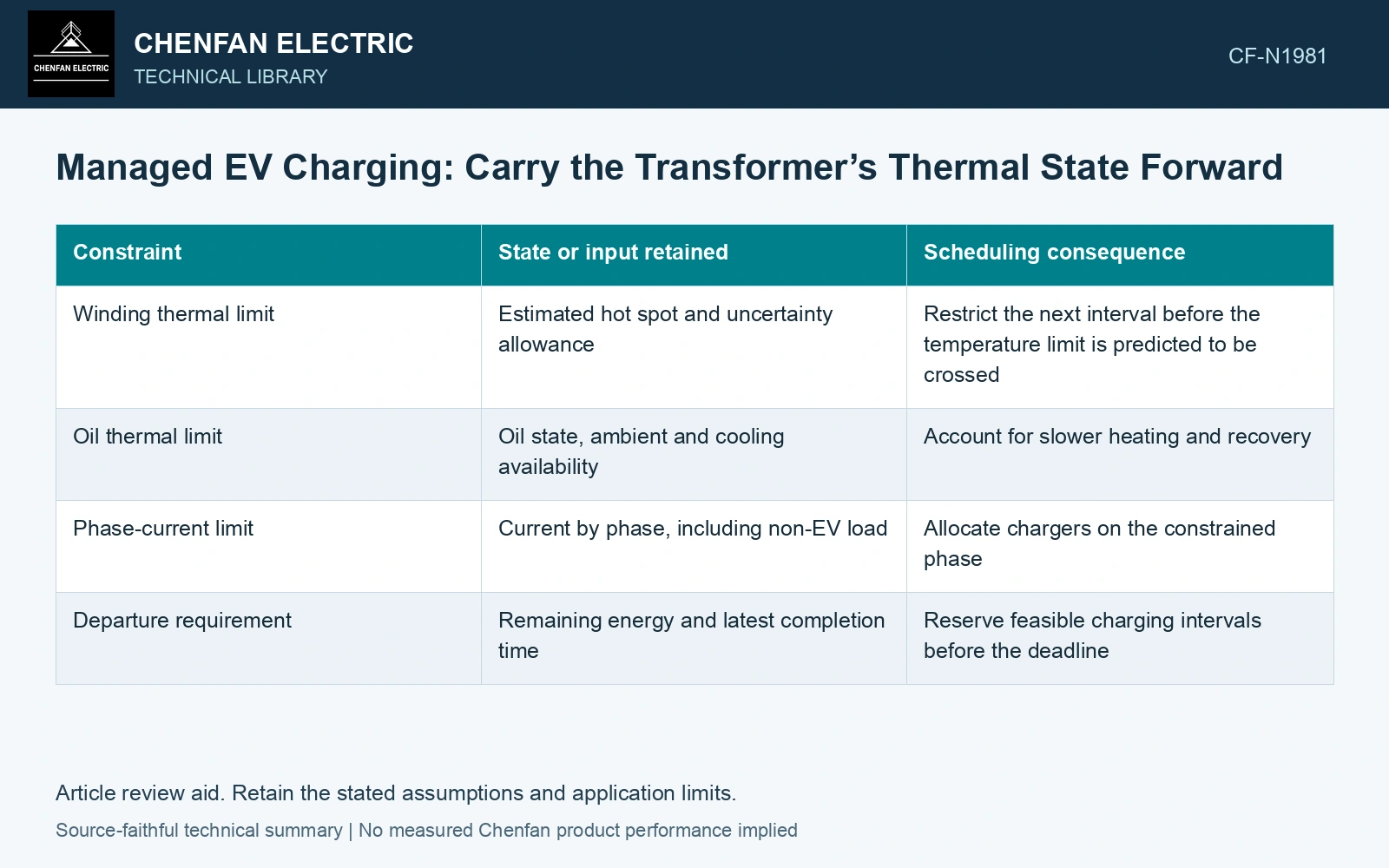
| Constraint | State or input retained | Scheduling consequence |
|---|---|---|
| Winding thermal limit | Estimated hot spot and uncertainty allowance | Restrict the next interval before the temperature limit is predicted to be crossed |
| Oil thermal limit | Oil state, ambient and cooling availability | Account for slower heating and recovery |
| Phase-current limit | Current by phase, including non-EV load | Allocate chargers on the constrained phase |
| Departure requirement | Remaining energy and latest completion time | Reserve feasible charging intervals before the deadline |
Check the energy promise against the feasible intervals
For an illustrative constant-efficiency calculation, delivered energy is E = Σ ηpₖΔtₖ. Here E is battery energy in kWh, pₖ is AC charging power in kW, Δtₖ is interval duration in hours and η is the assumed charging efficiency. The sum must reach the requested remaining energy within the permitted intervals. Real efficiency and vehicle acceptance can vary; the arithmetic is a planning constraint, not a guarantee of charge completion.
If the thermal constraint and departure request cannot both be met, expose that conflict. Quietly reducing the promised energy makes the schedule look feasible by changing the customer requirement. Conversely, silently relaxing a temperature limit changes the asset requirement.
Make the fallback visible in the schedule
Run the schedule with a credible upper thermal-state estimate as well as the central estimate. Identify which vehicles lose flexibility and which limits bind. If a temperature sensor becomes stale or a cooling state is unknown, change to the defined conservative operating envelope rather than continuing to spend an unverified thermal margin.
Assume first-order oil rise with τ = 180 min, initial rise 60 K and curtailed equilibrium 30 K. After 60 min, rise is 51.496 K. Restoring a 70 K-equilibrium duty for 30 min gives 54.337 K. With an assumed 60 K oil-rise cap, solve 60 = 70 +(51.496−70)e⁻ᵗ/¹⁸⁰: recovery reaches it after 110.77 min. Limit this teaching recovery duty to that oil-state window, then check the winding hot spot and charger energy separately. Resetting to ambient would invent capacity; these time constants and caps are assumptions.
Keep the interval record concise: assumed starting state, proposed phase currents, predicted temperatures, delivered energy and any unmet request. That record explains why a charger was slowed and whether the limitation came from the transformer or from the vehicle’s remaining availability. It also makes a later model correction reviewable without rewriting the original operating history.
References
- A. Jain and M. Karimi-Ghartemani, Mitigating Adverse Impacts of Increased Electric Vehicle Charging on Distribution Transformers, Energies 15, 9023, 2022. DOI: 10.3390/en15239023.
- U.S. Department of Energy, DOE-HDBK-1012/2-92, Thermodynamics, Heat Transfer, and Fluid Flow, Volume 2, 1992.